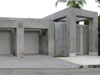




















Four Families Now Live in the Season Six Rock the Block Homes in Grantsville, Utah
April 20, 2026 —
Hamlet HomesSALT LAKE CITY, April 20, 2026 /PRNewswire/ -- The premier of Rock the Block season seven aired last Monday and is set in Las Vegas, Nevada. Rock The Block is HGTV's highest rated show. Last year, season six was set in Utah and had HGTV's highest rating yet, with over 14 million viewers. All episodes of season six were filmed in the Worthington Ranch community in Grantsville, Utah. The four homes on the show were built by Utah builder Hamlet Homes. During the show, the location of the four Rock The Block homes had to be kept secret and were surrounded by a locked gate. After over a year of being inaccessible, the Utah public was invited in May 2025 to tour the homes and help raise money together for charity. On May 30-31, 2025, Hamlet hosted a 'Rock The Block Party' where the public was able to walk through the homes made famous by the show.
Hamlet Owner, VP of Marketing & Design Tami Ostmark shares stories from the show and her perspective of what it's like to be the builder on a national show like this. Ostmark was on set almost the entire time. "As expected, there were times when there was tension on the set. All four designers were super competitive with each other. It's amazing that the production team was able to produce the show as well as they did. I'm very impressed," said Ostmark.
Another interesting point related to the show is how much work the local builder is responsible for. Some nights as many as 30 Hamlet team members worked through the night to keep up with the pace of production. "Each designer provided their own trusted carpenters to do finishing work. In two of the cases, designers' flew their favorite carpenters in to carry out their visions. Given the quick turnaround, it's not always practical for finishing work to be permanent. Sometimes, it just needs to look appealing on camera," said Ostmark. This is frequently referred to as 'TV Magic'. "When the show was over, Hamlet re-did any areas that required extra attention". The show really does shoot in only 7 weeks as depicted. This creates a fast pace that was very exciting to be a part of", continued Ostmark. All four of the homes featured on the show have since been purchased; four Utah families currently call them home.
ABOUT HAMLET HOMES
Hamlet Homes (www.hamlethomes.com) crafts quality customer-oriented townhomes and single-family homes located in attractively designed communities in Utah and Idaho. Since the company's founding in 1995, Hamlet has built over 5,000 homes in 80 communities. The company is a proud recipient of many awards on Sustainable Business & Design, Quality Builder Awards; recognized both locally and nationally. Named by the Salt Lake Chamber of Commerce as the 'Veteran Owned Small Business of the Year, in 2019'. Hamlet has since been named several times to the Professional Builder's Housing Giants List and annual HOME AWARDS Best Customer Experience. Most recently in 2026, Hamlet was named Utah's 'Best of State for Real Estate Development and Utah Businesses 'Best Companies to Work For' for the 6th consecutive year.
Consider The Limited Warranty from Your Homebuilder
July 06, 2026 —
David Adelstein - Florida Construction Legal UpdatesWhen purchasing a home from a homebuilder, there is an important consideration when it comes to the limited warranty you receive around the time you close on the home. That limited warranty likely includes an arbitration provision requiring you to arbitrate your disputes, such as construction defect claims, against the homebuilder. That arbitration provision will most likely include all claims, including statutory claims (such as a statutory violation of a building code claim), requiring you to arbitrate, as opposed to litigate, your disputes against the homebuilder. This is an important consideration. If the arbitration provision does not allow you to arbitrate all of your claims, and eliminates your rights to legitimate statutory claims, the arbitration provision could be unenforceable.
By way of example, in a residential construction defect dispute, Anderson v. Taylor Morrison of Florida, Inc., 223 So.3d 1088 (Fla. 2d DCA 2017), the appeal turned on whether the arbitration provision in the homebuilder’s limited warranty was valid. The homeowners took possession of their home in 2009. In 2015, the homeowners served a Florida Statutes Chapter 558 notice of construction defects that included a statutory violation of a building code claim under Florida Statute §553.84. The limited warranty included an arbitration provision that specified it was the “exclusive remedy” for all disputes arising out of or related to the warranty or issues with the home and property. When read together with the warranty’s disclaimer that precluded claims not covered by the warranty “whether in contract, tort, or otherwise,” the statutory building code violation claim could not be remedied through arbitration because it fell outside the warranty’s coverage.
Read the full story...Reprinted courtesy of
David Adelstein, Kirwin NorrisMr. Adelstein may be contacted at
dma@kirwinnorris.com
New Executive Order on AI Innovation and Security: Key Takeaways for the Construction Industry
June 15, 2026 —
Richard R. Volack & Denis Serkin - Peckar & Abramson, PCOn June 2, 2026, President Trump signed an Executive Order titled “Promoting Advanced Artificial Intelligence Innovation and Security.” At its core, the Order is a cybersecurity and national-security measure rather than a broad regulation of how private companies develop or use AI. It directs federal agencies to harden government systems against AI-enabled cyber threats, establishes voluntary frameworks for collaboration between the federal government and the AI and critical-infrastructure sectors, and strengthens criminal enforcement against the malicious use of AI.
Notably, the Order expressly disclaims any intent to create a “mandatory governmental licensing, preclearance, or permitting” regime for the “development, publication, release, or distribution of new AI models.” Instead, the Executive Order seeks to “promote AI innovation and security” by working with the private sector to modernize government and private-sector information systems and harden them against external threats, protect intellectual property from exploitation or theft, and cultivate American AI capabilities.
Reprinted courtesy of
Richard R. Volack, Peckar & Abramson, PC and
Denis Serkin, Peckar & Abramson, PC
Mr. Volack may be contacted at rvolack@pecklaw.com
Mr. Serkin may be contacted at dserkin@pecklaw.com
Read the full story...
Congratulations to Las Vegas Partner Jeffrey Saab and Senior Associate Shanna Carter on Winning Another Motion for Summary Judgment!
March 17, 2026 —
Dolores Montoya - Bremer Whyte Brown & O'Meara LLPPartner
Jeffrey Saab and Senior Associate
Shanna Carter’s client owned a condo, which he rented out. The tenant allegedly assaulted Plaintiff across the street from the condo, resulting in personal injury, including nerve damage. Shanna did the research and writing, and Jeff argued the Motion for Summary Judgment. The Court ruled, in pertinent part, that the subject assault off property was not foreseeable, resulting in a complete dismissal of the lawsuit with prejudice.
Read the full story...Reprinted courtesy of
Dolores Montoya, Bremer Whyte Brown & O'Meara LLP
DOI Finalizes Long-Awaited Modernization of Type A Natural Resource Damage Assessment Regulations
August 03, 2026 —
Amanda G. Halter, Ashleigh K. Myers & Jillian Marullo - Gravel2Gavel Construction & Real Estate Law BlogFor nearly three decades, the U.S. Department of the Interior’s (DOI) simplified “Type A” Natural Resource Damage Assessment (NRDA) regulations were available more in theory than in practice, constrained by dated models, narrow geographic applicability and a $100,000 cap that rarely matched the economics of modern environmental claims. DOI has now finalized revisions to the Type A natural resource damages assessment procedures under 43 C.F.R. Part 11 for hazardous substance releases under the Comprehensive Environmental Response, Compensation, and Liability Act (CERCLA) and the Clean Water Act (CWA), with the final rule published in the
Federal Register on July 13, 2026 and scheduled to become effective August 12, 2026.
As discussed
previously, DOI has sought to modernize what it views as an “inefficient and inflexible” process and restore the Type A procedure to its intended role as a more streamlined pathway for smaller, less contentious NRD claims. The final rule adopts a $5 million default damages threshold, allows use above that amount if all parties agree, clarifies that Type A may be used in all environments and for all natural resource types, and removes legacy model appendices that had tethered the process to outdated formulas.
Reprinted courtesy of
Amanda G. Halter, Pillsbury,
Ashleigh K. Myers, Pillsbury and
Jillian Marullo, Pillsbury
Ms. Halter may be contacted at amanda.halter@pillsburylaw.com
Ms. Myers may be contacted at ashleigh.myers@pillsburylaw.com
Ms. Marullo may be contacted at jillian.marullo@pillsburylaw.com
Read the full story...
Construction Seyt Named a Top Construction Blog by FeedSpot
March 31, 2026 —
Seyfarth Shaw LLP - The Construction SeytSince 2019, we have strived to bring our readers practical, useful insights on recent trends shaping our industry. Whether you are a contractor, designer, developer, attorney, or industry professional, our goal is to equip you with the knowledge to navigate your business with that much more confidence. We are honored that “The Construction Seyt” has been named by FeedSpot as a “Best Construction Blog” to follow for 2026.
Read the full story...Reprinted courtesy of
Seyfarth Shaw LLP
Defend Now, Allocate Later? An Unresolved Tension in Colorado Construction Law
August 16, 2026 —
David McLain - Colorado Construction Litigation BlogFor decades, Colorado law has recognized an important distinction between the duty to defend and the duty to indemnify. The former ordinarily arises at the beginning of litigation; the latter generally cannot be determined until the underlying liability is known. That distinction makes intuitive sense. A defense that becomes due only after litigation concludes is not much of a defense.
But Colorado’s construction anti-indemnity statute, C.R.S. § 13-21-111.5(6), raises an interesting question about how that familiar rule operates in construction disputes. The statute expressly regulates contractual obligations not only to indemnify, but also to insure and defend, and it reflects a legislative policy that construction businesses should bear financial responsibility for their own negligence.
Those principles have developed along separate tracks. At some point, a Colorado appellate court may have to decide precisely how they fit together.
Read the full story...Reprinted courtesy of
David McLain, Higgins, Hopkins, McLain & Roswell, LLCMr. McLain may be contacted at
mclain@hhmrlaw.com
Endra Rethinks MEP Design with AI
July 06, 2026 —
Aarni Heiskanen - AEC BusinessNiklas Lindgren, co-founder and CEO of Endra, joins the
AEC Business Podcast to discuss why his Stockholm-based startup is rebuilding MEP design from the ground up with AI. Endra recently raised $50 million in Series A funding and counts some of the world’s largest engineering consultancies as customers.
Niklas explains why Revit’s underlying data model is too coarse to support deep automation, and why Endra built its own granular 3D data model instead of working as a plugin. He describes Endra’s “spatial AI” approach to routing conduit and ductwork without clashes, and how the platform models entire electrical systems, from receptacle to transformer, inside a single source of truth.
Read the full story...Reprinted courtesy of
Aarni Heiskanen, AEC BusinessMr. Heiskanen may be contacted at
aec-business@aepartners.fi