Court Requires Adherence to “Good Faith and Fair Dealing” in Construction Defect Coverage
September 30, 2011 — CDJ Staff
The California Court of Appeals has ruled in the case of Allied Framers, Inc. v. Golden Bear Insurance Company. Allied had been sued in a construction defect case and its primary insurer had become insolvent. Coverage for Allied’s defense was paid for by the California Insurance Guarantee Association through June 8, 2006. When warned that CIGA’s involvement was ending, Allied notified Golden Bear, which declined to provide coverage.
In the matters that followed, Golden Bear claimed that Allied had not exhausted its $1 million in primary insurance. Allied then showed that $1 million had already been paid out in the case. A few months thereafter, Golden Bear offered a $500,000 settlement on behalf of Allied which was rejected. Thereafter, Golden Bear hired new counsel to defend Allied. Golden Bear received, but allegedly did not pay, invoices Allied sent from their former counsel. Golden Bear finally settled the construction defect case for $2 million.
Allied’s original counsel sued Allied for payment. Golden Bear declined coverage. Allied then claimed that Golden Bear liable on several counts, arising from its failure to settle the construction defect action earlier than it did and its failure to pay Allied’s counsel. Golden Bear demurred, arguing that Allied had now exhausted is coverage with the $2 million settlement. The lower court sustained Golden Bear’s demurrer, dismissing Allied’s complaints.
The appeal court reviewed Allied’s seven complaints and sustained most of them. However, the court did reverse the trial court’s order in regard to Allied’s complaint that Golden Bear breached an implied covenant of good faith and fair dealing. The appeals court was not convinced that Golden Bear properly evaluated the settlement demand in the underlying construction defect case. The court found three other ways in which Golden Bear’s actions might show bad faith, in refusing to pay defense fees “after promising [Allied] such costs would be paid in full,” “failing to advise Allied about ‘actual or potential negative consequences of agreeing to the proposed settlement,’” and that their choice of counsel “failed to protect [Allied’s] interests in the negotiation.”
Read the court’s decision…
Coverage for Construction Defects Barred by Business Risk Exclusions
September 1, 2011 — Tred Eyerley, Insurance Law Hawaii
Although the court determined there was an occurrence, coverage was excluded by the business risk exclusions. See Cont’l W. Ins. Co. v. Shay Constr. Co., 2011 U.S. Dist. LEXIS 82839 (D. Colo. July 28, 2011).
White was the general contractor on the project. White had three subcontracts with Shay to provide framing, siding, and related work on the project. Shay was insured under a CGL policy issued by Continental Western.
Two of Shay’s subcontractors furnished materials, labor and equipment to Shay. These subcontractors filed suit in state court alleging they had not been compensated for the work and materials. White and Shay were named as defendants. White cross claimed against Shay, alleging Shay had breached its obligations under the subcontracts. Several allegations sounded in contract. Other allegations, however, contended Shay had performed defective work and had damaged the work of other trades in correcting deficiencies in its own performance.
Shay sought coverage under Continental Western’s policy. Continental Western filed suit for a declaratory judgment and moved for summary judgment.
Read the full story…
Reprinted courtesy of Tred R. Eyerly, Insurance Law Hawaii. Mr. Eyerly can be contacted at te@hawaiilawyer.com
Battle of “Other Insurance” Clauses
March 23, 2011 —
Tred R. Eyerly -
Insurance Law Hawaii - March 23, 2011
The New York Court of Appeals considered the impact of competing “other insurance” provisions located in both a CGL policy and a D&O policy. See Fieldston Property Owners Assoc., Inc. v. Hermitage Ins. Co., Inv., 2011 N.Y. LEXIS 254 (N.Y. Feb. 24, 2011).
�In the underlying case, Fieldston’s officers were charged with making false statements and fraudulent claims with respect to a customer's right to access its property from adjacent streets. Suit was eventually filed against Fieldston and its officers, alleging several causes of action including injurious falsehood. Damages were sought.
�Fieldston’s CGL policy was issued by Hermitage. The “other insurance” provision stated, “If other valid and collectible insurance is available to the insured for a loss we cover . . . our obligations are limited,” but also stated it would share with all other insurance as a primary policy.
�Read the full story...�Reprinted courtesy of Tred R. Eyerly, Insurance Law Hawaii. Mr. Eyerly can be contacted at te@hawaiilawyer.com
South Carolina Contractors Regain General Liability Coverage
May 20, 2011 — CDJ Staff
PR Newswire reports that the Carolinas Associated General Contractors (CAGC) have successfully persuaded the South Carolina legislature to pass a bill restoring commercial general liability (CGL) coverage. Governor Nikki Hartley signed the legislation on May 17.
�A South Carolina Supreme Court decision given on January 7, 2011, had ended commercial general liability coverage in the state. Senate Bill 431 addressed this decision, restoring the ability of home builders to obtain CGL coverage.
�PR Newswire quotes South Carolina homebuilder, Allen Amsler: “We have seen a lot of legislation with substantial impact to our business over the years. However, I would place this in the same level of importance with the original tort reform legislation. The effects of the Supreme Court’s ruling could have been catastrophic to our industry in South Carolina had it not been for this bill. Thanks to all those in the House, Senate and the Governor’s office who assisted us.”
�Read the full story…
Another Guilty Plea in Las Vegas HOA Scandal
December 20, 2012 — CDJ Staff
A twenty-eighth person has plead guilty in the ongoing Las Vegas HOA scandal. Dax Louderman, who had been a construction company manager had acknowledged that he stole more than $495,000 from his former employers, Alpha 1 Construction and the Stone Canyon Homeowners Association, and further that he did not report this improper income on his tax returns. He has agreed to work with prosecutors and to pay $134,860 to the IRS. His actual sentencing will happen on June 24.
Read the full story…
Court Rules on a Long List of Motions in Illinois National Insurance Co v Nordic PCL�
May 10, 2012 — CDJ Staff
The case Illinois National Insurance Co. v Nordic PCL, et al. “involves a dispute about whether insurance benefits are available to a general contractor who built structures that allegedly have construction defects. Plaintiffs Illinois National Insurance Company (‘Illinois National’) and National Union Fire Insurance Company of Pittsburgh, PA (‘National Union’) (collectively, the ‘Insurers’), commenced this action for declaratory relief against Defendant Nordic PCL Construction, Inc., f/k/a Nordic Construction, Ltd. ("Nordic"), on August 23, 2011.”
�The court was asked to rule on a long list of motions: “Counterclaim Defendants’ Request for Judicial Notice in Support of Their (1) Motion to Dismiss the Counterclaim and (2) Motion to Strike Portions of the Counterclaim, ECF No. 16 (‘Request for Judicial Notice’); Counterclaim Defendants’ Motion to Dismiss Counterclaim Filed October 24, 2011, ECF No. 14 (‘Motion to Dismiss Counterclaim’); Counterclaim Defendants’ Motion to Strike Portions of the Counterclaim Filed October 24, 2011, ECF No. 15 (‘Motion to Strike’); Third-Party Defendant Marsh USA, Inc.’s Motion to Dismiss or, in the Alternative, Stay Proceedings in Favor of Pending State Action, ECF No. 33 (‘Marsh’s Motion To Dismiss Or Stay’); Defendant and Third-Party Plaintiff Nordic PCL Construction, Inc., f/k/a Nordic Construction Ltd.’s Substantive Joinder to Third-Party Defendant Marsh USA Inc.’s Motion to Dismiss or, in the Alternative, Stay Proceedings in Favor of Pending State Action, ECF No. 36 (‘Nordic’s Joinder’); and Third-Party Defendant Marsh USA, Inc.’s Motion for Judgment on the Pleadings on Counts V and VI of Defendant/Third-Party Plaintiff Nordic PCL Construction, Inc.’s Third-Party Complaint, ECF No. 29 (‘Marsh’s Motion for Judgment on the Pleadings’).”
�In result, the court reached the following decisions: “The court GRANTS IN RELEVANT PART the Insurers’ Request for Judicial Notice to the extent it covers matters relevant to these motions; GRANTS IN PART the Insurers’ Motion to Dismiss Counterclaim, but gives Nordic leave to amend the Counterclaim in certain respects; DENIES the Insurers’ Motion to Strike; DENIES Marsh’s Motion To Dismiss Or Stay and Nordic’s Joinder; and GRANTS Marsh’s Motion for Judgment on the Pleadings.”
�The court provides a bit of background on the case: “This action arises out of alleged construction defects involving two projects on which Nordic acted as the general contractor. Nordic is a defendant in a pending state court action with respect to one of the projects and says it spent more than $400,000 on repairs with respect to the other project. Nordic tendered the defense of the pending state court action to the Insurers and sought reimbursement of the cost of repairs already performed. The Insurers responded by filing this action to determine their rights under the insurance policies issued to Nordic.”
�Furthermore, the court presented a brief procedural history: “The Insurers commenced this declaratory action in this court on August 23, 2011. The Complaint asserts two claims, one seeking a declaration that the Insurers have no duty to provide a defense or indemnification regarding the Safeway Action, the other seeking such a declaration regarding the Moanalua Claims. Along with its Answer, Nordic filed a Counterclaim against the Insurers. The Counterclaim asserts breach of contract, breach of the covenant of good faith and fair dealing, misrepresentations and omissions of material fact, and bad faith, and seeks declaratory relief against the Insurers.”
�The procedural history continues: “Nordic also filed a Third-Party Complaint against Marsh, the broker that had procured the Policies from the Insurers for Nordic. Nordic alleges that it reasonably believed that the Policies would provide completed operations insurance coverage for the types of construction defects alleged in the Safeway Action and Moanalua Claims. The Third-Party Complaint asserts breach of contract, negligence, promissory estoppel, breach of fiduciary duties, implied indemnity, and contribution and equitable subrogation.”
�In conclusion, “The court GRANTS IN RELEVANT PART the Insurers’ Request for Judicial Notice. With regard to the Insurers’ Motion to Dismiss Counterclaim, the court GRANTS the motion as to Count I (breach of contract), Count II (duty of good faith and fair dealing), Count III (fraudulent and negligent misrepresentation), the portion of Count IV (bad faith) premised on fraud, and Count IV (declaratory relief). The court DENIES the motion as to Count IV (bad faith) that is not premised on fraud. Except with respect to the "occurrence" issue, which the court disposes of here on the merits, and Count V, which concerns only a form of relief, Nordic is given leave to amend its Counterclaim within three weeks of the date of this order. The court DENIES the Insurers’ Motion to Strike, DENIES Marsh’s Motion to Dismiss or Stay and Nordic’s Joinder, and GRANTS Marsh’s Motion for Judgment on the Pleadings with respect to Counts V and VI of the Third-Party Complaint.”
� Read the court’s decision…
�
Nevada Supreme Court Reverses Decision against Grader in Drainage Case
June 30, 2011 — CDJ Staff
The Nevada Supreme Court has issued an opinion in the case of Rayburn Lawn & Landscape Designers v. Plaster Development Corporation, reversing the decision of the lower court and remanding the case for a new trial.
�The case originated in a construction defect suit in which Plaster Development Corporation was sued by homeowners. Plaster filed a third-party complaint against its subcontractor, Reyburn. The testimony of Reyburn’s owner was considered to be admission of liability and so the court limited the scope of Reyburn’s closing argument and did not allow the jury to determine the extent of Reyburn’s liability. Reyburn appealed.
�Plaster, in their case, cited California’s Crawford v. Weather Sheild MFG, Inc. The court held the application of these standards, but noted that the “an indemnitor’s duty to defend an indemnitee is limited to those claims directly attributed to the indemnitor’s scope of work and does not include defending against claims arising from the negligence of other subcontractors and the indemnittee’s own negligence.”
�On the matter of law against Reyburn, the court concluded, “Given the conflicting evidence at trial as to whether Reyburn’s work was implicated in the defective retaining walls and sidewalls, and viewing the evidence and inferences in Reyburn’s favor, we conclude that a reasonable jury could have granted relief in favor of Reyburn.” The Nevada Supreme Court conduced that the district court should not have granted Plaster’s motion for judgement.
�Further, the Nevada Supreme Court found that the district court should have apportioned the fees and costs to those claims directly attributed to Reyburn’s scope of work, “if any,” and should not have assigned all attorney costs and court fees to Reyburn.
� Read the court’s decision…
Judge Rejects Extrapolation, Harmon Tower to Remain Standing
November 7, 2012 — CDJ Staff
CityCenter has filed an emergency motion asking the Nevada Supreme Court to intervene in Judge Elizabeth Gonzalez’ order that the building’s defects cannot be extrapolated from those tested. CityCenter’s structural engineering expert “evaluated 397 of the Harmon’s critical structural elements and found all but one defective,” according to the article on Vegas.Inc. Judge Gonzalez would not permit this to be extrapolated to the untested 1,072, as the locations tested were not random.
Judge Gonzalez also ruled that if CityCenter does additional testing, they may not appeal her order that ruled the extrapolation inadmissible. CityCenter argued to the Nevada Supreme Court that “the notion that CityCenter should be forced to incur additional millions of dollars in testing costs and sanctions ?Äì on the condition that it waive its right to appeal this ruling ?Äì just to be permitted to present its own damages evidence, shocks the conscience.”
Gonzalez gave the okay to CityCenter to demolish the building, but its demolition would make any further testing impossible. Under Gonzalez’ ruling, the untested structural elements cannot b assumed to be defective.
Read the full story…
2011 West Coast Casualty Construction Defect Seminar – Recap
June 1, 2011 — CDJ Staff
� 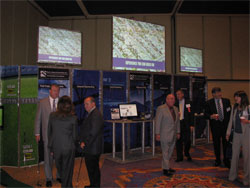 | �
�| Event exhibitors and sponsors contribute to an informative and engaging environment | �
�This year’s meeting was the best yet for the industry-leading construction defect and claims event.
�This year’s seminar concluded on May 13, 2011 with the Construction Defect Community Charitable Foundation Golf Tournament, held at Strawberry Farms Golf Course.
�The Disneyland Hotel in Anaheim, California was the place where more than 1,500 attendees convened for two days of professional development activities and seminars that included CLE workshops and panel discussions of special interest to legal and insurance professionals concerned with construction defect and claims litigation. Key events included “Challenges for Experts in Construction Defect Claims and Litigation,” “Keeping Up with Construction Defect Coverage,” and “Tips for Avoiding the ‘Perfect Storm’ in Handling of Wrap Claims.”
� �  | �
�| Supporting the golf tournament at the 15th hole | �
�This year’s Ollie award was given to George D. Calkins II, Esq. The West Coast Casualty Jerrold S. Oliver Award of Excellence was named in honor of the late Judge Jerrold S. Oliver, and recognizes an individual who is outstanding or has contributed to the betterment of the construction community.
�In addition to being the most comprehensive professional development seminar in the area of construction defects, this year’s seminar was equally valuable as a networking opportunity for members of the industry. People participated in professional development events during the day and then continued networking in the evening at numerous social events. The Lawn Party as well as the legendary Wood, Smith, Henning & Berman events were very well attended. Additional valuable networking events were hosted by a number of industry professionals at the House of Blues, and Tortilla Joe’s.
�As of this writing the 2011, West Coast Casualty's Construction Defect Seminar has applied for or has already received the following continuing education accreditation in the following areas;
�Read the full story…
�For more information about next year’s event, visit West Coast Casualty.
School District Marks End of Construction Project by Hiring Lawyers
June 19, 2012 — CDJ Staff
A school district in northeastern Pennsylvania has retained legal services as they approach the end of a construction project. The Mid Valley School Board cited concerns about the project’s budget, but Randy Parry, Superintendent of Mid Valley schools referenced “possible litigation at the end of the project.” Mr. Parry told the Scranton Times Tribune that construction delays could be a reason for litigation.
In addition to approving an additional $20,000 for legal representation, the board also approved $21,579 for additional project costs.
Read the full story…
Supreme Court of Oregon Affirms Decision in Abraham v. T. Henry Construction, et al.
April 20, 2011 — April 20, 2011 Beverley BevenFlorez - Construction Defect Journal
After reviewing the decision in Abraham v. T. Henry Construction, et al., the Oregon Supreme Court affirmed that a tort claim for property damage arising from construction defects may exist even when the homeowner and the builder are in a contractual relationship.
�When the case was initially filed, the plaintiffs alleged breach of contract and negligence. The defendants moved for summary judgment arguing that one, the claim was barred by the six-year statute of limitations and two, no special relationship (such as one between a doctor and patient) existed. The court agreed with the defendants. However, the Court of Appeals while affirming the trial court’s decision on breach of contract reversed the decision on negligence. The Court of Appeals stated that an administrative or statute rule could establish a standard of care independent from the contract.
�The Oregon Supreme Court gave an example of cases where a tort claim could exist when a contract is present: “If an individual and a contractor enter into a contract to build a house, which provides that the contractor will install only copper pipe, but the contractor installs PVC pipe instead (assuming both kinds of pipe comply with the building code and the use of either would be consistent with the standard of care expected of contractors), that failure would be a breach of contract only. […] If the failure to install the copper pipe caused a reduction in the value of the house, the plaintiff would be able to recover that amount in an action for breach of contract. […] On the other hand, if the contractor installed the PVC pipe in a defective manner and those pipes therefore leaked, causing property damage to the house, the homeowner would have claims in both contract and tort. […] In those circumstances, the obligation to install copper instead of PVC pipe is purely contractual; the manner of installing the pipe, however, implicates both contract and tort because of the foreseeable risk of property damage that can result from improperly installed pipes.”
�Read the court’s decision…
El Paso Increases Surety Bond Requirement on Contractors
April 25, 2011 — April 25, 2011 Beverley BevenFlorez - Construction Defect Journal
The city of El Paso has recently increased surety bonds required of contractors from $10,000 to $50,000, according to the El Paso Times. Proponents of the increase believe it was necessary to protect homeowners from fly-by-night builders, while opponents argue that the increase will have an adverse effect on an industry in that is already suffering due to the economic slowdown.
�Arguments for and against the increase have been flooding the blogosphere with their views. Christian Dorobantescu on the Small Business Entrepreneur Blog claims that “only about 15% of the city’s 2,500 contractors had been able to secure a higher bond to remain eligible for work after the new requirements were announced.” However, insurance companies have a different take. “From a surety broker standpoint, most contractors will be able qualify for the bond; some will just have to pay higher premium rates to obtain it,” a recent post on the Surety1 blog argues.
�While the increased bond may help homeowners deal with construction defect claims, it is not clear what effect it will have on builders in El Paso.
�Read more from the El Paso Times…
�Read more from the Small Business Entrepreneur Blog…
�Read more from the Surety1 Blog…
Mortar Insufficient to Insure Summary Judgment in Construction Defect Case
January 6, 2012 — CDJ Staff
The US District Court of Nevada issued a summary judgment in the case of R&O Construction Company V. Rox Pro International Group, Ltd. on December 19, 2011. The case involved the installation of stone veneer at a Home Depot location (Home Depot was not involved in the case). R&O’s subcontractor, New Creation Masonry, purchased the stone veneer from Arizona Stone. Judge Larry Hicks noted that “the stone veneer failed and R&O was forced to make substantial structural repairs to the Home Depot store.”
Rox Pro asked the court for a summary judgment, which the court granted only in part. The court looked at two issues in the case, whether the installation instructions constituted a breach of implied warranty of merchantability, and whether there was a breach of an implied warranty of fitness for a particular purpose.
Judge Hicks found that there was a breach of implied warranty of merchantability. The instructions drafted by Real Stone and distributed by Arizona Stone were not sufficient for affixing the supplied stones, according to R&O’s expert, a claim the plaintiffs dispute. “Because there is an issue of material fact concerning the installation guidelines, the court shall deny Arizona Stone’s motion for a summary judgment on this issue.”
On the other hand, the judge did not find that the instructions had any bearing as to whether R&O bought the stone, since the stone was selected by the shopping center developer. This issue was, in the view of the judge, appropriately dismissed.
Read the court’s decision…
Construction Defect Exception Does Not Lift Bar in Payment Dispute
September 13, 2012 — CDJ Staff
The Court of appeals of Oregon has affirmed the ruling of a lower court, agreeing that ORS 701.131(1) bars John Pincetich from pursuing a payment dispute against his clients, Thomas and Frances Nolan. The Nolans hired Mr. Pincetich to build a home, during which time Mr. Pinchtich lost his license due to a lapse in liability insurance. Mr. Pincetich was reinstated after reestablishing insurance.
�After the house was concluded, a dispute over payment arose. The Nolans claimed that Mr. Pincetich was unable to bring an action against them as ORS 701.131(1)(b) specifies that the contractor must hold a license “continuously while performing the work for which compensation is sought.” As there were fourteen days in which Mr. Pincetich did not hold a license, the trial court concluded that this law did not apply.
�Mr. Pincetich claimed that in hiring him, the defendants became residential developers. Mr. Pincetich argued that developers are exempted under ORS 701.121(2)(C), but this was rejected by the trial court. This formed the basis of his appeal. The appeals court concluded that the exception he cited was motivated to “further benefit consumers by providing authority for unlicensed contractors to pursue third-party claims in construction-defect cases.” The court concluded that Mr. Pincetich’s reasoning would “allow unlicensed contractors to do the very thing that the claims bar is intended to prevent them from doing.”
Read the court’s decision…
Condo Board May Be Negligent for not Filing Construction Defect Suit in a Timely Fashion
December 9, 2011 — CDJ Staff
The Maryland Court of Special Appeals has ruled that condominium association boards have a duty to “properly pursue any claims,” overturning the decision of a lower court that said that it had no legal duty to file suit. Tom Schild, writing at Marylandcondominiumlaw.net, writes about Greenstein v. Avalon Courts Six Condominium, Inc.
In this case, the condominium board waited six years after residents complained about water intrusion problems before suing the developer. The court ruled that the suit could not be filed, as the statute of limitations was only three years. After residents were assessed for the repairs, homeowners sued the board, arguing that their delay lead to the need for the special assessment.
After overturning the decision, the Court of Special Appeals has asked the trial court to review the negligence claim.
Read the full story…
Florida trigger
May 18, 2011 — May 18, 2011 - CDCoverage.com
In Johnson-Graham-Malone, Inc. v. Austwood Enterprises, Inc., No. 16-2009-CA-005750-XXXX-MA (Fla. 4th Cir. Ct. Duval County, April 29, 2011), insured JGM was the general contractor for an apartment project completed in 1998. In 2007, the project owner sued JGM seeking damages for defective construction resulting in moisture penetration property damage. JGM tendered its defense to Amerisure. Amerisure denied a defense. JGM defended and settled the underlying suit and then filed suit against Amerisure seeking recovery of defense and settlement costs. The trial court granted JGM’s motion for partial summary judgment. The court first addressed Amerisure’s duty to defend. Applying Florida law, the court held that, although the underlying complaint alleged that the property damage was not discovered until after expiration of the Amerisure policies
�Read the full story…
�Reprinted courtesy of CDCoverage.com
Florida County Suspends Impact Fees to Spur Development
November 18, 2011 — CDJ Staff
Hernando County, just north of Tampa on Florida’s west coast, has suspended impact fees for a year, hoping to spur development. Hernando Today reports that the move drew applause from the audience at the county commissioners meeting. Many of those in attendance were builders or members of the Greater Hernando Chamber of Commerce.
Not all were convinced. Frankie Burnett, the mayor of Brooksville, told the commissioners that his city council were not convinced that this would spur development. “Development should pay its fair share, even in slow economic times.” Burnett’s letter to the board warned that “if lowering impact fees succeeded in stimulating more residential overbuilding, it would only further depress the current real estate market.”
Read the full story…
Allowing The Use Of a General Verdict Form in a Construction Defect Case Could Subject Your Client to Prejudgment Interest
August 16, 2012 — Heather Anderson, Higgins, Hopkins, McLain & Roswell, LLC
A recent opinion from the Colorado Court of Appeals is a cautionary tale concerning the calculation of pre-judgment interest. See Hendricks v. Allied Waste Transportation, Inc., 2012 WL 1881004 (Colo. App. 2012). The Hendricks sued Allied after one of its drivers backed into the corner of their home with an Allied garbage truck. At trial, a jury awarded the Hendricks $160,100 in damages. Although the jury was instructed on the cost of repairs, diminution in value, and non-economic damages, the parties agreed to a general verdict form that did not ask the jury to specify the types of damages awarded. Id. at *1. The Hendricks sought to amend the judgment to include prejudgment interest and costs, which the trial court granted.
Allied appealed, arguing that the trial court erred by awarding the Hendricks prejudgment interest from the date their property was damaged. Id. at *7. The Colorado Court of Appeals found no error, and affirmed.
Read the full story…5
Reprinted courtesy of Heather Anderson, Higgins, Hopkins, McLain & Roswell, LLC. Ms. Anderson can be contacted at anderson@hhmrlaw.com









































