Nevada Assembly Sends Construction Defect Bill to Senate
June 6, 2011 — CDJ Staff
In a 26 to 16 vote, the Nevada Assembly has passed Assembly Bill 401, which extends the time limit for legal action over home construction defects. According to the Las Vegas Sun, Assembly member Marcus Conklin, Democrat of Las Vegas, said the bill was about “keeping the consumer whole.” However, Ira Hansen, Republican of Sparks, told the sun that suits are happening before contractors can make repairs. The bill would allow attorney fees even if repairs are made.
�Read the full story…
2011 West Coast Casualty Construction Defect Seminar – Recap
June 1, 2011 — CDJ Staff
� 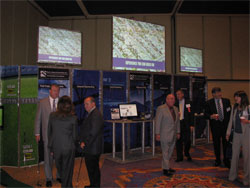 | �
�| Event exhibitors and sponsors contribute to an informative and engaging environment | �
�This year’s meeting was the best yet for the industry-leading construction defect and claims event.
�This year’s seminar concluded on May 13, 2011 with the Construction Defect Community Charitable Foundation Golf Tournament, held at Strawberry Farms Golf Course.
�The Disneyland Hotel in Anaheim, California was the place where more than 1,500 attendees convened for two days of professional development activities and seminars that included CLE workshops and panel discussions of special interest to legal and insurance professionals concerned with construction defect and claims litigation. Key events included “Challenges for Experts in Construction Defect Claims and Litigation,” “Keeping Up with Construction Defect Coverage,” and “Tips for Avoiding the ‘Perfect Storm’ in Handling of Wrap Claims.”
� �  | �
�| Supporting the golf tournament at the 15th hole | �
�This year’s Ollie award was given to George D. Calkins II, Esq. The West Coast Casualty Jerrold S. Oliver Award of Excellence was named in honor of the late Judge Jerrold S. Oliver, and recognizes an individual who is outstanding or has contributed to the betterment of the construction community.
�In addition to being the most comprehensive professional development seminar in the area of construction defects, this year’s seminar was equally valuable as a networking opportunity for members of the industry. People participated in professional development events during the day and then continued networking in the evening at numerous social events. The Lawn Party as well as the legendary Wood, Smith, Henning & Berman events were very well attended. Additional valuable networking events were hosted by a number of industry professionals at the House of Blues, and Tortilla Joe’s.
�As of this writing the 2011, West Coast Casualty's Construction Defect Seminar has applied for or has already received the following continuing education accreditation in the following areas;
�Read the full story…
�For more information about next year’s event, visit West Coast Casualty.
Follow Up on Continental Western v. Shay Construction
March 28, 2012 — Brady Iandiorio, Colorado Construction Litigation
Writing in Construction Law Colorado, Brady Iandiorio revisits the case Continental Western v. Shay Construction. He promises to continue to follow cases dealing with Colorado HB 10-1394.
�Recently the Court ruled on two Motions to Reconsider filed by Defendants Milender White and Shay Construction.
�Procedurally, the Motions to Reconsider were ruled on by the Honorable William J. Martinez, because the day after the motions were filed the action was reassigned to Judge Martinez. In the short analysis of the Motion to Reconsider, the court leaned on Judge Walker D. Miller’s ruling on the summary judgment and his analysis of the (j)(5) and (j)(6) exclusions.
�As a quick refresher regarding the grant of summary judgment, Judge Miller agreed with Continental Western’s argument that the asserted claims were excluded under the “damage to property” exclusion. The policy’s exclusions state: “(j) Damage to Property . . . (5) that particular part of real property on which you or any contractors or subcontractors working directly or indirectly on your behalf are performing operations, if the ‘property damage’ arises out of those operations; or (6) that particular part of any property that must be restored, repaired or replaced because ‘your work’ was incorrectly performed on it.” Judge Miller found that both exclusions (j)(5) and (6) applied to both Shay’s allegedly defective work.
Read the full story…
�Reprinted courtesy of Brady Iandiorio of Higgins, Hopkins, McClain & Roswell, LLC. Mr. Iandiorio can be contacted at iandiorio@hhmrlaw.com.
Excess Carrier Successfully Appeals Primary Insurer’s Summary Judgment Award
December 9, 2011 — Tred R. Eyerly, Insurance Law Hawaii
Although the excess carrier was given inadequate notice of the underlying arbitration, the trial court determined it shared responsibility with the primary carrier for the arbitration award. Finding disputed issues of fact, the Washington Court of Appeals reversed in Am. States Ins. Co. v. Century Surety Co., 2011 Wash. App. LEXIS 2488 (Wash. Ct. App. Oct. 31, 2011).
The primary insurer, American States, issued two liability policies to Professional Home Builders (PHB), a siding contractor. The policies were for successive years, 1998-1999 and 1999-2000. Each policy had annual limits of $1 million per occurrence. PHB also had a commercial excess liability policy for 1999-2000 with Century Surety Company.
PHB was sued by Residential Investment Partners (RIP) for construction defects after moisture entered the building envelope, causing decay and damage. Century’s expert determined the decay started before the 1999-2000 policy period.
RIP and PHB went to arbitration.
Read the full story…
Reprinted courtesy of Tred R. Eyerly, Insurance Law Hawaii. Mr. Eyerly can be contacted at te@hawaiilawyer.com
Time to Repair Nevada’s Construction Defect Laws?
February 10, 2012 — CDJ Staff
The Builders Magazine writes that during the previous session of the Nevada legislature, reforms sought by the building industry were stopped by the Speaker of the Nevada Assembly. The new session brings a new speaker and new hope for construction defect reform in Nevada.
� Pat Hickey, a member of the Assembly and a small business owner told The Builders Magazine that “we need to apply pressure on the legislators to fix the law.” He also recommended that people “go to Governor Sandoval and ask for his help.” Builders seeks legislation that will include right to repair and it should “define construction defect in such a way that it allows for a fair process.”
Read the full story…
Colorado statutory “property damage” caused by an “occurrence”
August 4, 2011 — CDCoverage.com
Colorado General Assembly House Bill 10-1394 was signed into law by the Governor on May 21, 2010, codified at Colo. Rev. Stat. § 13-20-808 (2010)
�13-20-808. Insurance policies issued to construction professionals
�(1) (a) The general assembly finds and determines that:
�(I) The interpretation of insurance policies issued to construction professionals is of vital importance to the economic and social welfare of the citizens of Colorado and in furthering the purposes of this part 8.
�(II) Insurance policies issued to construction professionals have become increasingly complex, often containing multiple, lengthy endorsements and exclusions conflicting with the reasonable expectations of the insured.
�(III) The correct interpretation of coverage for damages arising out of construction defects is in the best interest of insurers, construction professionals, and property owners.
� Read the full story…
�Reprinted courtesy of CDCoverage.com
No Coverage For Damage Caused by Chinese Drywall
October 28, 2011 — Tred Eyerley, Insurance Law Hawaii
The pollution exclusion barred coverage for alleged property damage and bodily injury in Evanston Ins. Co. v. Harbor Walk Dev., LLC, No. 2:10cv312 (E.D. Va. Sept. 9, 2011).
Homeowners sued the insured, Harbor Walk, in three lawsuits, alleging the Chinese drywall installed in their homes emitted sulfides and other noxious gases. This caused corrosion and damage to the air-conditioning and ventilation units, refrigeration coils, copper tubing, faucets, metal surfaces, electrical appliances and other personal items. The homeowners also alleged the compounds emitted by the drywall caused bodily injury, such as allergic reactions, headaches, etc.
Harbor Walk’s insurer, Evanston, filed for a declaratory judgment that the pollution exclusion precluded coverage.
Read the full story...
Reprinted courtesy of Tred R. Eyerly, Insurance Law Hawaii. Mr. Eyerly can be contacted at te@hawaiilawyer.com
Policing Those Subcontractors: It Might Take Extra Effort To Be An Additional Insured
June 14, 2011 — Douglas Reiser, Builders Council Blog
I just came across a case that I think truly paints the insurance dilemma for contractors. Thanks to this recent Illinois case, I don’t have to make up any factual scenarios—so kudos to Attorney Robert Boylan for posting it.
�In reading over my RSS feeds this weekend, I noticed a great writeup on long-time blogger Josh Glazov’s Construction Law Today. Attorney Robert Boylan’s post describes a recent Illinois case where a general contractor was denied its additional insured status on a second-tier subcontractor’s insurance. The reason for the denial: the general contractor failed to procure an agreement in writing with the second-tier subcontractor, requiring it to be listed as an additional insured.
�Read the full story…
�Reprinted courtesy of Douglas Reiser of Reiser Legal LLC. Mr. Reiser can be contacted at info@reiserlegal.com
New Construction Laws, New Forms in California
July 10, 2012 — CDJ Staff
New construction laws came into effect in California on July 1. Writing for the Martindale-Hubble Legal Library, Glenn Mau, J. Michael McGuire, and John Tonsing, all of Archer Norris, discuss these changes. They note that the most important part of the changes to California construction law is that “all mechanics liens, stop notices and bond claims recorded after July 1, 2012 must use the new standardized forms and follow the new definitions, notice prerequisites and statutory release form language.”
Read the full story…
Eleventh Circuit Asks Georgia Supreme Court if Construction Defects Are Caused by an "Occurrence"
December 20, 2012 — Tred Eyerly, Insurance Law Hawaii
The Eleventh Circuit certified a question to the Georgia Supreme Court, asking whether property damage can constitute an "occurrence" under a CGL policy where its effects are not felt on "other property." HDI-Gerling Am. Ins. Co. v. Morrison Homes, Inc., 2012 U.S. App. Ct. LEXIS 23813 (11th Cir. Nov. 19, 2012).
The general contractor, Taylor Morrison Services, Inc., was covered by a CGL policy issued by Gerling. The policy excluded "expected or intended injury," contractual liability," and business risk exclusions. Morrison was sued by homeowners in a class action suit. Morrison had allegedly omitted four inches of gravel required beneath the base of the concrete foundations by the Uniform Building Code. Thereafter, the houses sustained water intrusion, cracks in the floors and driveways, and warped and buckling flooring.
Gerling defended, but sued Morrison for a declaratory judgment.
Read the full story…
Reprinted courtesy of Tred R. Eyerly, Insurance Law Hawaii. Mr. Eyerly can be contacted at te@hawaiilawyer.com
Tenth Circuit Finds Insurer Must Defend Unintentional Faulty Workmanship
December 9, 2011 — Tred R. Eyerly, Insurance Law Hawaii
Applying Colorado law, the Tenth Circuit found a duty to defend construction defect claims where the faulty workmanship was unintentional. Greystone Const. Inc. v. National Fire & Marine Ins. Co., 2011 U.S. App. LEXIS 22053 (10th Cir. Nov. 1, 2011). A prior post [here] discussed the Tenth Circuit’s certified question to the Colorado Supreme Court in this matter, a request that was rejected by the Colorado court.
In two underlying cases, Greystone was sued by the homeowner for damage caused to the foundation by soil expansion. In both cases, the actual construction was performed by subcontractors. Further, in neither case was the damage intended or anticipated. Nevertheless, National Union refused to defend, contending property damage resulting from faulty construction was not an occurrence.
Relying on a Colorado Court of Appeals case, General Security Indemn. Co. of Arizona v. Mountain States Mut. Cas. Co., 205 P.3d 529 (Colo. App. 2009), the district court granted summary judgment to National Union.
On appeal, the Tenth Circuit first considered whether Colorado legislation enacted to overturn General Security could be applied retroactively. The statute, section 13-20-808, provided courts "shall presume that the work of a construction professional that results in property damage, including damage to the work itself or other work, is an accident unless the property damage is intended and expected by the insured."
Read the full story…
Reprinted courtesy of Tred R. Eyerly, Insurance Law Hawaii. Mr. Eyerly can be contacted at te@hawaiilawyer.com
Allowing the Use of a General Verdict Form in a Construction Defect Case Could Subject Your Client to Prejudgment Interest
August 2, 2012 — Heather Anderson, Higgins, Hopkins, McLain & Roswell, LLC
A recent opinion from the Colorado Court of Appeals is a cautionary tale concerning the calculation of pre-judgment interest. See Hendricks v. Allied Waste Transportation, Inc., 2012 WL 1881004 (Colo. App. 2012). The Hendricks sued Allied after one of its drivers backed into the corner of their home with an Allied garbage truck. At trial, a jury awarded the Hendricks $160,100 in damages. Although the jury was instructed on the cost of repairs, diminution in value, and non-economic damages, the parties agreed to a general verdict form that did not ask the jury to specify the types of damages awarded. The Hendricks sought to amend the judgment to include prejudgment interest and costs, which the trial court granted.
Allied appealed, arguing that the trial court erred by awarding the Hendricks prejudgment interest from the date their property was damaged. Id. at *7. The Colorado Court of Appeals found no error, and affirmed.
Read the full story…
Reprinted courtesy of Heather Anderson, Higgins, Hopkins, McLain & Roswell, LLC. Ms. Anderson can be contacted at anderson@hhmrlaw.com
Surveyors Statute Trumps Construction Defect Claim in Tennessee
June 19, 2012 — CDJ Staff
The Tennessee Court of Appeals has issued an opinion in the case of Dale v. B&J Enters. (Tenn. App., 2012), affirming the ruling of the Chancery Court for Knox County. The homeowners purchased properties in Knoxville, Tennessee in 2007 and 2008. Subsequently, according to the complaint, they found “significant sink holes and depressions throughout the subdivision.” The plaintiffs determined that a previous developer in 2004 had been aware of the sink holes. The Knox County Metropolitan Planning Commission, upon giving approval, made requirements that included that sink holes, even if they were filled, had to be designated on the site plans. The developer did not indicate these locations on the final plans. The plaintiffs made claims of “failure to disclose, misrepresentation, misrepresentation by concealment, and violation of the Tennessee Consumer Protection Act.” They filed their suit in June 2009.
The defendants in the initial case, argued that they did not create the final plat, the site plan indicating the features and lot lines. This had been the work of the previous developer. In September, 2009, the plaintiffs amended their complaint to include the previous developer and its engineering firm. The engineering firm disavowed any responsibility. The developer noted that the surveyor, Benchmark Associates, had “failed to properly include the sink holes and/or depressions on the final plat.” In June, 2010, the plaintiffs added Benchmark.
Benchmark argued that the plaintiffs’ claims should be dismissed, as Tennessee has a four-year statute of limitations on claims against surveyors. The final plat was recorded on May 19, 2006, and the plaintiff filed their claims against Benchmark on June 16, 2010, slightly less than a month over four years. The plaintiffs argued that “the real issue [was] the tortious misrepresentation by Benchmark.” The Chancery Court found for Benchmark.
On appeal, the plaintiffs raised three issues. They argued that the trial court applied the wrong section of the law, and should have applied the section applying to construction and not surveyors. They also argued that the timeliness of the claim should be based on when the defects were discovered. The also raised the question of whether the laws concerning surveyors bar claims for misrepresentation. The appeals court upheld the decision of the Chancery Court.
For the plaintiff’s first claim, although the statute addressing deficiencies in construction mentions surveying, an earlier court ruling found that the legislature had removed a reference to surveyors in one part of the statute, but failed to do so in the second part. The earlier court had concluded that the “obvious intent of the legislature was to place all limits on actions against surveyors into the new statute.” As the applicable statute states that “any such action not instituted within this four (4) year period shall be forever barred,” the court held that the plaintiffs’ claims must be time barred. Further, as the intent of the legislature was determined to “place all limits on actions against surveyors into one statute,” the court felt that it could not apply the Consumer Protection Act.
Read the court’s decision…
Seven Former North San Diego County Landfills are Leaking Contaminants
April 7, 2011 — April 7, 2011 Beverley BevenFlorez - Construction Defect Journal
Deborah Sullivan Brennan of the North County Times reported that seven former dumps in San Diego are leaking contaminants into the surrounding groundwater. John R. Odermatt, a senior engineering geologist for the California Regional Water Quality Control Board s San Diego region, told the North County Times, “the risk to most county residents is very small or negligible, while local water supplies located in more rural areas may be at a somewhat elevated but unquantified level of risk.”
�This issue is causing heavy scrutiny of a new proposed landfill in Gregory Canyon. The landfill would be located on 308 acres of undeveloped land near Pala, alongside the San Luis Rey River. The group “Save Gregory Canyon” has been speaking out against the landfill, stating that “the project threatens major detrimental impacts to both surface and groundwater, as well as a potential compromise of the two major San Diego Water Authority pipelines nearby.” Richard Felago, a Gregory Canyon Ltd. Consultant, told the North County Times that the 8-foot-thick liner, composed of layers of gravel and synthetic material, would not leak.
�The appeal hearing is being rescheduled later this month after one of the three panelists recused himself due to having a competing interest in the property, according to the article by Gary Warth in the North County Times.
�Read the full story (link 1)...
�Read the full story (link 2)...
South Carolina Legislature Redefining Occurrences to Include Construction Defects in CGL Policies
April 1, 2011 — April 1, 2011 Beverley BevenFlorez - Construction Defect Journal
The question of what circumstances must be in place for construction defects to be covered in a general commercial liability (CGL) policies is being raised by the courts and the legislature in South Carolina. The Insurance Journal reports that the American Insurance Association as well as the Property and Casualty Insurers Association of America are speaking out on the issue.
The problem seems to be centered on what defines an “occurrence.” CGL policies were not meant to cover faulty workmanship, according to the filing by the South Carolina Supreme Court. In January of this year, the South Carolina Supreme Court reversed the ruling in Crossmann Communities v Harleysville Mutual declaring that “Respondents cannot show the damage here was the result of an occurrence. Rather, the damage was a direct result and the natural and expected consequence of faulty workmanship; faulty workmanship did not cause an occurrence resulting in damage.” They focused their attention on the word “accident,” stating that there is a fortuity element that is not diminished.
�The South Carolina legislature reacted by producing a bill that would add new language directly negating the ruling by the Supreme Court. The South Carolina bill S-431 would change the definition of an occurrence in regards to construction defects as follows: “For a liability insurance policy issued to a construction professional, an ‘occurrence’ means, at a minimum: (1) an accident; or (2) continuous or repeated exposure to substantially the same general harmful condition or substance. No additional requirement of a fortuitous event is needed to constitute an ‘occurrence.’”
�S-431 is currently residing in the House Committee on Labor, Commerce and Industry.
�Read the full story...
Mobile Home Owners Not a Class in Drainage Lawsuit
March 1, 2012 — CDJ Staff
Comparing it to a “complex construction defect action,” the California Court of Appeals for Orange County has rejected the claims of a group of mobile home owners that they should be certified as a class in their lawsuit against Huntington Shorecliffs Mobilehome Park. The Appeals court sustained the judgment of the lower court. The court issued a decision in the case of Criswell v. MMR Family LLC on January 17, 2012.
�The claims made by the group were that the owners and operators of the mobile home park had known of an “on-going and potentially worsening shallow groundwater condition on the property” and had “exacerbated the problem by changing ‘the configuration and drainage related to the hillside that abuts’ the park.” The homeowners claimed that the class should consist of “any past or current homeowner during the same time frame” who had experienced “the accumulation of mold, fungus, and/or other toxins,” “property damage to his/her mobilehome and/or other property resulting from drainage problems, water seepage, water accumulation, moisture build-up, mold, fungus, and/or other toxins,” emotional distress related to drainage problems or mold, and finally health problems “resulting from exposure to drainage problems, water seepage, water accumulation, moisture build-up, mold, fungus, and/or other toxins, in or around one’s home, lot, or common areas of the park.”
�The lower court concluded that while the limits of the class were identifiable, they failed to constitute a class in other ways. First, the people affected were small enough in number that they could be brought together. They “are not so numerous that it would be impracticable to bring them all before the Court.”
�The court noted that while many of the homeowners would have issues in common, they did not find “a well-defined community of interest among the class members.” The Appeals Court wrote that “the individual issues affecting each mobile home and homeowner will predominate over the common issue of the presence of standing or pooling water in and around the park.” The court noted that each home would be affected differently by water and “the ‘accumulation of mold, fungus, and/or other toxins.’”
�While the court conceded that there would be common issues, such as the “defendants’ alleged concealment of excess moisture conditions and their allegedly negligent roadwork and landscaping,” they noted that “these common issues would be swamped by the swarm of individual determinations of property damage, emotional distress, and personal injury.” The Appeals Court cited an earlier case that ruled against certification “if a class action ‘will splinter into individual trials.’” The court affirmed the judgment of the lower court that they could not proceed as a class.
Read the court’s decision…
Harmon Towers Case to Last into 2014
December 20, 2012 — CDJ Staff
Don’t expect a fast resolution to the Harmon Tower case in Las Vegas. The latest schedule sets trial for the construction defect claims in January 2014. Previously, these claims were going to be heard during the trial set to start in June 2013. Now the June trial will be over payment issues only.
Don’t expect the building to come down soon either. While CityCenter claims the building could come down in an earthquake, Judge Elizabeth Gonzalez had determined that as the structural testing was not random; its results cannot be extrapolated through the entire structure. As a result, CityCenter has elected to do more testing, holding off on demolishing the building. They are appealing Gonzalez’s order to the Nevada Supreme Court.
Read the full story…
Cogently Written Opinion Finds Coverage for Loss Caused By Defective Concrete
November 7, 2012 — Tred Eyerly, Insurance Law Hawaii
If ever in need of a concise, well-reasoned opinion on “occurrence,” “property damage” and applicability of the business risk exclusions, turn to Pamperin Rentals II, LLC v. R.G. Hendricks & Sons Construction, Inc., 2012 Wis Ct. App. LEXIS 698 (Wis. Ct. App. Sept. 5, 2012).
A contractor was hired to install concrete during construction of seven gas stations. Red-D-Mix provided the concrete. The contractor and Red-D-Mix were eventually sued by the gas stations, based upon allegations that the concrete was defectively manufactured and installed. The gas stations alleged that Red-D-Mix supplied concrete that was defective and resulted in damages, including the need to repair nearby asphalt.
Red-D-Mix tendered to its insurers, who denied coverage. Suit was filed and the insurers moved for summary judgment. The trial court determined there were no allegations of either “property damage” or an “occurrence.” Therefore, there was no duty to defend or indemnify Red-D-Mix.
Read the full story…
Reprinted courtesy of Tred R. Eyerly, Insurance Law Hawaii. Mr. Eyerly can be contacted at te@hawaiilawyer.com