Coverage Exists Under Ensuing Loss Provision
July 10, 2012 — Tred Eyerly, Insurance Law Hawaii
Finding coverage under the ensuing loss provision, the Washington Supreme Court overruled a Court of Appeals decision we previously reported here. Vision One, LLC v. Philadelphia Indem. Ins. Co., 276 P.3d 300 (Wash. 2012).
Vision developed a condominium project. Before concrete was poured, a subcontractor supplied the shoring to temporarily support the poured concrete slabs. After the shoring installation was completed, concrete was poured on the first floor. When the pouring was finished, the shoring gave way. The framing, rebar and newly poured concrete came crashing down onto the the lower level parking area, where the wet concrete eventually hardened. It took several weeks to clean up the debris and repair the damage.
Vision had a builders’ risk policy with Philadelphia. The policy excluded losses caused by or resulting from deficient design or faulty workmanship. Collapse, however, was not listed as an excluded event. Further, the exclusion for faulty workmanship contained a resulting loss clause providing that "if loss or damage by a Covered Cause of Loss results, [Philadelphia] will pay for the loss or damage caused by that Covered Cause of Loss."
Philadelphia denied coverage under the faulty workmanship exclusion.
Read the full story…
Reprinted courtesy of Tred R. Eyerly, Insurance Law Hawaii. Mr. Eyerly can be contacted at te@hawaiilawyer.com
Contractor Underpaid Workers, Pocketed the Difference
February 10, 2012 — CDJ Staff
Property Casualty 360 reports that the owner of a construction company in California’s Bay Area has been arraigned in San Francisco Superior Court. The fifty-seven felony counts include charges of payroll theft and insurance fraud.
� San Francisco District Attorney, George Gascon is quoted as saying that Doherty’s actions “hurts the honest businesses that were unable to successfully compete for these projects which the defendant was able to underbid and win as a result of this scheme.”
� Frances Ann Doherty, owner of Doherty Painting & Construction has been charged with submitting false documentation as to what wages she paid her workers. It is alleged that over three years she pocketed $600,000. Additionally, she is charged with underpaying her insurer by more than $100,000 by submitting to them the fake payroll information.
Read the full story…
OSHA Extends Delay of Residential Construction Fall Protection Requirements
September 13, 2012 — CDJ Staff
OSHA has announced a fourth delay in full implementation of requiring fall protection in residential construction. The requirements, which would obligate those in residential construction to use the same degree of fall protection as is used in commercial construction, were originally set to go into effect in September 2011. As part of the phasing in of the new requirements, penalties were reduced, originally until March 2012. This has now been extended until December 15, 2012.
Read the full story…
Australian Developer Denies Building Problems Due to Construction Defects
June 15, 2011 — CDJ Staff
The Sunland Group, the developer, is objecting to claims that it is responsible for corrosion damage in a residential building in Gold Coast, Australia, as reported in the Courier & Mail. Residents of Q1, the world’s tallest residential tower, are suing the developer, claiming that defects and corrosion “compromise the long-term durability and appearance of” the six-year-old building.
�The developer has not only denied that there are defects in the building, but has also stated that the construction contract “did not warrant that the construction would be defects-free.” Sunland claimed that corrosion was due to the homeowners association having “failed to carry out the maintenance requirements.”
�Repair of the building is expected to cost millions of dollars. Sunland denies that it should pay any of that.
�Read the full story…
New Safety Standards Issued by ASSE and ANSI
March 28, 2012 — Melissa Dewey Brumback, Construction Law North Carolina
The American National Standards Institute (ANSI) and the American Society of Safety Engineers (ASSE) have recently announced their approval of two new safety standards to enhance construction site safety.
�The two new standards, which are set to take effect during June 2012, are the ANSI/ASSE A10.1-2011 Pre-Project and Pre-Task Safety and Health Planning for Construction and Demolition Operations, and the ANSI/ASSE A10.26-2011 Emergency Procedures for Construction and Demolition Sites.
�The new A10.1-2011 standard was designed to assist construction owners, contractors, and designers by ensuring that safety and health planning were standard parts of their pre-construction planning. It is also intended to help owners of construction sites to establish a process for evaluating constructor candidates with regard to their safety and health performance planning.
�The A10.26 standard applies to emergency situations, including fires, collapses, and hazardous spills. The standard deals with emergency rescue, evacuation, and transportation of injured workers, and also plans for coordinating with emergency medical facilities ahead of potential disasters.
� Read the full story…
���Reprinted courtesy of Melissa Dewey Brumback of Ragsdale Liggett PLLC. Ms. Brumback can be contacted at mbrumback@rl-law.com.
�
New Construction Laws, New Forms in California
July 10, 2012 — CDJ Staff
New construction laws came into effect in California on July 1. Writing for the Martindale-Hubble Legal Library, Glenn Mau, J. Michael McGuire, and John Tonsing, all of Archer Norris, discuss these changes. They note that the most important part of the changes to California construction law is that “all mechanics liens, stop notices and bond claims recorded after July 1, 2012 must use the new standardized forms and follow the new definitions, notice prerequisites and statutory release form language.”
Read the full story…
Allowing the Use of a General Verdict Form in a Construction Defect Case Could Subject Your Client to Prejudgment Interest
August 2, 2012 — Heather Anderson, Higgins, Hopkins, McLain & Roswell, LLC
A recent opinion from the Colorado Court of Appeals is a cautionary tale concerning the calculation of pre-judgment interest. See Hendricks v. Allied Waste Transportation, Inc., 2012 WL 1881004 (Colo. App. 2012). The Hendricks sued Allied after one of its drivers backed into the corner of their home with an Allied garbage truck. At trial, a jury awarded the Hendricks $160,100 in damages. Although the jury was instructed on the cost of repairs, diminution in value, and non-economic damages, the parties agreed to a general verdict form that did not ask the jury to specify the types of damages awarded. The Hendricks sought to amend the judgment to include prejudgment interest and costs, which the trial court granted.
Allied appealed, arguing that the trial court erred by awarding the Hendricks prejudgment interest from the date their property was damaged. Id. at *7. The Colorado Court of Appeals found no error, and affirmed.
Read the full story…
Reprinted courtesy of Heather Anderson, Higgins, Hopkins, McLain & Roswell, LLC. Ms. Anderson can be contacted at anderson@hhmrlaw.com
Nevada Construction Defect Lawyers Dead in Possible Suicides
March 28, 2012 — CDJ Staff
A number of news sources have reported on the recent death of Nevada construction defect attorney, Nancy Quon. Ms. Quon was implicated in a recent scandal in which a group conspired to control homeowner associations in order to divert construction defect lawsuits to the members of the conspiracy.
�Ms. Quon was found dead in her bathtub. The details are still under investigations. She and her boyfriend were accused of a failed arson/suicide scheme in 2010. Ms. Quon survived an attempt to burn down her home. Subsequently, her boyfriend obtained some gamma-hydroxybutyric acid (GBH) for her, as part of another failed suicide attempt.
�Subsequent to Ms. Quon’s death, David Amesbury was found in California dead by hanging. Mr. Amesbury took a plea deal in the case, and he had admitted his role in providing legal and construction contracts to firms in the conspiracy. He was accused of fixing HOA elections.
Read the full story…
�Read the full story…
�Read the full story…
�Read the full story…
Save a Legal Fee: Prevent Costly Lawsuits With Claim Limitation Clauses
April 25, 2012 — Douglas Reiser, Builders Cousel
Ever had that lingering problem with a contracting partner that went away for awhile and then came back to bite you ? years later? In Washington, construction contract claims can be raised for up to six years after substantial completion. Six years!? Why would I want to wait that long to find out if I have a problem? You don’t have to.
�Over the past few years, I have discussed the notion of “contractual claim periods” on The Builders Counsel. For today’s Save a Legal Fee column, I cannot think of a better topic. These provisions are specifically intended to save you from unnecessary legal fees that might arise if a problem goes unnoticed for too long.
�Contractual claim periods are simply a way to reduce the amount of time that a contracting party has to raise a claim against its contracting partner. For example, a subcontractor might require that a general contractor raise any claim that it might have ? for defective or incomplete work, injury, damages, etc ? within a particular amount of time or forever lose the ability to raise the claim in a legal proceeding.
� Read the full story…
�Reprinted courtesy of Douglas Reiser of Reiser Legal LLC. Mr. Reiser can be contacted at info@reiserlegal.com
�
Construction Law Alert: A Specialty License May Not Be Required If Work Covered By Another License
March 7, 2011 — By
Steve Cvitanovic of
Haight Brown & Bonesteel, LLP.Contractors should always be sure that they understand the licensing in any Subcontract or Prime Contract before entering into any agreement. However, on March 3, 2011, in the case of Pacific Casson & Shoring, Inc. v. Bernards Bros., Inc. 2011 Cal.App.Lexis 236, the Court of Appeal determined that if a specialty license is subsumed within another license, the specialty license may not be required.
�Bernards entered into a subcontract with Pacific to excavate, backfill, grade and provide geotechnical design parameters for a hospital. The Prime Contract required the bidder to maintain a Class C-12 specialty earthwork license. However, Pacific only held a Class A general engineering license which it turns out was suspended during the performance of the work. Pacific sued Bernards for nonpayment of $544,567, but the lawsuit was dismissed because the trial court found that Pacific (1) lacked a C-12 license, and (2) Pacific’s Class A license was suspended for failure to pay an unrelated judgment. Pacific was also ordered to disgorge $206,437 in prior payments.
�The Court of Appeal reversed and remanded. The Court of Appeal agreed with Pacific and held that a C-12 specialty license was not required despite the Prime Contract. The Court of Appeal found that the C-12 specialty license would have been “superfluous” since it was fully encompassed within the Class A requirements. However, the Court of Appeal also remanded the case for further
�Read the full story...
�Reprinted courtesy of Steve Cvitanovic of Haight Brown & Bonesteel, LLP.
Virginia Homebuilding Slumps After Last Year’s Gain
June 19, 2012 — CDJ Staff
As of May, only 61 residential construction permits have been issues in Roanoke County, Virginia, leaving officials doubtful that this year will meet last year’s mark of 179 permits. Residential construction was at its highest in the county in 2004. The worst year since then was 2009, when the county issued 143 permits. The county is in the western end of the state, near the border with West Virginia, and far from the D.C. metropolitan area.
Arnold Covey, the Director of Community Development for the county said that “it may be until 2014 before we really see a difference. The article by WDBJ7.com notes that a “key part” of the county budget comes from real estate.
Read the full story…
2011 West Coast Casualty Construction Defect Seminar – Recap
June 1, 2011 — CDJ Staff
� 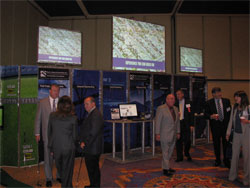 | �
�| Event exhibitors and sponsors contribute to an informative and engaging environment | �
�This year’s meeting was the best yet for the industry-leading construction defect and claims event.
�This year’s seminar concluded on May 13, 2011 with the Construction Defect Community Charitable Foundation Golf Tournament, held at Strawberry Farms Golf Course.
�The Disneyland Hotel in Anaheim, California was the place where more than 1,500 attendees convened for two days of professional development activities and seminars that included CLE workshops and panel discussions of special interest to legal and insurance professionals concerned with construction defect and claims litigation. Key events included “Challenges for Experts in Construction Defect Claims and Litigation,” “Keeping Up with Construction Defect Coverage,” and “Tips for Avoiding the ‘Perfect Storm’ in Handling of Wrap Claims.”
� �  | �
�| Supporting the golf tournament at the 15th hole | �
�This year’s Ollie award was given to George D. Calkins II, Esq. The West Coast Casualty Jerrold S. Oliver Award of Excellence was named in honor of the late Judge Jerrold S. Oliver, and recognizes an individual who is outstanding or has contributed to the betterment of the construction community.
�In addition to being the most comprehensive professional development seminar in the area of construction defects, this year’s seminar was equally valuable as a networking opportunity for members of the industry. People participated in professional development events during the day and then continued networking in the evening at numerous social events. The Lawn Party as well as the legendary Wood, Smith, Henning & Berman events were very well attended. Additional valuable networking events were hosted by a number of industry professionals at the House of Blues, and Tortilla Joe’s.
�As of this writing the 2011, West Coast Casualty's Construction Defect Seminar has applied for or has already received the following continuing education accreditation in the following areas;
�Read the full story…
�For more information about next year’s event, visit West Coast Casualty.
In Re Golba: The Knaubs v. Golba and Rollison, Debtors
June 19, 2012 — Brady Iandiorio
Now comes another cautionary tale for builders and developers, especially those using single purpose business entities to handle individual construction projects. The United States Bankruptcy Court in Denver, Colorado, through the Honorable Michael Romero, provided an order regarding plaintiffs’ problems with a home they purchased from an entity controlled or represented by defendants. Plaintiffs, Kelvin and Holly Knaub (the “Knaubs”) filed adversary proceedings against debtor Robert Golba in his bankruptcy proceeding and against debtor Greg Rollison in his separate bankruptcy proceeding. The adversary proceedings were partially consolidated to proceed in parallel but not substantively.
The Knaubs purchased a home from Gemm Homes (“Gemm”) in May 2003. Problems stemming from the foundation caused the Knaubs to seek an explanation and ultimately a solution from Gemm and then from Avalon Homes (“Avalon”), which the Knaubs claim is just a continuation of Gemm. Through their complaint, the Knaubs seek relief for 1) damages caused by fraudulent representations and false pretenses under 11 U.S.C. § 523(a)(2)(A), based on Golba’s misrepresentation that Gemm and Rollison were not involved in Avalon; 2) damages caused by actual fraud under § 523(a)(2)(A), based on Golba’s and Rollison’s alleged conspiracy fraudulently to convey the assets of Gemm to the Avalon entities; and 3) damages caused by breach of fiduciary duty under § 523(a)(4), alleging Gemm was an insolvent company which owed a fiduciary duty to its creditors, and alleging Golba participated in transferring Gemm’s assets to Avalon for no consideration. In the Golba action, the third claim for relief was dismissed.
The facts of the case are important and somewhat convoluted. In an effort to make the cases clear, the evidence, allegations, and facts will be laid out in detail below. The Knaubs’ house was purchased from Gemm and soon after both Gemm and Rollison had an engineering company perform an analysis which discovered the foundation was not laid on stable ground.
Read the full story…
Reprinted courtesy of Brady Iandiorio, Higgins, Hopkins, McLain & Roswell, LLC. Mr. Iandiorio can be contacted at iandiorio@hhmrlaw.com
OSHA Cites Construction Firm for Safety Violations
August 16, 2012 — CDJ Staff
S.J. Louis Construction of Texas Ltd. has been cited by OHSH for one serious and one repeat safety violation, according to a report in Insurance Journal. OSHA officials saw S.J. Louis employees working in an unshored trench along a highway service road. The company had cited for this violation previously. Without shoring of trenches deeper than five feet there is a risk of serious injury or death.
Read the full story…
Insurer Not Entitled to Summary Judgment on Construction Defect Claims
February 10, 2012 — Tred Eyerly, Insurance Law Hawaii
The insurer unsuccessfully moved for summary judgment, contending it had no obligation to defend two related underlying construction defect cases. Amerisure Ins. Co. v. R.L.Lantana Boatyard, Ltd., 2012 U.S. Dist. LEXIS 2466 (S.D. Fla. Jan. 9, 2012).
� An engineering report noted design construction defects and deficiencies in visible, physical improvements at The Moorings at Lantana Condominium. In two lawsuits, The Moorings sued the developer, R.L. Lantana Boatyard ("RLLB"), and the contractor, Current Builders of Florida.
� Current Builders was insured by Amerisure. RLLB was named as an additional insured under the Amerisure policy.
Read the full story…
� � � Reprinted courtesy of Tred R. Eyerly, Insurance Law Hawaii. Mr. Eyerly can be contacted at te@hawaiilawyer.com
�
Construction Case Alert: Appellate Court Confirms Engineer’s Duty to Defend Developer Arises Upon Tender of Indemnity Claim
January 27, 2010 — By
Steven M. Cvitanovic,
Haight Brown & Bonesteel, LLP, January 27, 2010
In the recent case of UDC-Universal Development, L.P. v. CH2M Hill, 2010 Cal.App.LEXIS 47 (filed January 15, 2010), the Sixth District Court of Appeal provided a stunning illustration of the far-reaching effects of the California Supreme Court’s holding in Crawford v. Weather Shield Manufacturing Inc. (2008) 44 Cal.4th 541. In Crawford, the Court held the duty to defend under an indemnity agreement arose upon the mere tender of defense of a claim covered by the indemnity.
�In the UDC case, CH2M Hill provided engineering and environmental planning services to developer UDC on a project that ultimately wound up in a construction defect lawsuit by the homeowners association ( HOA ). UDC tendered its defense to CH2M Hill, the tender was rejected, and UDC filed a cross-complaint for negligence, breach of contract and indemnity against CH2M Hill and others. After the HOA’s construction defect claims were settled, UDC proceeded to trial against CH2M Hill. The jury found in favor of CH2M Hill on the claims for negligence and breach of contract. At the request of the parties prior to trial, the trial court ruled on the application of the indemnity agreement in light of Crawford and, in so doing, found that the defense obligation arose upon the tender and that CH2M Hill breached that duty despite the jury finding in favor of CH2M Hill.
�The Court of Appeal affirmed, noting that the defense obligation arose as soon as the defense was tendered and did not depend on the outcome of the litigation, and that the HOA’s general description of the defects along with an allegation that Doe engineers were negligent triggered the duty to defend.
�Although this case did not expand the crushing impact of Crawford’s holding, it is
�Read the full story...
Workers Hurt in Casino Floor Collapse
February 10, 2012 — CDJ Staff
More than a dozen construction workers fell about thirty feet when a floor collapsed in a Cincinnati casino. The workers were pouring cement on the second-floor level when the accident happened. The area in question will be the gaming area in the completed casino. Scott Allen, OSHA’s regional spokesperson, said their investigation of the accident would probably take about a month to complete.
� The cause of the collapse is still undetermined. Although the weather has been wet in the area, experts thought it unlikely to be the cause. A construction forensics professor at Ohio State University said that “concrete pouring is very common” and that “you cannot go wrong unless something happens with the connection.” Engineering experts said it was more likely an issue with the metal decking.
Read the full story…
Southern California Lost $8 Billion in Construction Wages
August 17, 2011 — CDJ Staff
Los Angeles and Orange Counties are first on a list no area wants to be on. According to the Sacramento Bee, reporting on data from the U.S. Bureau of Economic Analysis, LA and Orange Counties saw an $8 billion drop in construction wages in 2010, as compared to 2006. In 2006, the region saw payrolls of $26.8 billion, but in 2010, that was reduced to $18.5 billion.
�This was not the largest percentage change. Of the metropolitan areas with the largest declines in construction earnings, Las Vegas saw a $3.6 billion drop, however that represented half of their 2006 totals of $7.2 billion. Conversely, a $3.3 billion drop in the New York area represented only 10% of what had been $33.8 billion in payroll in 2006.
Read the full story…