
















Home Builder Doesn’t See Long Impact from Hurricane
November 7, 2012 — CDJ Staff
No one needs to tell Toll Brothers about the impact of Hurricane Sandy. The Wall Street Journal reports that the home building company lost power as a result of the storm. Martin Connor, the company’s CFO, told the Journal that he did not expect the hurricane to have a big effect on sales. Luckily for the company, many of its large projects are either sufficiently completed to provide shelter or too early in the process to be affected by the storm. “This type of weather event has limited impact on the market. It may move settlements later, and may defer people a weekend or two until they go out shopping. But it doesn’t have a long impact.”
Read the full story…
Home Repair Firms Sued for Fraud
September 30, 2011 — CDJ Staff
The Illinois Attorney General has filed a lawsuit in Cook County Circuit Court alleging that two connected firms took money from homeowners and then failed to perform the contracted work. One of the three defendants, Chris Bidigare, was an owner of agent of both Fairway Construction and Maintenance Services, LLC, and Rock Construction Management, LLC.
In once case, according to the article on the OakPark Patch, one homeowner provided a $111,000 down payment, only to have the company cancel the job and refuse to return the money. One homeowner was told by Fairway that she should contact their insurance provider. The insurance provider told her that Fairway’s insurance had been cancelled due to non-payment.
The suit seeks to bar the three defendants from working in home repair in Illinois.
Read the full story…
2011 West Coast Casualty Construction Defect Seminar – Recap
June 1, 2011 — CDJ Staff
 |
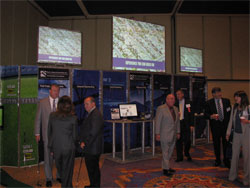
| Event exhibitors and sponsors contribute to an informative and engaging environment |
This year’s meeting was the best yet for the industry-leading construction defect and claims event.
This year’s seminar concluded on May 13, 2011 with the Construction Defect Community Charitable Foundation Golf Tournament, held at Strawberry Farms Golf Course.
The Disneyland Hotel in Anaheim, California was the place where more than 1,500 attendees convened for two days of professional development activities and seminars that included CLE workshops and panel discussions of special interest to legal and insurance professionals concerned with construction defect and claims litigation. Key events included “Challenges for Experts in Construction Defect Claims and Litigation,” “Keeping Up with Construction Defect Coverage,” and “Tips for Avoiding the ‘Perfect Storm’ in Handling of Wrap Claims.”
 |
| Supporting the golf tournament at the 15th hole |
This year’s Ollie award was given to George D. Calkins II, Esq. The West Coast Casualty Jerrold S. Oliver Award of Excellence was named in honor of the late Judge Jerrold S. Oliver, and recognizes an individual who is outstanding or has contributed to the betterment of the construction community.
In addition to being the most comprehensive professional development seminar in the area of construction defects, this year’s seminar was equally valuable as a networking opportunity for members of the industry. People participated in professional development events during the day and then continued networking in the evening at numerous social events. The Lawn Party as well as the legendary Wood, Smith, Henning & Berman events were very well attended. Additional valuable networking events were hosted by a number of industry professionals at the House of Blues, and Tortilla Joe’s.
As of this writing the 2011, West Coast Casualty's Construction Defect Seminar has applied for or has already received the following continuing education accreditation in the following areas;
Read the full story…
For more information about next year’s event, visit West Coast Casualty.
Construction Defects and Contractor-Owners
July 10, 2012 — CDJ Staff
On the expert advice site Avvo.com, a user asks if he can be sued for construction defects by the new owner of a building for which he served as general contractor and then owned for four years. He had construction insurance, but does not think he had construction defect insurance.
A lawyer responding to his question says that “you could be sued.” In the event of a suit, “you would have to bring claims against all of your subcontractors.”
Read the full story…
Coverage for Construction Defects Barred by Business Risk Exclusions
September 1, 2011 — Tred Eyerley, Insurance Law Hawaii
Although the court determined there was an occurrence, coverage was excluded by the business risk exclusions. See Cont’l W. Ins. Co. v. Shay Constr. Co., 2011 U.S. Dist. LEXIS 82839 (D. Colo. July 28, 2011).
White was the general contractor on the project. White had three subcontracts with Shay to provide framing, siding, and related work on the project. Shay was insured under a CGL policy issued by Continental Western.
Two of Shay’s subcontractors furnished materials, labor and equipment to Shay. These subcontractors filed suit in state court alleging they had not been compensated for the work and materials. White and Shay were named as defendants. White cross claimed against Shay, alleging Shay had breached its obligations under the subcontracts. Several allegations sounded in contract. Other allegations, however, contended Shay had performed defective work and had damaged the work of other trades in correcting deficiencies in its own performance.
Shay sought coverage under Continental Western’s policy. Continental Western filed suit for a declaratory judgment and moved for summary judgment.
Read the full story…
Reprinted courtesy of Tred R. Eyerly, Insurance Law Hawaii. Mr. Eyerly can be contacted at te@hawaiilawyer.com
Utah Construction Defect Claims Dependant on Contracts
July 10, 2012 — CDJ Staff
An owner who wants to sue a subcontractor directly may find limited ability to do so under Utah court decisions. Writing on the JDSupra site, Stewart O. Peay and Mark O. Morris of Snell & Wilmer discuss the distinction the Utah courts make between contractor (with whom an owner has direct contracts) and subcontractors (with whom an owner does not). In the Utah courts, construction defect claims must be based on contract, rather than tort. With no contract, there is no way to pursue claims against a subcontractor alone.
They note that the Utah couts do not “accept negligence and negligent misrepresentation claims that many other jurisdictions embrace.” They recommend that in setting up contracts for a construction project, owners should ensure that they are provided with “third-party beneficiary rights to purse claims against subs.” They suggest that “the owner may require his generals to include language in the various subcontracts that incorporates some or all of the terms of the prime contract into the subcontracts.” Additionally they suggest that the owner “require the general to include ‘flow down’ provisions in the various subcontracts.”
Read the full story…
Liability policy covers negligent construction: GA high court
October 31, 2010 — Original article by
Michael Bradford in Business Insurance
ATLANTA—Negligent construction that results in damage to surrounding property constitutes an occurrence under a commercial general liability policy, the Georgia Supreme Court has ruled.
In a 6-1 opinion Monday in
American Empire Surplus Lines Insurance Co. Inc. vs. Hathaway Development Co. Inc., the Georgia high court upheld a lower court ruling that the general contractor’s claim for damage caused by a subcontractor’s faulty plumbing work was covered.
The ruling on construction defects is the latest in number of such cases across the United States
Read Full Story...
Reprinted courtesy of Michael Bradford of Business Insurance.
No Coverage for Negligent Misrepresentation without Allegations of “Bodily Injury” or “Property Damage”
February 10, 2012 — Tred Eyerly, Insurance Law Hawaii
Jeff City Industries was the general contractor for a sewer system improvement project in Branson, Missouri. Bituminous Cas. Corp. v. United HRB Gen. Contractors, Inc., 2011 U.S. Dist. LEXIS 145666 (W.D. Mo. Dec. 19, 2011). Branson sued Jeff City, alleging breach of the construction contract for the project. The claims included improperly bedded sewer piping, improper aligning portions of trenching for the sewer piping, improper service line connections to the sewer piping, etc.
Read the full story…
Reprinted courtesy of Tred R. Eyerly, Insurance Law Hawaii. Mr. Eyerly can be contacted at te@hawaiilawyer.com
New Web Site Tracks Settled Construction Defect Claims
June 19, 2012 — CDJ Staff
Peter Lissner, a former Nevada homebuilder, has created a new site to help track homes that have been involved in construction defect litigation. His site, housefaxreview.com, collections documentation about homes where claims of construction defects have been made. He told The Builders Magazine concerns about “the number of homes that have been served notices, received compensation, yet the homes weren’t repaired.” On the site, the creator is identified as “a family owned builder.” According to the site, “the builder had no claims until the neighborhood reached the statutory claims limit 10 years.”
Lissner also claims that in many cases, after settling construction defect lawsuits, the homeowners sell to subsequent buyers without disclosing the lawsuit or their failure to repair. “Who is going to let the new homeowner know about the issue?” he asks.
Documents on the site are priced according to their relevance. Lissner notes that those who provide documents to the site will receive free access.
Read the full story…
Contractor Sues License Board
June 30, 2011 — CDJ Staff
Judge Kendall J. Newman of the US District Court handed down a decision on June 24 on the case of Kent v California Department of Consumer Affairs. Mr. Kent, appearing as his own counsel, had brought the suit against the California Department of Consumer Affairs and the Contractors State Licensing Board after he was arrested in a sting operation and, as the plaintiff put it, “was absurdly arrested and uncooperatively detained for a time longer than necessary or allowed by law under the false pretense of contracting with out a license.” Mr. Kent’s alleged that Rick Lopez, one of the defendants, formed him to read allow from the California Business and Professions Code. He said he was later handcuffed and placed in an uncomfortable chair, “enduring physical pain and emotional agony.”
Although Kent was given a Notice to Appear, he alleged that a further defendant, Stuart Rind, “closed the plaintiff’s case marked citation A7773 without giving written notice to anyone.” As a result, the Placer County District Attorney’s Office had no record of his Notice to Appear.
Kent alleged that subsequently his firm was essentially shut down for two years and that he was prevented from “legally contracting or selling services for any other contractor or qualifying for any other licensed capacity governed by the CSLB.” After this, the CSLB suspended the license for his firm, DSI Construction. He was assessed a $1,500 fine, after which he claims he sent a letter to the CSLB demanding money damages. The judge noted that the letter was not included in the plaintiff’s Ninth Amended Complaint.
Judge Kendall recommended that the plaintiff’s Complaints be dismissed, although he did allow that sixth, and perhaps the eighth and ninth, could be amended with a tenth amended complaint.
Read the court’s decision…
In Re Golba: The Knaubs v. Golba and Rollison, Debtors
June 19, 2012 — Brady Iandiorio
Now comes another cautionary tale for builders and developers, especially those using single purpose business entities to handle individual construction projects. The United States Bankruptcy Court in Denver, Colorado, through the Honorable Michael Romero, provided an order regarding plaintiffs’ problems with a home they purchased from an entity controlled or represented by defendants. Plaintiffs, Kelvin and Holly Knaub (the “Knaubs”) filed adversary proceedings against debtor Robert Golba in his bankruptcy proceeding and against debtor Greg Rollison in his separate bankruptcy proceeding. The adversary proceedings were partially consolidated to proceed in parallel but not substantively.
The Knaubs purchased a home from Gemm Homes (“Gemm”) in May 2003. Problems stemming from the foundation caused the Knaubs to seek an explanation and ultimately a solution from Gemm and then from Avalon Homes (“Avalon”), which the Knaubs claim is just a continuation of Gemm. Through their complaint, the Knaubs seek relief for 1) damages caused by fraudulent representations and false pretenses under 11 U.S.C. § 523(a)(2)(A), based on Golba’s misrepresentation that Gemm and Rollison were not involved in Avalon; 2) damages caused by actual fraud under § 523(a)(2)(A), based on Golba’s and Rollison’s alleged conspiracy fraudulently to convey the assets of Gemm to the Avalon entities; and 3) damages caused by breach of fiduciary duty under § 523(a)(4), alleging Gemm was an insolvent company which owed a fiduciary duty to its creditors, and alleging Golba participated in transferring Gemm’s assets to Avalon for no consideration. In the Golba action, the third claim for relief was dismissed.
The facts of the case are important and somewhat convoluted. In an effort to make the cases clear, the evidence, allegations, and facts will be laid out in detail below. The Knaubs’ house was purchased from Gemm and soon after both Gemm and Rollison had an engineering company perform an analysis which discovered the foundation was not laid on stable ground.
Read the full story…
Reprinted courtesy of Brady Iandiorio, Higgins, Hopkins, McLain & Roswell, LLC. Mr. Iandiorio can be contacted at iandiorio@hhmrlaw.com
Mississippi exclusions j(5) and j(6) “that particular part”
June 7, 2011 — CDCoverage.com
In Lafayete Ins. Co. v. Peerboom, No. 3:10cv336 (S.D. Miss. June 2, 2011), claimant homeowner Peerboom hired insured contractor Absolute to raise Peerboom’s house two feet to avoid future flooding. While Absolute was raising the house, it fell, resulting in physical injury to the home. Peerboom sued Absolute for negligence, breach of contract, and fraud, seeking damages for the destruction of the home. Absolute’s CGL insurer Lafayette defended under a reservation of rights and filed a declaratory judgment action.
Read the full story…
Reprinted courtesy of CDCoverage.com
Boyfriend Pleads Guilty in Las Vegas Construction Defect Scam Suicide
November 7, 2012 — CDJ Staff
One of the odder twists of the Las Vegas construction defect scandal was the charge that Nancy Quon’s boyfriend helped her in an initial suicide attempt. Quon, implicated by not charged in the case of taking control of homeowner boards in order to profit from construction defect settlements. William Webb was alleged to have bought the drug GBH in order to allow Quon, his girlfriend, to commit suicide. Ms. Quon later overdosed on a combination of alcohol and prescription drugs.
In addition to pleading guilty to the drug charges, Webb also made a plea bargain with prosecutors in which he did not admit guilt in an insurance fraud charge, but acknowledged that prosecutors would likely be successful at obtaining a conviction. Webb will be sentenced February 7 and is expected to receive a sentence of six years imprisonment.
Read the full story…
Texas covered versus uncovered allocation and “legally obligated to pay.”
April 27, 2011 — April 27, 2011, by CDCoverage.com
In Markel American Ins. Co. v. Lennar Corp., No. 14-10-00008-CV (Tex. Ct. App. April 19, 2011), insured homebuilder Lennar filed suit against its insurer Markel seeking recovery of costs incurred by Lennar to repair water damage to homes resulting from defective EIFS siding. Following a jury trial, judgment was entered in favor of Lennar and against Markel. On appeal, the intermediate appellate court reversed. Applying Texas law, the court first held that Lennar failed to satisfy its burden of allocating damages between covered and uncovered. In a prior decision, the court had held that, while the costs incurred by Lennar for the repair of the resulting water damage
Read the full story…
Reprinted courtesy of CDCoverage.com
Defective Shingle Claims Valid Despite Bankruptcy
June 19, 2012 — CDJ Staff
The Third Circuit Court has allowed claims to go forward against Owens Corning for making allegedly defective shingles. The shingles split, leading to leaking roofs. The building products manufacturer filed for bankruptcy in 2000, which “extinguished” claims against it. The company was facing millions in liabilities over asbestos lawsuits.
The lawsuit was filed in 2009. The courts initially found the lawsuit timely, but the Third Circuit Court later applied determined the exposure stated before the bankruptcy. On appeal, the court has reversed this and is again allowing the suit to proceed.
Read the full story…
Judge Concludes Drywall Manufacturer Sold in Florida
September 13, 2012 — CDJ Staff
A Florida judge has concluded that the Chinese drywall manufacturer Taishan actively sought to sell its products in Florida and cannot now claim that it was not involved. Judge Joseph Farnia also noted that the main distributor of the drywall was, as noted in the Miami Herald, an arm of the company. Lennar Hones has sued the firm after installing drywall manufactured by the company in hundreds of homes.
Taishan’s activities in Florida included not only distributing samples, but also hosting tours of their plants in China for construction executives, and even making customized runs. According to other reports, has lost past cases over defects in their drywall.
Read the full story…
The Complete and Accepted Work Doctrine and Construction Defects
August 16, 2012 — CDJ Staff
Matthew C. Bouchard of Lewis & Roberts PLLC, writes how North Carolina is “bucking the trend” on the “complete and accepted work doctrine.” As he notes, in most states “a contractor can be found liable for personal injuries suffered by third parties from accidents occurring after the contractor’s work is completed and accepted.” But one exception is North Carolina.
He gives the example of a case, Lamb v. D.S. Duggins Welding, Inc., in which a site superintendent was “injured by the alleged negligence of the project’s steel deck installer, a sub-subcontractor in the contractual chain” “after the sub-sub’s work had been completed and accepted.” The trial court held that the “completed and accepted work doctrine” ended the subcontractor’s liability. The case noted that “employees of the general contractor had modified the installation of the perimeter safety cable in question after the sub-sub had demobilized from the site.”
Mr. Bouchard notes that “once a project is accepted and turned over, the contractor typically loses control over maintenance of the new facility.” However, he notes that “where the contractor’s work constitutes negligence ?Ķ the doctrine may not apply.” Nor does it end breach of contract claims. It only covers third parties.
Read the full story…
More Charges in Las Vegas HOA Scandal
September 13, 2012 — CDJ Staff
The indictments continue in the Las Vegas HOA scandal. A lawyer for the Justice Department told the judge in the case that “we expect several indictments before the end of the year.” According to the Las Vegas Review Journal, “a dozen or more” additional people will be charged in the conspiracy.
The judge in the case, Senior U.S. District Judge Lloyd George, told prosecutors that he wanted to address the issue of compensation for homeowners. Currently, defendants have agreed to pay $1.5 million to compensate homeowners associations and banks. Vistana homeowners have claimed that the conspirators got the bulk of a $19 million construction defect settlement.
Read the full story…