2011 West Coast Casualty Construction Defect Seminar – Recap
June 1, 2011 — CDJ Staff
� 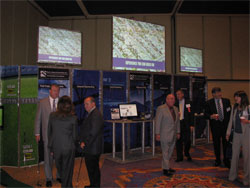 | �
�| Event exhibitors and sponsors contribute to an informative and engaging environment | �
�This year’s meeting was the best yet for the industry-leading construction defect and claims event.
�This year’s seminar concluded on May 13, 2011 with the Construction Defect Community Charitable Foundation Golf Tournament, held at Strawberry Farms Golf Course.
�The Disneyland Hotel in Anaheim, California was the place where more than 1,500 attendees convened for two days of professional development activities and seminars that included CLE workshops and panel discussions of special interest to legal and insurance professionals concerned with construction defect and claims litigation. Key events included “Challenges for Experts in Construction Defect Claims and Litigation,” “Keeping Up with Construction Defect Coverage,” and “Tips for Avoiding the ‘Perfect Storm’ in Handling of Wrap Claims.”
� �  | �
�| Supporting the golf tournament at the 15th hole | �
�This year’s Ollie award was given to George D. Calkins II, Esq. The West Coast Casualty Jerrold S. Oliver Award of Excellence was named in honor of the late Judge Jerrold S. Oliver, and recognizes an individual who is outstanding or has contributed to the betterment of the construction community.
�In addition to being the most comprehensive professional development seminar in the area of construction defects, this year’s seminar was equally valuable as a networking opportunity for members of the industry. People participated in professional development events during the day and then continued networking in the evening at numerous social events. The Lawn Party as well as the legendary Wood, Smith, Henning & Berman events were very well attended. Additional valuable networking events were hosted by a number of industry professionals at the House of Blues, and Tortilla Joe’s.
�As of this writing the 2011, West Coast Casualty's Construction Defect Seminar has applied for or has already received the following continuing education accreditation in the following areas;
�Read the full story…
�For more information about next year’s event, visit West Coast Casualty.
Can Negligent Contractors Shift Blame in South Carolina?
July 10, 2012 — CDJ Staff
Clay Olson looks back to a 1991 Carolina case, Nelson v. Concrete Supply Company. The court concluded in that case that “a plaintiff in South Carolina may recover only if his/her negligence does not exceed that of the defendant’s and amount of plaintiff’s recovery shall be reduced in proportion to amount of his or her negligence; if there is more than one defendant, plaintiff’s negligence shall be compared to combined negligence of all defendants.” In 2005, he reports, as part of tort reform in South Carolina, the legislature further addressed this.
He then suggests a possible outcome of this is that negligent contractors may be able to shift some of the blame (and cost of the settlement) to other defendants who may not be to blame. He offers a scenario in which a contractor is sued for construction defects and a jury has to allocate responsibility for indivisible damage. “A jury need only find the two subcontractors to have each contributed 15% of the indivisible damage.” He adds in another 15% for claims against the architect. Minor blame is given to the manufacturers, and suddenly the negligent contractor is paying less than 50% of the total settlement.
He notes that the previous system in place also had its problems, but notes that this one may not be “fair and equitable.”
Read the full story…
California insured’s duty to cooperate and insurer’s right to select defense counsel
April 14, 2011 — April 14, 2011 - CDCoverage.com
In Travelers Property Casualty Co. v. Centex Homes, No. C 10-02757 (N.D. Cal. April 1, 2011), general contractor Centex was sued by homeowners for construction defects. Centex tendered its defense to Travelers as an additional insured under policies issued by Travelers to two Centex subcontractors. Travelers agreed to defend Centex under a reservation of rights and selected defense counsel to defend Centex. Centex refused to accept the defense, asserting that it was entitled to select defense counsel. Travelers filed suit against Centex seeking a declaratory judgment that Centex had breached the duty to cooperate condition in the Travelers’ policy.
�Read the full story...
�Reprinted courtesy of CDCoverage.com
Seller Cannot Compel Arbitration for Its Role in Construction Defect Case<
March 1, 2012 — CDJ Staff
The buyer of a leaky home in Venice, California cannot be compelled to arbitration with the seller in a construction defect lawsuit, according to a decision in Lindemann v. Hume, which was heard in the California Court of Appeals. Lindemann was the trustee of the Schlei Trust which bought the home and then sued the seller and the builder for construction defects.
�The initial owner was the Hancock Park Trust, a real estate trust for Nicholas Cage. Richard Hume was the trustee. In 2002, Cage agreed to buy the home which was being built by the Lee Group. Cage transferred the agreement to the Hancock Park Trust. Hancock had Richard Nazarin, a general contractor, conduct a pre-closing walk through. They also engaged an inspector. Before escrow closed, the Lee Group agreed to provide a ten-year warranty “to remedy and repair any and all damage resulting from water infiltration, intrusion, or flooding due to the fact that the door on the second and third floors of the residence at the Property were not originally installed at least one-half inch (1/2”) to one inch (1”) above the adjacent outside patio tile/floor on each of the second and third floors.”
�Cage moved in and experienced water intrusion and flooding. The Lee Group was unable to fix the problems. Hume listed the home for sale. The Kamienowiczs went as far as escrow before backing out of the purchase over concerns about water, after the seller’s agent disclosed “a problem with the drainage system that is currently being addressed by the Lee Group.”
�The house was subsequently bought by the Schlei Trust. The purchase agreement included an arbitration clause which included an agreement that “any dispute or claim in Law or equity arising between them out of this Agreement or any resulting transaction, which is not settled through mediation, shall be decided by neutral, binding arbitration.” The warranty the Lee Group had given to Hancock was transferred to the Schlei trust and Mr. Schlei moved into the home in May 2003.
�Lindemann enquired as to whether the work done would prevent future flooding. Nazarin sent Schlei a letter that said that measures had been taken “to prevent that situation from recurring.” In February, 2004, there was flooding and water intrusion. Lindemann filed a lawsuit against the Lee Group and then added the Hancock Park defendants.
�The Hancock Park defendants invoked the arbitration clause, arguing that Lindemann’s claims “were only tangentially related to her construction defect causes of action against the Lee Group.” On June 9, 2010, the trial court rejected this claim, ruling that there was a possibility of conflicting rulings on common issues of law. “With respect to both the developer defendants and the seller defendants, the threshold issue is whether there was a problem with the construction of the property in the first instance. If there was no problem with the construction of the property, then there was nothing to fail to disclose.” Later in the ruling, the trial court noted that “the jury could find there was no construction defect on the property, while the arbitration finds there was a construction defect, the sellers knew about it, and the sellers failed to disclose it.” The appeals court noted that while Hancock Park had disclosed the drainage problems to the Kamienowiczs, no such disclosure was made to Sclei.
�The appeals court described Hancock Park’s argument that there is no risk of inconsistent rulings as “without merit.” The appeals court said that the issue “is not whether inconsistent rulings are inevitable but whether they are possible if arbitration is ordered.” Further, the court noted that “the Hancock Park defendants and the Lee Group have filed cross-complaints for indemnification against each other, further increasing the risk of inconsistent rulings.”
�The court found for Lindemann, awarding her costs.
Read the court’s decision…
Defective Shingle Claims Valid Despite Bankruptcy
June 19, 2012 — CDJ Staff
The Third Circuit Court has allowed claims to go forward against Owens Corning for making allegedly defective shingles. The shingles split, leading to leaking roofs. The building products manufacturer filed for bankruptcy in 2000, which “extinguished” claims against it. The company was facing millions in liabilities over asbestos lawsuits.
The lawsuit was filed in 2009. The courts initially found the lawsuit timely, but the Third Circuit Court later applied determined the exposure stated before the bankruptcy. On appeal, the court has reversed this and is again allowing the suit to proceed.
Read the full story…
Construction Defect Journal Marks First Anniversary
January 6, 2012 — CDJ Staff
November 2011 marked the first anniversary of the Construction Defect Journal. During the first year our staff and contributors in the insurance and legal communities have compiled several hundred articles of interest to the construction defect and claims community.
Each of these articles are maintained in the CDJ archives, and are accessible at http://www.constructiondefectjournal.com/archives.html. Each story in the archives is listed in the order it was posted to the archives. Each story in the archives opens up in its own page, so you can easily locate topics and articles of interest.
If you’re new to Construction Defect Journal, or just want peruse past articles, please take a moment to visit the CDJ Archives page. Also please feel encouraged to submit your firm’s articles or legal publications of interest to the CD community at http://www.constructiondefectjournal.com/submitStory.html.
Defective Grout May Cause Trouble for Bridges
August 16, 2012 — CDJ Staff
Grout, which was used to protect the steel support cables of the Woodrow Wilson Bridge, may lead to problems instead. The Baltimore Sun reports that the Federal Highway Administration is looking at three dozen bridges in twenty-one states that were built with defective grout. The grout contains high levels of chlorides, which can lead to corrosion. The collapse of pedestrian walkway in Concord, North Carolina was attributed to chloride contamination in the grout.
The grout, SikaGrout 300PT, was advertised as "non-corrosive, does not contain chlorides," but later testing showed that it contained levels that exceeded limits by 400 percent. Throughout the country, about 16 million pounds of this were used. Sika Corp. suspended production of the grout in 2010. If repairs need to be made, it is unclear who will pay.
Read the full story…
2011 Worst Year Ever for Home Sales
September 9, 2011 — CDJ Staff
So few new single-family homes have sold in 2011 that expectations are that this will be the worst year for new homes sales since the Commerce Department started tracking this in 1963. The Harford Courant notes that previously builders created a new supply to which was added homes under foreclosure.
Ed Leamer, economist and director of UCLA’s Anderson Forecast, says that recovery would be driven by two sectors, manufacturing and construction. “It doesn’t look like there is going to be a big recovery in manufacturing,” he says. “It is going to have to come in housing.”
The soft housing market, however, is leading to a loss of construction jobs, as reported by the Associated General Contractors of America. As a result, stock prices for the twelve largest publicly-traded home builders have declined 22.7 percent in a market that has declined 4.2 percent overall.
Read the full story…
Subcontractor Not Liable for Defending Contractor in Construction Defect Case
February 10, 2012 — CDJ Staff
The California Court of Appeals has ruled on January 9, 2012 in Hensel Phelps Construction Company v. Urata & Sons Cement, upholding the judgment of the lower court.
�Hensel Phelps was the general contractor for a high-rise in Sacramento. They were sued by the owners of the building after problems were discovered in the concrete slabs of the building’s parking garage. Instead of welded steel wire mesh, the slabs had been constructed with fiber mesh. Hensel Phelps filed a cross-complaint against Urata Cement, the subcontractor that had performed the cement work. Urata refused to defend Hensel Phelps. The owners’ case was subsequently dismissed due to the statute of limitations.
�Although the original case was over, Hensel Phelps continued in their claims against Urata. “Urata argued that a handwritten interlineation required Hensel Phelps to prove Urata was at fault for the injury alleged in the building owners’ complaint before Urata was obliged to defend Hensel Phelps in that action.”
�The lower court concluded that Urata would have been obligated to defend Hensel Phelps if the owners’ lawsuit had alleged that the damage was due to the subcontractor’s work or if evidence at trial established this. The lower court found neither of these true. Instead, the use of the fiber mesh was a design issue and “that decision was outside the scope of the subcontractor’s work.”
�During the trial, Hensel Phelps conceded that Urata was not at fault. The appeals court could find no reading of the contract that would cause Urata to be obligated to defend Hensel Phelps, calling Hensel Phelps’s reading of the contact as “grammatically infeasible.”
�Judges Nicholson, Raye, and Butz upheld the decision of the lower court and awarded costs on appeal to Urata.
Read the court’s decision…
Home Repair Firms Sued for Fraud
September 30, 2011 — CDJ Staff
The Illinois Attorney General has filed a lawsuit in Cook County Circuit Court alleging that two connected firms took money from homeowners and then failed to perform the contracted work. One of the three defendants, Chris Bidigare, was an owner of agent of both Fairway Construction and Maintenance Services, LLC, and Rock Construction Management, LLC.
In once case, according to the article on the OakPark Patch, one homeowner provided a $111,000 down payment, only to have the company cancel the job and refuse to return the money. One homeowner was told by Fairway that she should contact their insurance provider. The insurance provider told her that Fairway’s insurance had been cancelled due to non-payment.
The suit seeks to bar the three defendants from working in home repair in Illinois.
Read the full story…
Appeals Court Upholds Decision by Referee in Trial Court for Antagan v Shea Homes
May 10, 2012 — CDJ Staff
In the case Antangan v. Shea Homes Ltd. Partnership (Cal. App., 2012), Plaintiffs appealed “an order vacating a judgment and entering a modified judgment in their construction defect action against defendants Shea Homes, Inc. and Shea Homes Limited Partnership,” while the Defendant, Shea Homes Limited Partnership (Shea Homes) appealed “an order of the judicial referee denying its motion to strike and tax costs.”
�On the Antagon issue, the appeals court concluded that “the trial court did not err by vacating and modifying its judgment so that the cost of referee’s fees would be equally divided by the parties and consistent with a prior stipulation they filed in court.”
�On the Shea Homes issue, the appeals court concluded: “1) the judicial referee did not err by ruling that plaintiffs’ offers to compromise (§ 998) were validly served on Shea Homes’ counsel, 2) the offers substantially complied with statutory requirements, 3) the offers were not required to be apportioned, and 4) the referee’s award of $5,000 as costs for a person assisting plaintiffs’ counsel was not an abuse of discretion.” The appeals court affirmed the judgment.
�Here is a brief history of the trial case: “Plaintiffs Chito Antangan, Jimmy Alcova and other homeowners brought an action against defendants Shea Homes, Inc. and Shea Homes Limited Partnership for damages alleging that the properties they purchased from these ‘developer defendants’ were defective. Plaintiffs claimed numerous construction defects required them ‘to incur expenses’ for ‘restoration and repairs’ and the value of their homes had been diminished.”
�In response, Shea Homes filed a motion for an order to appoint a judicial referee. The motion was granted and it was ruled that “a referee would ‘try all issues’ and ‘report a statement of decision to this court.’”
�On May 10, 2010 the judicial referee (Thompson) “awarded plaintiffs damages and various costs, and ruled that ‘Shea Homes shall bear all of the Referee’s fees.’” The latter ruling would become a matter for contention later on.
�In July of 2010, the plaintiffs “sought, among other things, $54,409.90 for expert fees, and $14,812.50 for the services of Melissa Fox for ‘exhibit preparation & trial presentation.’ Shea Homes filed a motion to strike and/or tax costs claiming: 1) Fox was a paralegal, 2) plaintiffs were not entitled to attorney’s fees, and 3) the fees for Fox’s services were an indirect and improper method to obtain attorney’s fees. The referee disagreed and awarded $5,000 for Fox’s services. The referee also ruled that plaintiffs had properly served valid offers to compromise (§ 998) on Shea Homes’ counsel in 2009. He said those offers to defendants in the case at that time did not have to be apportioned.”
�“Antangan contends the trial court erred when it vacated and modified its original judgment, which ordered Shea Homes to pay all the referee’s fees. We disagree.”
�Antagon contended that the trial court erred when it vacated and modified its original judgment regarding Shea Homes paying the referee’s fees. The appeals court disagreed: “A trial court has inherent authority to vacate or correct a judgment that is void on its face, incorrect, or entered by mistake. (§ 473; Rochin v. Pat Johnson Manufacturing Co. (1998),67 Cal.App.4th 1228; Olivera
� Read the court’s decision…
�
AFL-CIO Joins in $10 Billion Infrastructure Plan
June 30, 2011 — CDJ Staff
The AFL-CIO has announced plans to generate up to $10 billion in funding for infrastructure development, training construction workers, and making buildings more energy efficient, pledging $20 million to retrofit buildings. Bloomberg News reports that union officials made the announcement in Chicago at the Clinton Global Initiative, releasing a statement from Richard Trumka, president of the union, “we, at the AFL-CIO, believe that together, with our partners in business and government, we can profitably invest significant resources to make America more competitive and energy efficient.” A foot injury prevented Mr. Trumka from attending the event.
�The statement also quoted Mark Ayers, president of the Building and Construction Trades Department of the AFL-CIO, “the time is now to become intensely focused on the creation of jobs.”
� Read the full story…
Harmon Hotel Construction Defect Update
July 18, 2011 — CDJ Staff
Coverage of the ongoing litigation concerning the Harmon Hotel continues to proliferate. Architectural Record and a number of other news outlets continue to provide additional details and coverage of the matter. Chief among the conditions alleged are improperly installed reinforcing steel inside link beams on 15 floors. MGM Claims that the conditions amount to hundreds of millions of dollars in damages, while Perini (the builder) indicated in a July 12th statement that the buildings problems are related to the design, and the they are “fixable.”
�There is significant speculation that MGM Resorts International isn’t interested in repairing the hotel due to a glut of hotel rooms attendant to the troubled economy. In a statement Tuesday Perini reportedly stated that “Repairing and opening the Harmon would only create a greater glut of unused hotel rooms for MGM,” “If market conditions were better and MGM found that demand existed for the Harmon hotel rooms, MGM would not be claiming that the Harmon is unstable.”
�MGM asserts that Perini failed to ”properly construct” the project. Clark County’s Department of Development Services has reportedly asked MGM to provide a plan to fix the project by August 15th.
�The Harmon is part of the $8.5 billion CityCenter project that opened in the fourth quarter of 2009 and is jointly owned by MGM Resorts and Dubai World.
�Prior reports indicated that the owner (MGM) had considered razing the entire project. The future of the project remains uncertain.
Construction Defects and Contractor-Owners
July 10, 2012 — CDJ Staff
On the expert advice site Avvo.com, a user asks if he can be sued for construction defects by the new owner of a building for which he served as general contractor and then owned for four years. He had construction insurance, but does not think he had construction defect insurance.
A lawyer responding to his question says that “you could be sued.” In the event of a suit, “you would have to bring claims against all of your subcontractors.”
Read the full story…
Federal Judge Dismisses Insurance Coverage Lawsuit In Construction Defect Case
December 9, 2011 — CDJ Staff
A federal judge dismissed a coverage lawsuit brought by Mid Continent Casualty Company against its insured, Greater Midwest Builders Ltd.
Plaintiff brought this declaratory judgment action in response to a suit filed in Johnson County District Court, seeking a judicial determination that it had no coverage obligation for claims asserted against its insured. This case was stayed until the state court action entered judgment against the insured. The prevailing parties then commenced a garnishment action against the plaintiff, and another insurance company, in state court in Missouri. The court was asked whether it should lift the stay and proceed with the case, or decline jurisdiction in favor of resolution in the Missouri state court.
The court granted the motion to dismiss holding that proceeding with the case would lead to protracted, piecemeal litigation, while deferring to the Missouri state court would decide all the claims involved in the dispute.
Read the court’s decision…
Largest Per Unit Settlement Ever in California Construction Defect Case?
October 28, 2011 — CDJ Staff
BusinessWire reports that the Chelsea Court Homeowners Association has settled their construction defect case for $5.4 million. That works out to $169,000 per unit, which BusinessWire describes as “California’s largest per-unit recovery known to be on record to date.”
Most of the money in the settlement is coming from insurance companies for the builder and thirteen subcontractors. Issues included roof and window leaks, deck failures, and unsafe walkways.
Read the full story...
Is There a Conflict of Interest When a CD Defense Attorney Becomes Coverage Counsel Post-Litigation?
September 1, 2011 — Chad Johnson of Higgins, Hopkins, McLain & Roswell, LLC
In Weitz Co., LLC v. Ohio Cas. Ins. Co., the U.S. District Court for the District of Colorado was asked to rule on a motion to disqualify counsel in an insurance coverage action. 11-CV-00694-REB-BNB, 2011 WL 2535040 (D. Colo. June 27, 2011). Motions to disqualify counsel are viewed with suspicion, as courts “must guard against the possibility that disqualification is sought to ‘secure a tactical advantage in the proceedings.’” Id. at *2 (citing Religious Technology Center v. F.A.C.T. Net, Inc., 945 F. Supp. 1470, 1473 (D. Colo. 1996).
Weitz Company, LLC (“Weitz”) is a general contractor and defendant in an underlying construction defect suit which had concluded before the action bringing rise to this order. In the underlying action, Weitz made third-party claims against subcontractors, including NPW Contracting (“NPW”). Weitz was listed as an additional insured under NPW’s policies with both Ohio Casualty Insurance Company and Mountain States Mutual Casualty Company (collectively “the Carriers”). The Carriers accepted Weitz’s tender of defense under a reservation of rights. However, neither insurance carrier actually contributed to Weitz’s defense costs in the underlying action. At the conclusion of the construction defect action, the parties unsuccessfully attempted to apportion the attorney’s fees and costs. Eventually, Weitz brought suit against the recalcitrant carriers. The Lottner firm, which had previously represented Weitz in the underlying construction defect action, continued to represent Weitz in this coverage action.
Read the full story…
Reprinted courtesy of Higgins, Hopkins, McLain & Roswell, LLC. Mr. Johnson can be contacted at johnson@hhmrlaw.com
Construction Defect Exception Does Not Lift Bar in Payment Dispute
September 13, 2012 — CDJ Staff
The Court of appeals of Oregon has affirmed the ruling of a lower court, agreeing that ORS 701.131(1) bars John Pincetich from pursuing a payment dispute against his clients, Thomas and Frances Nolan. The Nolans hired Mr. Pincetich to build a home, during which time Mr. Pinchtich lost his license due to a lapse in liability insurance. Mr. Pincetich was reinstated after reestablishing insurance.
�After the house was concluded, a dispute over payment arose. The Nolans claimed that Mr. Pincetich was unable to bring an action against them as ORS 701.131(1)(b) specifies that the contractor must hold a license “continuously while performing the work for which compensation is sought.” As there were fourteen days in which Mr. Pincetich did not hold a license, the trial court concluded that this law did not apply.
�Mr. Pincetich claimed that in hiring him, the defendants became residential developers. Mr. Pincetich argued that developers are exempted under ORS 701.121(2)(C), but this was rejected by the trial court. This formed the basis of his appeal. The appeals court concluded that the exception he cited was motivated to “further benefit consumers by providing authority for unlicensed contractors to pursue third-party claims in construction-defect cases.” The court concluded that Mr. Pincetich’s reasoning would “allow unlicensed contractors to do the very thing that the claims bar is intended to prevent them from doing.”
Read the court’s decision…