A Loud Boom, But No Serious Injuries in World Trade Center Accident
March 1, 2012 — CDJ Staff
The Wall Street Journal reports that nearly twenty tons of steel fell forty stories at the World Trade Center site on February 16. One person was checked by medical personnel. One person who works in the Financial District said it was “almost like thunder.” Frank Pensabene, one of the ironworkers on the site said that after “loud boom,” “all hell broke loose.” The steel beams and cables fell onto a flatbed truck, which was not occupied at the time.
Read the full story…
Construction Defect Exception Does Not Lift Bar in Payment Dispute
September 13, 2012 — CDJ Staff
The Court of appeals of Oregon has affirmed the ruling of a lower court, agreeing that ORS 701.131(1) bars John Pincetich from pursuing a payment dispute against his clients, Thomas and Frances Nolan. The Nolans hired Mr. Pincetich to build a home, during which time Mr. Pinchtich lost his license due to a lapse in liability insurance. Mr. Pincetich was reinstated after reestablishing insurance.
�After the house was concluded, a dispute over payment arose. The Nolans claimed that Mr. Pincetich was unable to bring an action against them as ORS 701.131(1)(b) specifies that the contractor must hold a license “continuously while performing the work for which compensation is sought.” As there were fourteen days in which Mr. Pincetich did not hold a license, the trial court concluded that this law did not apply.
�Mr. Pincetich claimed that in hiring him, the defendants became residential developers. Mr. Pincetich argued that developers are exempted under ORS 701.121(2)(C), but this was rejected by the trial court. This formed the basis of his appeal. The appeals court concluded that the exception he cited was motivated to “further benefit consumers by providing authority for unlicensed contractors to pursue third-party claims in construction-defect cases.” The court concluded that Mr. Pincetich’s reasoning would “allow unlicensed contractors to do the very thing that the claims bar is intended to prevent them from doing.”
Read the court’s decision…
In Colorado, Primary Insurers are Necessary Parties in Declaratory Judgment Actions
December 9, 2011 — Heather M. Anderson, Colorado Construction Litigation
The United States District Court for the District of Colorado recently ruled that primary insurers are necessary parties, under Fed. R. Civ. P. 19, in a declaratory judgment action being pursued by an excess carrier. See Insurance Co. of State of Pennsylvania v. LNC Communities II, LLC, 2011 WL 5548955 (D. Colo. 2011). Federal Rule of Civil Procedure 19 is almost identical to Colorado Rule of Civil Procedure 19 and pertains to the joinder of persons needed for “just adjudication.” The Insurance Co. of the State of Pennsylvania (“ICSOP”) sought a declaratory judgment that it did not have a duty to defend or indemnify the defendants (collectively referred to as “Lennar Companies”) with regard to the underlying lawsuit brought by The Falls at Legend Trail Owners Association, Inc. (the “HOA”). Id. at *2. In its lawsuit, the HOA alleged Lennar Companies were liable for construction defects at The Falls at Legend Trail residential development.
Lennar Companies held two primary insurance policies, one issued by OneBeacon Insurance Company f/k/a General Accident Insurance Company (“General Accident”) and the other issued by American Safety Risk Retention Group, Inc. (“American Safety”). Lennar Companies also carried excess policies issued by ICSOP and Ohio Casualty Insurance Company (“Ohio Casualty”).
Read the full story…
Reprinted courtesy of Heather M. Anderson of Higgins, Hopkins, McClain & Roswell, LLP. Ms Anderson can be contacted at anderson@hhmrlaw.com
Homeowners Sue Over Sinkholes, Use Cash for Other Things
January 6, 2012 — CDJ Staff
Quoting one homeowner as saying that his house “can fall in the ground for all I care, I made my money,” the Tampa Bay Times looks at the issue of sinkhole claims in Florida. Homeowners “have paid off mortgages, put in pools, replaced roofs, or otherwise used money from sinkhole claims to do something besides fix sinkhole damage.
It’s been tough for insurance companies. Citizens Property Insurance took in $32 million in premiums for sinkhole coverage in 2010, but paid out $245 million in sinkhole claims. The Tampa Bay Times notes that some of those claims come from settling problems caused by their repairs, including one settlement of $350,000 for repairs to a house worth $39,000.
One couple, after receiving $217,000 from Citizens, sold the house to a company that bought unrepaired sinkhole homes for $190,000. The home has been sold since and remains unrepaired.
Sometimes the preferred solution by the insurance company isn’t the cheapest either. One couple was informed that Citizens was going to spend $150,000 to have the hole filled with grout. After they settled with the insurance company, they fixed the problem by installing steel piers, at a cost of about $45,000.
Read the full story…
Colorado Court of Appeals holds that insurance companies owe duty of prompt and effective communication to claimants and repair subcontractors
March 1, 2011 — Courtesy
Colorado Construction LitigationIn Dunn v. American Family Insurance, 09CA2173, 2010 WL 4791948 (Colo. App. Nov. 24, 2010), the Dunns reported a claim to American Family on their homeowners insurance policy after sewer and water backup caused sewage to flood their basement. American Family gave the Dunns contact information for a contractor (ICA) to remediate the flooding. However, ICA was unsuccessful and sewage began to infiltrate the Dunns’ HVAC system. Subsequently, black mold was detected in the HVAC system, the Dunns suffered health and respiratory problems, and they soon after vacated the home. The Dunns hired and fired two more contractors for unsatisfactory work throughout the winter before hiring a fourth to finish the job. Because the home remained vacant and unheated throughout the winter, the water pipes ruptured. The mold spread throughout the entire home and all of the contents needed to be replaced, which amounted to a claim of $340,000 on the policy.
�American Family agreed to pay the full $340,000. However, the Dunns brought suit claiming that American Family breached the implied duty of good faith and fair dealing by: 1) failing to screen ICA for expertise; 2) failing to screen ICA for liability insurance coverage; 3) failing to monitor ICA’s work; 4) failing to advise them that flooding can cause further damage, including freezing pipes and mold; and, 5) failing to adequately and promptly communicate with them and remediation subcontractors in the course of investigating and handling their claim.�The trial court found no duty owed by American Family beyond adjustment and timely payment of claims. Because American Family paid timely and in full, they dismissed all of the Dunns’ claims. However, the Court of Appeals reversed in part.
�Read the full story...
�Reprinted courtesy of Chad Johnson, Higgins, Hopkins, McLain & Roswell, LLC. Mr. Johnson can be contacted at johnson@hhmrlaw.com
2011 West Coast Casualty Construction Defect Seminar – Recap
June 1, 2011 — CDJ Staff
� 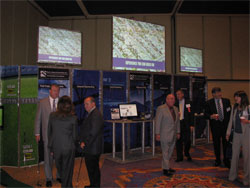 | �
�| Event exhibitors and sponsors contribute to an informative and engaging environment | �
�This year’s meeting was the best yet for the industry-leading construction defect and claims event.
�This year’s seminar concluded on May 13, 2011 with the Construction Defect Community Charitable Foundation Golf Tournament, held at Strawberry Farms Golf Course.
�The Disneyland Hotel in Anaheim, California was the place where more than 1,500 attendees convened for two days of professional development activities and seminars that included CLE workshops and panel discussions of special interest to legal and insurance professionals concerned with construction defect and claims litigation. Key events included “Challenges for Experts in Construction Defect Claims and Litigation,” “Keeping Up with Construction Defect Coverage,” and “Tips for Avoiding the ‘Perfect Storm’ in Handling of Wrap Claims.”
� �  | �
�| Supporting the golf tournament at the 15th hole | �
�This year’s Ollie award was given to George D. Calkins II, Esq. The West Coast Casualty Jerrold S. Oliver Award of Excellence was named in honor of the late Judge Jerrold S. Oliver, and recognizes an individual who is outstanding or has contributed to the betterment of the construction community.
�In addition to being the most comprehensive professional development seminar in the area of construction defects, this year’s seminar was equally valuable as a networking opportunity for members of the industry. People participated in professional development events during the day and then continued networking in the evening at numerous social events. The Lawn Party as well as the legendary Wood, Smith, Henning & Berman events were very well attended. Additional valuable networking events were hosted by a number of industry professionals at the House of Blues, and Tortilla Joe’s.
�As of this writing the 2011, West Coast Casualty's Construction Defect Seminar has applied for or has already received the following continuing education accreditation in the following areas;
�Read the full story…
�For more information about next year’s event, visit West Coast Casualty.
Mobile Home Owners Not a Class in Drainage Lawsuit
March 1, 2012 — CDJ Staff
Comparing it to a “complex construction defect action,” the California Court of Appeals for Orange County has rejected the claims of a group of mobile home owners that they should be certified as a class in their lawsuit against Huntington Shorecliffs Mobilehome Park. The Appeals court sustained the judgment of the lower court. The court issued a decision in the case of Criswell v. MMR Family LLC on January 17, 2012.
�The claims made by the group were that the owners and operators of the mobile home park had known of an “on-going and potentially worsening shallow groundwater condition on the property” and had “exacerbated the problem by changing ‘the configuration and drainage related to the hillside that abuts’ the park.” The homeowners claimed that the class should consist of “any past or current homeowner during the same time frame” who had experienced “the accumulation of mold, fungus, and/or other toxins,” “property damage to his/her mobilehome and/or other property resulting from drainage problems, water seepage, water accumulation, moisture build-up, mold, fungus, and/or other toxins,” emotional distress related to drainage problems or mold, and finally health problems “resulting from exposure to drainage problems, water seepage, water accumulation, moisture build-up, mold, fungus, and/or other toxins, in or around one’s home, lot, or common areas of the park.”
�The lower court concluded that while the limits of the class were identifiable, they failed to constitute a class in other ways. First, the people affected were small enough in number that they could be brought together. They “are not so numerous that it would be impracticable to bring them all before the Court.”
�The court noted that while many of the homeowners would have issues in common, they did not find “a well-defined community of interest among the class members.” The Appeals Court wrote that “the individual issues affecting each mobile home and homeowner will predominate over the common issue of the presence of standing or pooling water in and around the park.” The court noted that each home would be affected differently by water and “the ‘accumulation of mold, fungus, and/or other toxins.’”
�While the court conceded that there would be common issues, such as the “defendants’ alleged concealment of excess moisture conditions and their allegedly negligent roadwork and landscaping,” they noted that “these common issues would be swamped by the swarm of individual determinations of property damage, emotional distress, and personal injury.” The Appeals Court cited an earlier case that ruled against certification “if a class action ‘will splinter into individual trials.’” The court affirmed the judgment of the lower court that they could not proceed as a class.
Read the court’s decision…
David McLain to Speak at the CDLA 2012 Annual Conference
June 19, 2012 — CDJ Staff
The Colorado Dense Lawyers Association will be holding their 2012 Annual Conference from July 26 through the 28, in Crested Butte, Colorado. The CDLA provides benefits to its member defense trial lawyers, including educational and information resources.
David McLain of Higgins, Hopkins, McLain & Roswell, LLC will be joining in a discussion with William J. McConnell, PE of Vertex Engineering on Saturday, July 28. Their topic will be common building code violations alleged in construction defect cases and how to respond to these allegations.
Read the full story…
Court Consolidates Cases and Fees in Soil Construction Defect Case
August 16, 2012 — CDJ Staff
The California Court of Appeals has ruled in Burrow v. JTL Development. JTL Development had appealed a judgement in a construction defect case in which JTL Development and Highland Development were found liable for damage due to homes built on unstable and improperly compacted soil. The two companies were sued by the two sets of homeowners, the Burrows and the Balls, and their cases were consolidated at trial. Each family was awarded $700,000 in damages. This judgement had also been appealed and affirmed by the appeals court. In the current case, an additional $235,800 in cost-of-proof sanctions had been awarded to the two families.
Before the trial, Dale Burrows, Charles Ball, and Laurie Ball “asked JTL and Highland to admit that they ‘approved grading plans’ for the Burrows’ and Balls’ properties; ‘had knowledge that the [properties] contained improperly compacted fill’; ‘had knowledge that the [properties were’ not properly prepared for structures’; and ‘did not provide Plaintiffs with a complete soils report’ prepared by Gorian & Associates.” These were requests 14, 19, 20, and 22. JTL and Highland denied all of these.
At trial, the Burrows and Balls proved that all these were true. JTL and Highland’s geotechnical subcontractor, Gorian & Associates, had “recommended that Highland remove and re-compact the entire tract to a depth of 25 feet.” JTL and Highland did not follow this recommendation, “in order to avoid expense.”
After judgment, the Burrows and Balls moved for $582,587.45 for “attorneys’ fees and costs incurred proving the truth of requests for admission.” JTL and Highland claimed that only Dale Burrows could recover fees, but that also the fees were not recoverable. Joe Lynch of Highland “declared that he always believed the soils under the Burrows and Balls homes were properly compacted.” The Burrows and Balls responded with six identical sets of requests for admissions and the court awarded each of them twenty-five percent of $235,800, with JTL and Highland each responsible for fifty percent.
The appeals court noted that JTL and Highland filed a timely appeal and goes on to notes the four circumstances under which a responding party does not have to pay costs and fees. The court concluded that none of these were met. Instead of waiving the request, JTL and Highland denied the request, stating “without in any manner waiving the foregoing objection, responding party denies the request for admission.”
Nor was the admission “of no substantial importance,” instead the court said that the matters were of “substantial importance,” and the “trial would have been shortened by their admission. Highland and JTL “relied on Gorian when it denied the request,” but the trial court “discredited Lynch’s assertions,” finding that “Highland knew the soil was improperly compacted.”
As all plaintiffs had identical discovery requests, the court rejected the claim that only Dale Burrows was entitled to an award.
Read the court’s decision…
Tacoma Construction Site Uncovers Gravestones
August 11, 2011 — CDJ Staff
The Seattle Times reports that a transit construction project has uncovered about twenty-five gravestones. The area was historically sensitive, as it is in territory once occupied by the Puyallup Tribe. At current report, no human remains have been found and the article cites the project?s archeological consultant as describing the gravestones as “not historically significant.”
Read the full story…
Home Builder Doesn’t See Long Impact from Hurricane
November 7, 2012 — CDJ Staff
No one needs to tell Toll Brothers about the impact of Hurricane Sandy. The Wall Street Journal reports that the home building company lost power as a result of the storm. Martin Connor, the company’s CFO, told the Journal that he did not expect the hurricane to have a big effect on sales. Luckily for the company, many of its large projects are either sufficiently completed to provide shelter or too early in the process to be affected by the storm. “This type of weather event has limited impact on the market. It may move settlements later, and may defer people a weekend or two until they go out shopping. But it doesn’t have a long impact.”
Read the full story…
Preparing for Trial on a Cause of Action for Violation of Civil Code section 895, et seq.�
May 10, 2012 — Samir R. Patel, Esq., Lorber, Greenfield, & Polito, LLP
In 2002, the California Legislature enacted the Right to Repair Act (hereinafter “SB-800”), as codified in Title VII of the Civil Code. As set forth in Civil Code section 895, et seq., SB-800 established a set of standards for residential construction, and provides a statutory protocol to address alleged violations of those standards. SB-800 applies to all new single family homes sold after January 1, 2003, and it created its own cause of action governed completely by its own terms, in that in order to state a cause of action under SB-800, a plaintiff may only allege a violation of the Act. (Civ. Code, § 938.) Under Civil Code sections 896, 897, 943, and 944, the Legislature made it clear that it intended to create a single cause of action for construction defects in homes that fall under the purview of SB-800. By passing SB-800, the Legislature eliminated multiple and often redundant or conflicting causes of action, burdens of proof, statutes of limitations, and types of damages that were common in construction defect actions prior to the enactment of the same.
�Civil Code section 895, et seq. has significantly changed the landscape of construction defect lawsuits. Yet, for years, the only attention given to the statutes focused solely on the codified pre-litigation process that requires plaintiffs and builders to meet and confer regarding defects and attempt a process to repair the alleged defects before litigation is pursued. A major impediment to the implementation of the pre-litigation procedures has often been that the statutes specifically state that the information obtained during the pre-litigation process is admissible at trial. Hence, through use of the pre-litigation process, plaintiffs’ counsel can engage in a builder funded fishing expedition and later use the information obtained to advance their litigation goals. As such, many builders have chosen to opt out of codified pre-litigation process altogether, an option which the builder can elect within their Purchase and Sale Agreements.
�Recently, counsel for builders throughout California have turned their attention to the “exclusive remedy” aspect of SB-800 by seeking, often successfully, to limit plaintiffs to a single cause of action for violation of SB-800. Civil Code section 943 makes clear that a cause of action for violation of SB-800 performance standards is a plaintiff’s sole remedy for a residential construction defect action. Civil Code section 943 states:
�Except as provided in this title, no other cause of action for a claim covered by this title or for damages recoverable under 944 is allowed. (Civ. Code, § 943.) Â
�The question remains: what is the benefit of requiring plaintiffs to trim down their complaint and eliminate their tried and true common law causes of action, and requiring them to pursue only a single cause of action for violation of SB800?
�The construction standards enumerated within SB-800 include fifty-plus functionality standards. On their face, any benefit to pursuing a construction defect action under a single cause of action for violation of SB-800 initially appears trivial at best, in light of the fact that a jury may be very confused with the complexity of the functionality standards set forth within the Civil Code. Nevertheless, Title VII of the Civil Code actually contains numerous provisions that builders can utilize to their benefit throughout the process of construction defect litigation, including during preparation for trial.
�First and foremost, counsel for builders can assert numerous affirmative defenses that will be beneficial if the matter proceeds to trial. These affirmative defenses, as codified in Civil Code section 945.5, include mitigation, in whole or in part, for damages caused by: an unforeseen act of nature; a homeowner’s failure to allow reasonable and timely access for inspections and repair under the pre-litigation procedures; the homeowner’s failure to follow the builder’s recommendations and commonly accepted homeowner maintenance obligations; ordinary wear and tear; misuse; abuse; or neglect. Builders should include these affirmative defenses within their responsive pleadings and as trial approaches, prepare appropriate motions in limine and request special jury instructions regarding the same. As frustrated builders and their attorneys are well aware, many construction defect suits result from a homeowner’s failure to properly maintain their property in a manner that is consistent with normal maintenance procedures and guidelines. Furthermore, within the ten year statute of limitations for most defects, ordinary wear and tear is often attributable to numerous deficiencies alleged by plaintiffs. The affirmative defense for a homeowner’s failure to allow inspections and repairs is also vital, as plaintiffs’ counsel may encourage a homeowner to forego the repair and seek monetary damages, allowing plaintiffs’ counsel to ultimately obtain their share of attorney’s fees. Therefore, the SB-800 statutes provide the builder with recourse and distinctive mitigation defenses that were previously and confusingly mixed into tort and contract related defenses. These affirmative defenses can also be utilized by counsel during the cross-examination of plaintiff homeowners and expert witnesses. Defense counsel should fully grasp these defenses and utilize them as defense themes throughout litigation.
�As a plaintiff is limited to a single cause of action for violation of SB-800, if defense counsel has failed to properly eliminate excessive tort and contract causes of action prior to trial, a motion for summary adjudication, or at the very least, a motion for judgment on the pleadings should be brought to limit the introduction of evidence outside of a single cause of action for violation of SB-800. Practical judges are always looking for ways to streamline and expedite trials, and they are currently ruling that SB-800 is the exclusive remedy available to plaintiffs. In fact, plaintiffs’ firms in SB-800 matters are now voluntarily limiting their complaints to this one cause of action.
�Special jury instructions can also be crafted to limit a jury’s computation of damages pursuant to Civil Codesection 944, which provides the method for computing damages within a construction defect action, as follows:
�If a claim for damages is made under this title, the homeowner is only entitled to damages for the reasonable value of repairing any violation of the standards set forth in this title, the reasonable cost of repairing any damages caused by the repair efforts, the reasonable cost of repairing and rectifying any damages resulting from the failure of the home to meet the standards, the reasonable cost of removing and replacing any improper repair by the builder, reasonable relocation and storage expenses, lost business income if the home was used as a principal place of a business licensed to be operated from the home, reasonable investigative costs for each established violation, and all other costs or fees recoverable by contract or statute. (Civ. Code, § 944.) [Emphasis added.]
�Civil Code section 944 specifically prohibits recovery for damages outside the scope of its explicit language as it states “the homeowner is only entitled to ... damages for the reasonable value of repairing any violation of the standards set forth in this title....” [Emphasis added.] The statute ultimately provides a “reasonableness” standard for the computation of damages that did not exist when computing damages on traditional common law tort and contract claims. Therefore, defense counsel should prepare special jury instructions to limit evidence of damages introduced at trial to the reasonable value of repairing any violation of the standards, and to exclude any evidence of damages beyond the reasonableness standard. Defense counsel should seize the opportunity to utilize the theme of “reasonableness” when attacking plaintiffs’ allegations and plaintiffs’ proposed repair methodology throughout the discovery process and at trial.
�Defense counsel may also prepare a motion in limine or special jury instruction regarding the limitation of evidence regarding defects that did not cause resultant damage. Civil Code section 897 states:
�Intent of Standards
�The standards set forth in this chapter are intended to address every function or component of a structure. To the extent that a function or component of a structure is not addressed by these standards, it shall be actionable if it causes damage. (Civ. Code, § 897.) [Emphasis added.]
�Defense counsel can argue that the introduction of any evidence supporting a claim for construction-related deficiencies that are not enumerated within Civil Code section 896, or for deficiencies where no damage has occurred is prohibited and must be excluded at trial. This requirement of resultant damages is familiar as the general rule was previously established in Aas v. Superior Court (2000) 24 Cal.4th 627, in which the California Supreme Court held that there is no tort recovery for construction defects that have not actually caused property damage. The legislature effectively codified this rule within Civil Code section 897.
�A motion in limine can also be crafted to limit expert testimony to the standards enumerated in Civil Code section 896, and to deficiencies that caused damage pursuant to Civil Code 897. The motion in limine can be based upon Civil Code section 943 and the fact that claims for defects in homes which were sold after January 1, 2003 may only be pursued under a single cause of action for violation of SB-800. As such, expert testimony should be controlled by the standards set forth in Civil Code section 896. Furthermore, throughout a construction defect matter, defense counsel should ensure that their experts are well versed with the standards and that they can provide testimony that utilizes the same. Defense counsel’s knowledge of the standards will also be helpful during the cross-examination of plaintiffs’ expert witnesses.
�If, despite the efforts of defense counsel, the complaint still has numerous causes of action, or if only some homes fall under the purview of SB-800 while others do not, defense counsel can utilize a motion to bifurcate trial. The motion’s basis is that a cause of action for violation of SB-800 will require the introduction of evidence regarding the violations of the fifty-plus standards, and the tort and contract-based claims would also require the introduction of a wide range of evidence to prove each cause of action. For example, in order to prove the tort causes of action, plaintiffs must prove elements such as: duty, breach, proximate and actual causation, and that the builder placed the homes into the stream of commerce. (See Richards v. Stanley (1954) 43 Cal.2d 60, 63; Kriegler v. Eichler Homes, Inc. (1969) 269 Cal.App.2d 224, 227.) On the contract causes of action, plaintiffs must prove the existence of a valid written contract for the sale of the home, including proof regarding the existence of basic contractual elements such as offer, acceptance, and consideration. (Civ. Code, § 1624 subd. (a); Roth v. Malson (1997) 67 Cal.App.4th 552, 557.) Defense counsel can argue that exposing the jury to elements that may or may not be applicable to all of the homes in the action will complicate and confuse the jury. Thus, concurrently exposing the jury to the SB-800 claims and the non-SB-800 claims will necessitate undue consumption of time, and create the substantial danger of undue prejudice of confusing the issues or misleading the jury.
�One of the most important and relevant features of the SB-800 statutes is that they include shortened statutes of limitation as to certain enumerated defects. The codified statutes of limitations apply from the date of “close of escrow,” and are much more definitive than statutes of limitations regarding tort and contract claims. Therefore, they can be utilized within a motion for summary adjudication in cases where only one or a few defects are alleged. For example, under Civil Code section 896, et seq., there is a five year limitation on paint (Civ. Code, § 896, subd. (g)(1)); a four year limitation on plumbing fixtures (Civ. Code, § 896, subd. (e)); a three year limitation on landscaping (Civ. Code § 896, subd. (g)(12)); and a one year limitation on irrigation systems and drainage (Civ. Code, § 896, subd. (g)(7)). The non-SB-800 claims are subject to a four year statute of limitation for patent defects and a ten year statute of limitation for latent defects. (See Code of Civ. Proc., §§ 337.1, 337.15.) The contrast between the statute of limitations for the SB-800 claims and non-SB-800 claims can complicate a matter at trial, further establishing the necessity to limit plaintiffs to a single cause of action for violation of SB-800. Hence, defense counsel should also utilize a motion to bifurcate the statute of limitations issues from the issue of liability if a question of fact exists. If successful on the motion to bifurcate, plaintiff’s counsel will be barred from the introducing evidence at trial regarding a defect where the statute of limitations has run.
�Defense counsel should also seek to simplify the construction standards for the jury. Ultimately, by drafting jury instructions and a special verdict form that is easy to navigate, counsel can promote an easy interpretation of the standards enumerated within the Civil Code. The best route for drafting a special verdict form is to draft it as a check-list, similar to a traditional real estate walk-through check-list. By incorporating the shortened statutes of limitations into the special verdict form, defense counsel can effectively frame the case for the jury. The special verdict form should also allow the jury to easily eliminate any claim for damages that is mitigated, in whole or in part, through the codified affirmative defenses. Defense counsel should also consider drafting a trial brief that effectively and simplistically provides the trial court judge with an understanding of the specific defects before the court, and simultaneously notes which Civil Code standards are implicated and the scope of the same. If the trial judge is not well versed in construction defect litigation, defense counsel should be all the more careful in breaking down the parameters and limitations codified within SB-800 for the court.
�The strategies outlined within this article are only a few tactics that can be utilized to defend a construction defect suit. Depending on the defect allegations within any particular case, defense counsel should become intimately familiar with Title VII of the Civil Code and use all aspects of the same to their advantage. If not, plaintiffs’ counsel will have the advantage during “court-house step” settlement discussions and at trial.
� Printed courtesy of Samir R. Patel, Esq. of Lorber, Greenfield, & Polito, LLP. Mr. Patel can be contacted at spatel@lorberlaw.com.
�
Florida “get to” costs do not constitute damages because of “property damage”
August 11, 2011 — CDCoverage.com
In Palm Beach Grading, Inc. v. Nautilus Ins. Co., No. 10-12821 (11th Cir. July 14, 2011), claimant general contractor Palm Beach Grading (?PBG?) subcontracted with insured A-1 for construction of a sewer line for the project.  A-1 abandoned its work and PBG hired another subcontractor to complete construction of the sewer line.  The new subcontractor discovered that A-1?s work was defective requiring repair and replacement of portions of the sewer line which also required the destruction and replacement of surrounding work.�
Read the full story…
Reprinted courtesy of CDCoverage.com
Water Is the Enemy
August 16, 2012 — CDJ Staff
So says Melissa Mitchell, writing in the blog of Community Association Consultants. She cites the nightmare scenario of “an unseen presence lurking behind the walls.” Not a horror movie, but water intrusion, which she notes can cause hundreds of thousands of dollars in damage. Eric Hoff, of Western Architectural, is quoted that “it only takes a hole one-eighth inch diameter in a building’s exterior to allow the intrusion of 35 gallons of water over twelve months.” Destructive testing on a building in in the Pacific Northwest revealed that water intrusion had lead to structural failure of the building. The wet wood had made a home for carpenter ants. Repairs exceeded $100,000.
Mitchell notes that “deferred maintenance can be costly” and cites the importance of preventative maintenance or the development of a maintenance plan. She concludes that “if you own or are responsible for maintaining a condominium complex, apartment building or commercial structure, it’s simply good business sense to have a building envelope assessment conducted by experts in the field.”
Read the full story…
No Coverage Under Ensuing Loss Provision
September 9, 2011 — Tred Eyerley, Construction Law Hawaii
The cost of removing and replacing cracked flanges to prevent future leakage was not covered as an ensuing loss under a builder’s risk policy in RK Mechanical, Inc. v. Travelers Prop. Casualty Co. of Am., 2011 U.S. Dist. LEXIS 83958 (D. Colo. Aug. 1, 2011).
The insured, RK Mechanical Inc., was a subcontractor hired to install plumbing for a residential construction project. RK was an additional insured on the general contractor’s policy with Travelers. RK installed approximately 170 CPVC flanges on the project. Subsequently, two of the flanges cracked, allowing water to overflow and causing water damage to the project. Travelers was notified of the flange failure and resulting water damage.
RK subsequently removed and replaced the two cracked flanges and began water remediation. Travelers paid for the cost of the water damage due to the cracked flanges.
RK then examined all of the flanges installed in the project and discovered many were cracked and/or showed signs of potential failure. RK removed and replaced the cracked flanges. RK tendered a claim and demand for indemnity to Travelers for these repair costs. Travelers denied the claim. RK then sued for breach of contract and declaratory relief. The parties filed cross motions for summary judgment.
Read the full story…
Reprinted courtesy of Tred R. Eyerly, Insurance Law Hawaii. Mr. Eyerly can be contacted at te@hawaiilawyer.com
Home Sales Still Low, But Enough to Spur Homebuilders
August 16, 2012 — CDJ Staff
Although new home sales are still fifty percent below the average over the last forty years, the housing rebound has sent stock of homebuilders up 53 percent this year, during the same period, the S&P 500 rose only 12 percent. The San Francisco Chronicle reports that from 2005 through 2011, homebuilder stocks trailed the S&P 500.
The growth isn’t limited to homebuilders alone. Building suppliers are also seeing a growth in sales, with profits for companies that make gypsum wallboard, cabinetry, plumbing products, and other items used in home building.
Homebuilders have also been able to raise prices. Standard Pacific Corp of Irvine, California has raised prices and cut incentives. Nevertheless, the buyers still come. PulteGroup and D.R. Horton are also raising prices.
Read the full story…
Illinois Court Determines Insurer Must Defend Negligent Misrepresentation Claim
December 9, 2011 — Tred R. Eyerly, Insurance Law Hawaii
Although the insureds disclosed flooding problems in the basement, the buyers purchased their home. USAA Cas. Ins. Co. v. McInerney, 2011 Ill. App. LEXIS 1130 (Ill Ct. App. Oct. 31, 2011). In a supplemental disclosure, the insureds reported that during heavy rains light seepage occurred in the basement.
After moving in, the buyers experienced significant water infiltration and flooding in the basement. The buyers and their children also began to experience mold-related illnesses.
The buyers sued for rescission of the contract or, in the alternative, damages. They alleged breach of contract, fraudulent misrepresentation and negligent misrepresentation. In the claim for negligent misrepresentation, the buyers alleged that the insureds carelessly omitted the fact that there were material defects in the basement and foundation when they should have known of such defects.
Read the full story…
Reprinted courtesy of Tred R. Eyerly, Insurance Law Hawaii. Mr. Eyerly can be contacted at te@hawaiilawyer.com
Construction Defect Journal Marks First Anniversary
January 6, 2012 — CDJ Staff
November 2011 marked the first anniversary of the Construction Defect Journal. During the first year our staff and contributors in the insurance and legal communities have compiled several hundred articles of interest to the construction defect and claims community.
Each of these articles are maintained in the CDJ archives, and are accessible at http://www.constructiondefectjournal.com/archives.html. Each story in the archives is listed in the order it was posted to the archives. Each story in the archives opens up in its own page, so you can easily locate topics and articles of interest.
If you’re new to Construction Defect Journal, or just want peruse past articles, please take a moment to visit the CDJ Archives page. Also please feel encouraged to submit your firm’s articles or legal publications of interest to the CD community at http://www.constructiondefectjournal.com/submitStory.html.