Although the court determined there was an occurrence, coverage was excluded by the business risk exclusions. See Cont’l W. Ins. Co. v. Shay Constr. Co., 2011 U.S. Dist. LEXIS 82839 (D. Colo. July 28, 2011).
White was the general contractor on the project. White had three subcontracts with Shay to provide framing, siding, and related work on the project. Shay was insured under a CGL policy issued by Continental Western.
Two of Shay’s subcontractors furnished materials, labor and equipment to Shay. These subcontractors filed suit in state court alleging they had not been compensated for the work and materials. White and Shay were named as defendants. White cross claimed against Shay, alleging Shay had breached its obligations under the subcontracts. Several allegations sounded in contract. Other allegations, however, contended Shay had performed defective work and had damaged the work of other trades in correcting deficiencies in its own performance.
Shay sought coverage under Continental Western’s policy. Continental Western filed suit for a declaratory judgment and moved for summary judgment.
Coverage of the ongoing litigation concerning the Harmon Hotel continues to proliferate. Architectural Record and a number of other news outlets continue to provide additional details and coverage of the matter. Chief among the conditions alleged are improperly installed reinforcing steel inside link beams on 15 floors. MGM Claims that the conditions amount to hundreds of millions of dollars in damages, while Perini (the builder) indicated in a July 12th statement that the buildings problems are related to the design, and the they are “fixable.”
�There is significant speculation that MGM Resorts International isn’t interested in repairing the hotel due to a glut of hotel rooms attendant to the troubled economy. In a statement Tuesday Perini reportedly stated that “Repairing and opening the Harmon would only create a greater glut of unused hotel rooms for MGM,” “If market conditions were better and MGM found that demand existed for the Harmon hotel rooms, MGM would not be claiming that the Harmon is unstable.”
�MGM asserts that Perini failed to ”properly construct” the project. Clark County’s Department of Development Services has reportedly asked MGM to provide a plan to fix the project by August 15th.
�The Harmon is part of the $8.5 billion CityCenter project that opened in the fourth quarter of 2009 and is jointly owned by MGM Resorts and Dubai World.
�Prior reports indicated that the owner (MGM) had considered razing the entire project. The future of the project remains uncertain.
Condominium Communities Must Complete Construction Defect Repairs, Says FHA
July 10, 2012 — CDJ Staff
Laura K. Sanchez of HindmanSanchez writes that the FHA “will not approve or recertify” any condominium community “where there are any pending or incomplete repairs within the community which are a result of a construction defect claim, regardless of whether the litigation has been resolved and regardless of whether there are funds in the bank paid by the developer to pay for the repairs.” The FHA notes that failure to complete or fund repairs could “put FHA insured loans at risk.” Communities must disclose all maintenance and repair issues to the FHA. Sanchez notes that the FHA has stated that incomplete repairs could put FHA-insured loans at risk.
Read the full story…
2011 West Coast Casualty Construction Defect Seminar – Recap
June 1, 2011 — CDJ Staff
� 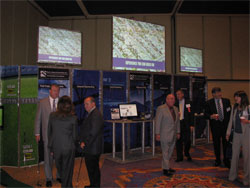 | �
�| Event exhibitors and sponsors contribute to an informative and engaging environment | �
�This year’s meeting was the best yet for the industry-leading construction defect and claims event.
�This year’s seminar concluded on May 13, 2011 with the Construction Defect Community Charitable Foundation Golf Tournament, held at Strawberry Farms Golf Course.
�The Disneyland Hotel in Anaheim, California was the place where more than 1,500 attendees convened for two days of professional development activities and seminars that included CLE workshops and panel discussions of special interest to legal and insurance professionals concerned with construction defect and claims litigation. Key events included “Challenges for Experts in Construction Defect Claims and Litigation,” “Keeping Up with Construction Defect Coverage,” and “Tips for Avoiding the ‘Perfect Storm’ in Handling of Wrap Claims.”
� �  | �
�| Supporting the golf tournament at the 15th hole | �
�This year’s Ollie award was given to George D. Calkins II, Esq. The West Coast Casualty Jerrold S. Oliver Award of Excellence was named in honor of the late Judge Jerrold S. Oliver, and recognizes an individual who is outstanding or has contributed to the betterment of the construction community.
�In addition to being the most comprehensive professional development seminar in the area of construction defects, this year’s seminar was equally valuable as a networking opportunity for members of the industry. People participated in professional development events during the day and then continued networking in the evening at numerous social events. The Lawn Party as well as the legendary Wood, Smith, Henning & Berman events were very well attended. Additional valuable networking events were hosted by a number of industry professionals at the House of Blues, and Tortilla Joe’s.
�As of this writing the 2011, West Coast Casualty's Construction Defect Seminar has applied for or has already received the following continuing education accreditation in the following areas;
�Read the full story…
�For more information about next year’s event, visit West Coast Casualty.
There is No Non-Delegable Duty on the Part of Residential Builders in Colorado
August 2, 2012 — Brady Iandiorio, Higgins, Hopkins, McLain & Roswell, LLC
Recently, in the Arapahoe District Court, the Honorable Michael Spear, issued an order holding that builders do not owe a non-delegable duty to homeowners. In Marx and Corken v. Alpert Custom Homes, Inc., et al., Judge Spear’s order came in response to plaintiffs’ motion for determination of question of law seeking a finding that the defendants owed a non-delegable duty to the plaintiffs and thus, to strike defendants’ designation of nonparties at fault. After being fully briefed, Judge Spear, found that such a non-delegable duty does not exist.
The case arises from the construction of a single-family residence in Aurora, Colorado. Through the construction and interaction with Alpert Custom Homes, Inc. and Scott and Sally Alpert, the defendants, Paul Marx and Kay Corken, the plaintiffs claimed they suffered various damages and losses, and brought claims for breach of contract-warranty, breach of contract, violation of the Colorado Consumer Protection Act, breaches of the implied covenant of good faith, promissory estoppel, willful breach of contract, and quantum meruit. During litigation, the defendants filed a designation of nonparties at fault, which named several parties which were at fault for the alleged construction defects at issue in the case. The pertinent nonparties named were subcontractors of defendant Alpert Custom Homes, Inc. during the construction of the residence.
Read the full story…
Reprinted courtesy of Brady Iandiorio, Higgins, Hopkins, McLain & Roswell, LLC. Mr. Iandiorio can be contacted at iandiorio@hhmrlaw.com
Late Filing Contractor Barred from Involving Subcontractors in Construction Defect Claim
March 1, 2012 — CDJ Staff
The Colorado Court of Appeals looked at that state’s Construction Defect Action Reform Act in determining if a general contractor could add subcontractors as third-party defendants to a construction defect lawsuit. Shaw Construction, LLC was the general contraction of the Roslyn Court condominium complex, and was sued by the homeowners’ association in a construction defect case. United Builder Services was the drywall subcontractor on the project. MB Roofing had installed roofs, gutters, and downspouts. The certificate of occupancy for the last building was issued on March 10, 2004. The project architect certified completion of all known remaining architectural items in June, 2004.
�The HOA filed a claim against the developers of the property on January, 21, 2009. A week later, the HOA amended its complaint to add Shaw, the general contractor. Shaw did not file its answer and third-party complaint until March 29, 2010, sending its notice of claim under the CDARA on March 30.
�The subcontractors claimed that the six-year statute of limitations had ended twenty days prior. Shaw claimed that the statute of limitations ran until six years after the architect’s certification, or that the HOA’s suit had tolled all claims.
�The trial court granted summary judgment to the subcontractors, determining that “substantial completion occurs ‘when an improvement to real property achieves a degree of completion at which the owner can conveniently utilize the improvement of the purpose it was intended.’”
�The appeals court noted that “Shaw correctly points out that the CDARA does not define ‘substantial completion.’” The court argued that Shaw’s interpretation went against the history and intent of the measure. “Historically, a construction professional who received a complaint responded by ‘cross-nam[ing] or add[ing] everybody and anybody who had a part to play in the construction chain.’” The court concluded that the intent of the act was to prevent unnamed subcontractors from being tolled.
�The court further rejected Shaw’s reliance on the date of the architect’s certification as the time of “substantial completion,” instead agreeing with the trial court that “the architect’s letter on which Shaw relies certified total completion.”
�The appeals court upheld the trial court’s determination that the statute of limitation began to run no later than March 10, 2004 and that Shaw’s complaint of March 29, 2010 was therefore barred. The summary judgment was upheld.
Read the court’s decision…
Insurer Has Duty to Defend in Water Intrusion Case
July 10, 2012 — CDJ Staff
The Seventh Circuit Court of Appeals has upheld a summary judgment against an insurance company in a construction defect suit. Lagestee-Mulder, Incorporated (LMI) was hired by Crown Centre to construct a multi-story office building in Franfort, Illinois. LMI hired Frontrunner Glass & Metal to supply and install windows and doors. Frontrunner purchased an insurance policy from Consolidated which named LMI as an additional insured. The project experienced water intrusion and other construction defects and Crown sued LMI. Consolidated denied coverage. LMI sued Consolidated and the US District Court granted a summary judgment against Consolidated.
The appeals court reviewed the grounds for summary judgment and determined that under Illinois law, Consolidated had a duty to defend. The court cited an earlier opinion that “if the underlying compliant alleges facts within or potentially within policy coverage, an insurer is obligated to defend its insured even if the allegations are groundless, false, or fraudulent.”
Read the court’s decision…
Ghost Employees Steal Jobs from Legit Construction Firms
September 13, 2012 — CDJ Staff
Firms that skirt labor laws for construction workers can undercut firms that are obeying those laws. In a piece in Raleigh, North Carolina’s News & Observer, Doug Burton, a commercial masonry contractor summed it up: “my competitors are cheating.” The article describes the low-bidding firms “called their workers independent contractors ? or treated them like ghosts, paid under the table and never acknowledged.” The cost to the state is “unpaid medical bills for injured workers, uncollected business and personal taxes, and payments not made to a depleted state unemployment reserve.”
�One firm examined in the article, Martin’s Bricklaying, employs mostly immigrant Mexican laborers, many of whom are in the country illegally. One employee told the News & Observer, “we don’t complain.”
Read the full story…
Coverage Rejected Under Owned Property and Alienated Property Exclusions
June 6, 2011 —
Tred R. Eyerly,
Insurance Law HawaiiThe insured’s request for a defense when sued in a construction defect action was denied under the owned property exclusion and the alienated property exclusion in1777 Lafayette Partners v. Golden Gate Ins. Co., 2011 U.S. Dist. LEXIS 48562 (N.D. Cal. April 29, 2011).
�In 1999, Lafayette Partners purchased an abandoned walnut processing factory to convert into living and working units. The property was developed into a rental property from 2000-2001, and thereafter rented. In May 2003, Lafayette Partners entered into a sales agreement with Wolff Enterprises LLC. The sale closed in February 2005. Wolff then converted the rental units into condominiums.
�In December 2007, the Walnut Factory Owners Association sued Wolff for construction defects. In Lafayette Partners was added to the suit in 2009. The suit alleged a variety of defective conditions, including the roofs, exteriors, windows, electrical , plumbing, and mechanical components and systems.
�Read the full story…
� � �Reprinted courtesy of Tred R. Eyerly, Insurance Law Hawaii. Mr. Eyerly can be contacted at te@hawaiilawyer.com
Ensuing Loss Provision Does Not Salvage Coverage�
October 23, 2012 — Tred Eyerly, Insurance Law Hawaii
The insureds' home was built in 1989. In 2006, extensive water damage was found to the house. The insureds notified their carrier, Chubb. The insureds had coverage for all risks unless stated otherwise in the policy or if an exclusion applied.
�Chubb hired an adjustor who determined that defective construction had enabled water to enter the wall and beam systems. Chubb denied coverage under the faulty planning, construction or maintenance exclusion.
� Read the full story…
��Reprinted courtesy of Tred R. Eyerly, Insurance Law Hawaii. Mr. Eyerly can be contacted at te@hawaiilawyer.com
��
Faulty Workmanship Exclusion Does Not Bar Coverage
November 18, 2011 — Tred Eyerley, Insurance Law Hawaii
The court determined that the Faulty Workmanship Exclusion only barred coverage for damages arising from problems with the property under construction itself and not to losses incurred to correct damage from accidents during construction. See 1756 First Associates, LLC v. Continental Casualty Co., 2011 U.S. Dist. LEXIS 117100 (S.D.N.Y. Oct. 3, 2011).
A tower crane collapsed at the construction site, causing damage. First Associates tendered the claim to its insurer, Continental. Continental reimbursed First Associates for certain costs arising from damage to and cleanup of the construction site and building stemming from the crane collapse. Continental refused, however, to reimburse First Associates for costs associated with construction delays resulting from the collapse.
Read the full story…
Reprinted courtesy of Tred R. Eyerly, Insurance Law Hawaii. Mr. Eyerly can be contacted at te@hawaiilawyer.com
Allowing the Use of a General Verdict Form in a Construction Defect Case Could Subject Your Client to Prejudgment Interest
August 2, 2012 — Heather Anderson, Higgins, Hopkins, McLain & Roswell, LLC
A recent opinion from the Colorado Court of Appeals is a cautionary tale concerning the calculation of pre-judgment interest. See Hendricks v. Allied Waste Transportation, Inc., 2012 WL 1881004 (Colo. App. 2012). The Hendricks sued Allied after one of its drivers backed into the corner of their home with an Allied garbage truck. At trial, a jury awarded the Hendricks $160,100 in damages. Although the jury was instructed on the cost of repairs, diminution in value, and non-economic damages, the parties agreed to a general verdict form that did not ask the jury to specify the types of damages awarded. The Hendricks sought to amend the judgment to include prejudgment interest and costs, which the trial court granted.
Allied appealed, arguing that the trial court erred by awarding the Hendricks prejudgment interest from the date their property was damaged. Id. at *7. The Colorado Court of Appeals found no error, and affirmed.
Read the full story…
Reprinted courtesy of Heather Anderson, Higgins, Hopkins, McLain & Roswell, LLC. Ms. Anderson can be contacted at anderson@hhmrlaw.com
Construction Defect Notice in the Mailbox? Respond Appropriately
August 4, 2011 — Douglas Reiser, Builders Counsel
Recently, I have seen a rash of ignored construction defect notices. What is a construction defect notice? It’s a statutorily required notice, sent from a homeowner to a contractor, listing a number of defects found at their property. If you get one, don’t ignore it.
�The Revised Code of Washington includes a number of provisions intended for residential construction disputes. Among them is the “Notice to Customer” requirement in RCW 18.27.114, which can preempt a contractor’s lien rights, and the “Notice of Construction Defects” found in RCW 64.50.020.
�The Notice of Construction Defects is a standard notice mandated by RCW 64.50, a chapter in the Revised Code of Washington, intended to provide a pre-litigation resolution process for contractors and consumers. The chapter applies only to those losses “caused by a defect in the construction of a residence or in the substantial remodel of a residence.”(See “Action” RCW 64.50.010).
�Unfortunately, many contractors will simply ignore these notices or tell the homeowner to make a warranty claim. But, the notice actually provides a contractor with a forty-five (45) day window to alleviate the dispute.
� Read the full story…
� Reprinted courtesy of Douglas Reiser of Reiser Legal LLC. Mr. Reiser can be contacted at info@reiserlegal.com
A Performance-Based Energy Code in Seattle: Will It Save Existing Buildings?
August 11, 2011 — Douglas Reiser, Builders Counsel
The City of Seattle has one of the most stringent energy codes in the nation. Based upon the Washington State Energy Code (which has been embroiled in litigation over its high standards), the code demands a lot from commercial developers. But, does it prevent developers from saving Seattle?s classic and old buildings? Perhaps.
�The general compliance procedure requires buildings to be examined during the permitting process. This means that buildings are examined before they begin operating. The procedure is not malleable and is applicable to all buildings, old and new, big and small.
�The downside of this procedure is that it eliminates awarding compliance to those buildings exhibiting a number of passive features, such as siting, thermal mass, and renewable energy production. This problem has prevented a number of interesting and architecturally pleasing existing building retrofits from getting off the ground. The cost of complying with the current system can be 20% more, and it might prevent builders from preserving a building?s historical integrity.
Read the full story…
�Reprinted courtesy of Douglas Reiser of Reiser Legal LLC. Mr. Reiser can be contacted at info@reiserlegal.com
Harmon Towers Case to Last into 2014
December 20, 2012 — CDJ Staff
Don’t expect a fast resolution to the Harmon Tower case in Las Vegas. The latest schedule sets trial for the construction defect claims in January 2014. Previously, these claims were going to be heard during the trial set to start in June 2013. Now the June trial will be over payment issues only.
Don’t expect the building to come down soon either. While CityCenter claims the building could come down in an earthquake, Judge Elizabeth Gonzalez had determined that as the structural testing was not random; its results cannot be extrapolated through the entire structure. As a result, CityCenter has elected to do more testing, holding off on demolishing the building. They are appealing Gonzalez’s order to the Nevada Supreme Court.
Read the full story…
No Coverage Under Ensuing Loss Provision
September 9, 2011 — Tred Eyerley, Construction Law Hawaii
The cost of removing and replacing cracked flanges to prevent future leakage was not covered as an ensuing loss under a builder’s risk policy in RK Mechanical, Inc. v. Travelers Prop. Casualty Co. of Am., 2011 U.S. Dist. LEXIS 83958 (D. Colo. Aug. 1, 2011).
The insured, RK Mechanical Inc., was a subcontractor hired to install plumbing for a residential construction project. RK was an additional insured on the general contractor’s policy with Travelers. RK installed approximately 170 CPVC flanges on the project. Subsequently, two of the flanges cracked, allowing water to overflow and causing water damage to the project. Travelers was notified of the flange failure and resulting water damage.
RK subsequently removed and replaced the two cracked flanges and began water remediation. Travelers paid for the cost of the water damage due to the cracked flanges.
RK then examined all of the flanges installed in the project and discovered many were cracked and/or showed signs of potential failure. RK removed and replaced the cracked flanges. RK tendered a claim and demand for indemnity to Travelers for these repair costs. Travelers denied the claim. RK then sued for breach of contract and declaratory relief. The parties filed cross motions for summary judgment.
Read the full story…
Reprinted courtesy of Tred R. Eyerly, Insurance Law Hawaii. Mr. Eyerly can be contacted at te@hawaiilawyer.com
Supreme Court of Oregon Affirms Decision in Abraham v. T. Henry Construction, et al.
April 20, 2011 — April 20, 2011 Beverley BevenFlorez - Construction Defect Journal
After reviewing the decision in Abraham v. T. Henry Construction, et al., the Oregon Supreme Court affirmed that a tort claim for property damage arising from construction defects may exist even when the homeowner and the builder are in a contractual relationship.
�When the case was initially filed, the plaintiffs alleged breach of contract and negligence. The defendants moved for summary judgment arguing that one, the claim was barred by the six-year statute of limitations and two, no special relationship (such as one between a doctor and patient) existed. The court agreed with the defendants. However, the Court of Appeals while affirming the trial court’s decision on breach of contract reversed the decision on negligence. The Court of Appeals stated that an administrative or statute rule could establish a standard of care independent from the contract.
�The Oregon Supreme Court gave an example of cases where a tort claim could exist when a contract is present: “If an individual and a contractor enter into a contract to build a house, which provides that the contractor will install only copper pipe, but the contractor installs PVC pipe instead (assuming both kinds of pipe comply with the building code and the use of either would be consistent with the standard of care expected of contractors), that failure would be a breach of contract only. […] If the failure to install the copper pipe caused a reduction in the value of the house, the plaintiff would be able to recover that amount in an action for breach of contract. […] On the other hand, if the contractor installed the PVC pipe in a defective manner and those pipes therefore leaked, causing property damage to the house, the homeowner would have claims in both contract and tort. […] In those circumstances, the obligation to install copper instead of PVC pipe is purely contractual; the manner of installing the pipe, however, implicates both contract and tort because of the foreseeable risk of property damage that can result from improperly installed pipes.”
�Read the court’s decision…
Discovery Ordered in Nevada Construction Defect Lawsuit
August 16, 2012 — CDJ Staff
Gemstone LVS was sued by the Manhattan Homeowners Association in Las Vegas, after which Chartis Specialty Insurance informed Gemstone that they “had no duty to defend or indemnify Gemstone under the Commercial Umbrella Liability Policy.” Gemstone “asserts that at the time the Policy was purchased, it was understood that Chartis would provide insurance coverage for a construction defect lawsuit” and now seeks discovery “to prove Chartis’ bad faith purpose in drafting an illusory Policy.”
The opinion notes that “the Court conducted a preliminary peek at the pending motion for partial summary judgment and finds that Chartis has not made the strong showing necessary to support the requested stay.” Further, the court notes that “when ambiguity in the language of a policy exists, the court may consider not only the language of the policy but also the ‘intent of the parties, the subject matter of the policy, and the circumstances surrounding its issuance.’” The court concludes that “this type of discovery is relevant to understanding the intent of the parties, more specifically, whether it was understood that Chartis would provide insurance coverage given the construction defect lawsuit.”
Accordingly, the court denied Chartis’ motion for stay of discovery and established a schedule for discovery, expert designations, rebuttal expert designations, and other matters related to the trial.
Read the court’s decision…