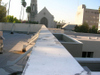
Vegas Hi-Rise Not Earthquake Safe
July 12, 2011 — CDJ Staff
If an earthquake hit Las Vegas, the Harmon Tower would not withstand it. A report from Weidlinger Associates told MGM Resorts that “in a code-level earthquake, using either the permitted or current code specified loads, it is likely that critical structural members in the tower will fail and become incapable of supporting gravity loads, leading to a partial or complete collapse of the tower.” The inspection came at the request of county officials, according to the article in Forbes.
�According to Ronald Lynn, directory of the building division in the county’s development services division, “these deficiencies, in their current state, make the building uninhabitable.” The county is concerned about risks to adjacent buildings.
�MGM Resorts is currently in litigation, separate from the stability issues, with Perini Corp., the builders of Harmon Tower.
� Read the full story…
Landmark San Diego Hotel Settles Defects Suit for $6.4 Million
March 4, 2011 — April 4, 2011 Beverley BevenFlorez - Construction Defect Journal
After five years of legal battles, the condo owners of the El Cortez Hotel building in downtown San Diego settled for $6.4 million, as reported by The San Diego Union-Tribune on March 28, 2011. The Homeowners Association will net just over $3 million from the settlement.
�The litigation may have had an adverse effect on the value of the condos within the El Cortez Hotel building. According to an article by Kelly Bennett of Voice of San Diego, “Many condos in the building originally sold for more than $600,000. Currently, the three units on the market are asking for just more than $200,000, the U-T said.”
�Andrew Berman, the owners’ attorney, told The San Diego Union-Tribune that the five years of litigation included six lawsuits, 200 depositions, and multiple construction tests.
�Read the full story... (San Diego Union Tribune)
�Read the full story... (Voice of San Diego)
Yellow Brass Fittings Play a Crucial Role in Baker v Castle & Cooke Homes�
May 10, 2012 — CDJ Staff
Baker v Castle & Cooke Homes Hawaii, et al. is a “class action filed by homeowners who allege that their homes have a construction defect. They allege that their plumbing systems include brass fittings susceptible to corrosion and likely to cause leaks. They bring this action against the developer of their homes and the manufacturers of the brass fittings.”
�Zurn, the manufacturer of the allegedly defective brass fittings, sought a dismissal, or if that could not be achieved, then “a more definite statement, of five of the six claims.” Zurn moved for summary judgment on the sixth claim, or alternately sought “summary judgment on one of the five claims it” sought to dismiss.” The court granted in part the motion, and denied the motion for summary judgment.
�The developer, Castle & Cooke, sought dismissal of the First Amended Complaint stating “that Plaintiffs have not complied with Hawaii’s Contractor Repair Act, chapter 672E of Hawaii Revised Statutes, which requires, among other things, a plaintiff to give a contractor the results of any testing done before filing an action against that contractor.” The court couldn’t determine “certain facts essential to ruling” on Castle & Cooke’s motion, and therefore denied the motion, but ordered Plaintiffs to submit requested material by the stated deadline.
�The Baker v Castle & Cooke case began with the Plaintiffs claim that the use of yellow brass fittings can lead to construction defects. They allege that “yellow brass is particularly susceptible to dezincification, a corrosion process in which zinc leaches into potable water that comes into contact with the brass. According to Plaintiffs, as the brass corrodes, it becomes porous and mechanically weak. Plaintiffs further allege that the PEX systems in the putative class members’ homes have begun to, or are about to, leak water into the walls, ceilings, and floors of their homes. Plaintiffs allege that the leakage will cause water damage and mold growth, exposing the occupants to toxins.”
�In response to the plaintiffs’ claims, Zurn argued “because their yellow brass fittings have not failed to date, Plaintiffs fail to allege, and have no evidence showing, that they have suffered any actual injury.” Plaintiffs replied, “even if the fittings have not failed as of today, failure in the future is inevitable.”
�However, the court stated, “whether Plaintiffs have suffered any injury, or whether Plaintiffs are attempting to proceed based solely on future injury, implicates Plaintiffs’ standing to bring this action, as well as whether this case is ripe for adjudication.” The court has requested the parties to submit “supplemental briefing on whether this case should be dismissed pursuant to Rule 12(b)(1). In supplemental briefs, Zurn argues that dismissal is appropriate because Plaintiffs lack standing, and Castle & Cooke argues that dismissal is appropriate because Plaintiffs’ claims are not ripe.”
�The court continues to discuss the problem of standing: “To establish standing, a plaintiff must demonstrate three things. First, the plaintiff must suffer an "injury-in-fact," which means that there must be a concrete and particularized "invasion of a legally protected interest" and the invasion is actual or imminent. Lujan v. Defenders of Wildlife, 504 U.S. 555, 560 (1992). Second, the injury must be fairly traceable to the challenged action. Third, a favorable decision must be likely to redress the injury. Id. It is the first element (injury-in-fact) that is in issue here.”
�The court found that the plaintiffs do have standing: “Even if the court could not rely on the allegations that the pipes will soon leak, the court would conclude that, for standing purposes, Plaintiffs have a sufficient injury-in-fact in the form of their alleged economic loss.” In a hearing, Plaintiffs argued that their homes had decreased in value.
�The court also denied Castle & Cooke’s motion to dismiss based on a lack of ripeness, stating “the same reasons Plaintiffs satisfy the injury-in-fact requirement for standing purposes, they satisfy the constitutional ripeness requirement.”
�Plaintiffs asserted six counts against Zurn. Zurn, in response, made a motion to dismiss counts VIII, IX, X, XII, and XIII. The court granted Zurn’s motion for Counts VIII, IX, and X only: “Counts VIII (product liability), IX (negligence), and X (strict liability) sound in tort. Zurn argues that, because Plaintiffs allege no injury other than to the PEX systems and the yellow brass fittings themselves, the economic loss rule bars their tort claims. The court agrees.”
�The court disagreed with Zurn’s motion regarding Count XII: “Count XII asserts that Zurn has breached the implied warranty of merchantability. Zurn argues that Count XII is barred by the applicable statute of limitations and that Plaintiffs do not sufficiently allege an injury. The court disagrees.”
�Zurn’s motion regarding Count XIII was also denied: “Count XIII asserts that Zurn violated section 480-2 of Hawaii Revised Statutes.” Furthermore, “Plaintiffs allege that Zurn ‘engaged in unfair and deceptive acts or practices when [it] designed, manufactured and sold Yellow Brass Fittings.’ Zurn argues that Plaintiffs fail to state a claim under section 480-2(a) because their claims are barred by the statute of limitations and they do not adequately allege reliance or a cognizable injury. The court disagrees.”
�The court denied the motion for summary judgment with respect to Counts XI and XII.
�Castle & Cooke sought to dismiss “Plaintiffs’ claims against it under section 672E-2 of Hawaii Revised Statutes, which provides for dismissal when claimants fail to comply with chapter 672E.” There was some discussion regarding the test results. Apparently, the plaintiffs had failed to provide a written notice of claim at least 90 days before filing the action. However, it is unclear if the Plaintiffs have since complied with the requirements of the chapter. “The court has received no supplemental information from either party about whether any test results from another case have been turned over or whether those materials are subject to a confidentiality agreement. The record at this point does not establish noncompliance with the requirement in chapter 672E to provide such information. The court therefore denies the motion to dismiss.”
�In summary, “Zurn’s motion to dismiss is granted as to Count VIII, Count IX, and Count X. Zurn’s motion to dismiss is denied with respect to Plaintiffs’ other claims. Zurn’s request for a more definite statement and its summary judgment motion are denied. Plaintiffs are given leave to file an amended Complaint no later than May 21, 2012.” Furthermore, “the court denies Castle & Cooke’s motion, but directs Plaintiffs to file, within two weeks, either a certificate of compliance with section 672E-3(c), or an explanation as to why they have not complied. Castle & Cooke may submit a response within two weeks of Plaintiffs’ submission. Each party’s submission is limited to 1000 words.”
� Read the court’s decision…
�
Michigan Supreme Court Concludes No Statute of Repose on Breach of Contract
July 19, 2011 — CDJ Staff
Judge Marilyn Kelly of the Michigan Supreme Court has remanded the case of Miller-Davis Co. v. Ahrens Constr. Inc. (Mich., 2011) to the Court of Appeals, after determining that the court had improperly applied the statute of repose. She reversed their judgment, pending a new trial.
�Ahrens Construction was a subcontractor, hired by Miller-Davis to build and install a natatorium room at a YMCA camp in Kalamazoo, Michigan. After its installation, the YMCA discovered a severe condensation problem, causing moisture to “rain” from the roof. The architect, testifying for Miller-Davis, alleged that the problems were due to improper installation by Ahrens. Ahrens claimed that the condensation problem was due to a design error.
�When the roof was removed and reconstructed, the moisture problem ended. Ahrens argued that the alleged defects were caused by the removal. Further, in trial Ahrens raised the issue of the statute of repose. The court found in favor of Miller-Davis and did not address the statute of repose.
�The Court of Appeals reversed the trial court, determining that the statute of repose had barred the suit. This rendered the other issues moot.
�The Michigan Supreme concluded that the issue at hand was “a suit for breach of contract,” and that the Michigan statute of repose is limited to tort actions. They remanded the case to the Court of Appeals to address the issues that had been mooted by the application of the statute of repose.
� Read the court’s decision…
Recent Case Brings Clarity and Questions to Statute of Repose Application
August 16, 2012 — Douglas Reiser, Builders Counsel
I have often chatted about the Washington Statute of Repose on this blog. The Statute of Repose prevents construction claims, for the most part, from being raised 6 years from the date of substantial completion or termination. Well, a recent Court of Appeals case dove deep into the specific determinative factors that tell us when to start the clock. It certainly raises questions about how long we really have to file suit.
The Statute of Repose has been a frequent topic here, so I will simply direct you to my prior post for further information on how this law works. A recent post was published about a lawsuit that might raise some questions about when and how the clock begins to roll, and claim periods begin to diminish.
Read the full story…
Reprinted courtesy of Douglas Reiser of Reiser Legal LLC. Mr. Reiser can be contacted at info@reiserlegal.com
Construction Defect Not a RICO Case, Says Court
August 4, 2011 — CDJ Staff
The US District Court of North Carolina has rejected an attempt by a homeowner to restart her construction defect claim by turning it into a RICO lawsuit. Linda Sharp, the plaintiff in the case of Sharp v. Town of Kitty Hawk, attempted to amend a claim under the Racketeer Influenced and Corrupt Organizations Act (RICO) and argued that her case belonged in the federal courts.
Ms. Sharp sued in November, 2010 claiming construction defects. She sued in federal court, although the court noted that as she and most of the defendants are citizens of North Carolina, the state court would have been the appropriate jurisdiction. Further, the court noted that one federal claim Sharp made was dismissed with prejudice, leaving only the state law claims. These the court dismissed without prejudice, declining to exercise jurisdiction over North Carolina law.
�After the dismissal, Ms. Sharp attempted to amend her complaint after the deadline. To do so, according to the court, she would be required to obtain consent from defendants or leave of the court. She did neither.
�In his opinion, Judge W. Earl Britt rejected her motion for leave to amend. He also granted the defendants’ motion to dismiss. The clerk was directed to close the case.
� Read the court’s decision…
Harmon Towers Duty to Defend Question Must Wait, Says Court
March 1, 2012 — CDJ Staff
The Harmon Towers project in Las Vegas was eventually halted short of the planned forty-seven stories after “it was determined that there was substantial defective construction, including defective installation of reinforcing steel throughout the Harmon.” The American Home Insurance Company and Lexington Insurance Company put forth a claim that they had no duty to defend Perini Construction, the builder of the defective Harmon Towers. Further, American Home seeks to recover the monies American reimbursed Perini. The United States District Court of Nevada ruled in the case of American Home Assurance Co. v. Perini Building on February 3, 2012.
�The two insurance companies covered Perini and its subcontractors, Century Steel, Pacific Coast Steel, and Ceco Concrete Construction. Century Steel was the initial subcontractor for the reinforcing steel; they were later acquired by Pacific Coast Steel. In this current case, Perini Construction is the sole defendant.
�Perini sought a dismissal of these claims, arguing that without the subcontractors joined to the case, “the Court cannot afford complete relief among existing parties.” The court rejected this claim, noting that the court can determine the duties of the insurance companies to Perini, which the court described as “separate and distinct from those of the subcontractors.” The subcontractors “have not claimed an interest in the subject matter of the action.” The court concluded that it could determine whether Perini was entitled or not to coverage without affecting the subcontractors. The court rejected Perini’s claim.
�Perini also asked the court to abstain from the case, arguing that it was better heard in a state court. The court noted that several considerations cover whether a case is heard in state or federal courts. The court noted that if the case weighed heavily on state law, the state courts would be the obvious location. Further, if there were a parallel action in the state courts, “there is a presumption that the whole suit should be heard in state courts.” This is, however, no parallel state suit, although the court noted that Perini has “threatened” to do so.
�However, the issue of who is to blame for the problems at Harmon Towers has not been resolved. The court concluded that until the “underlying action” was concluded, it was premature to consider the issues raised in this case while the earlier lawsuit was still in progress. The court denied Perini’s motion to dismiss the case. Given that the outcome of the earlier construction defect case may lead to further litigation in state court, the District Court granted Perini’s motion to abstain, but staying their judgment until the construction defect case is resolved.
Read the court’s decision…
Micropiles for bad soil: a Tarheel victory
March 14, 2011 — Original article by by Melissa Brumback on March 14, 2011
Despite foundation challenges, construction is almost complete on the expansion at University of North Carolina’s Kenan stadium. The project started with a deep foundation system from design-build contractor GeoStructures. Known as the Carolina Student-Athlete Center for Excellence, the addition was built on a parcel with a knotty mix of fill soils, subsurface boulders and varying depths to rock. To achieve uniform foundation support, GeoStructures designed a Micropile system (also known as a Mini pile system) which could be drilled into the variable ground conditions.
�Read the full story...
�Reprinted courtesy of Melissa Brumback of Ragsdale Liggett PLLC. Ms. Brumback can be contacted at mbrumback@rl law.com.
Counterpoint: Washington Supreme Court to Rule on Resulting Losses in Insurance Disputes
September 1, 2011 — Douglas Reiser, Builders Counsel
This is the fourth installment of posts on Vision One v. Philadelphia Indemnity, a Washington Supreme Court case touching on Washington construction and insurance law. After Williams v. Athletic Field got so much coverage, I wished that I had provided a forum for argument on Builders Counsel. While we await that opinion from the Supreme Court, I decided to let a few good writers have at Vision One here on the blog. Last week, attorney Chris Carr weighed in. Today, insurance expert David Thayer returns to give his final impression. David provided an initial peak at the case earlier this year. Thanks to both Chris and David for contributing to the debate.
In August 2011 the Washington Supreme Court will rule on a pair of joined cases that involve critical insurance coverage issues. The outcome of the ruling will impact a large swath of policyholders in Washington State including builders, developers, and homeowners to name a few.
The cases are Vision One vs. Philadelphia Indemnity Insurance and Sprague vs. Safeco. The Vision one case comes from Division Two of the Appellate Court which overturned a lower court decision in favor the plaintiff, Vision One. Division Two decided that the collapse of a concrete pour during the course of construction did not constitute a resulting loss due to faulty workmanship. They further went on to redefine efficient proximate cause in a way that is harmful to policyholders by broadening rather than narrowing the meaning of exclusionary language in Philadelphia’s Builders Risk Policy.
Read the full story…
Reprinted courtesy of Douglas Reiser of Reiser Legal LLC. Mr. Reiser can be contacted at info@reiserlegal.com
Although Property Damage Arises From An Occurrence, Coverage Barred By Business Risk Exclusions
July 8, 2011 — Tred R. Eyerly, Insurance Law Hawaii
The homeowners hired the insured to raise the structure of their home twenty-four inches above the flood zone. Lafayette Ins. Co. v. Peerboom, 2011 U.S. Dist. LEXIS 58985 (S.D. Miss. June 2, 2011). When the insured’s crew returned from lunch one day, they found the house had fallen from hydraulic jacks being used to raise the structure a few inches at a time. There was substantial damage to the entire structure.
�The homeowners sued, asserting several claims, including negligence and breach of contract. The complaint alleged the homeowners entered a contract with the insured to raise their structure while maintaining its integrity. However, the insured failed to use proper equipment, which caused the house to fall and be completely destroyed.
�The insured tendered the claim to its insurer, Lafayette Insurance Company. Lafayette defended under a reservation of rights and filed suit for a declaratory judgment. Lafayette’s subsequent motion for summary judgment contended there was no “occurrence” alleged in the underlying complaint and, even if there was, the business risk exclusions barred coverage.
Read the full story…
� �Reprinted courtesy of Tred R. Eyerly, Insurance Law Hawaii. Mr. Eyerly can be contacted at te@hawaiilawyer.com
Florida Construction Defect Case Settled for $3 Million
June 19, 2012 — CDJ Staff
The Runaway Beach Club Condominium Association of Kissimmee, Florida has settled its construction defect claims against the parties involved in the construction and development of the buildings. The association claimed that defective roofs and improperly installed windows had lead to leaks and associated damages. A trial date had been set, but parties involved were able to reach this settlement instead.
Read the full story…
San Diego Construction Defect Claim Settled for $2.3 Million
July 10, 2012 — CDJ Staff
The Nauman Law firm has settled the lawsuit by the Latitude Owners Association against CS-Crossroads and others, as reported in the Sacramento Bee from a press release by the firm. The owners at Latitude, a condominium community in San Diego, found that hillside crawl spaces were not property waterproofed, leading to rotting plywood, water intrusion, and pipe leaks. There were additional problems with retrofitted windows and repairs of outside decks. The case was filed in San Diego Superior Court, but settled after multiple mediations.
Read the full story…
South Carolina Legislature Defines "Occurrence" To Include Property Damage Arising From Faulty Workmanship
May 26, 2011 — Tred R. Eyerly, Insurance Law Hawaii
On May 17, 2011, South Carolina passed legislation to combat the restrictive interpretation of what constitutes an "occurrence" under CGL policies. S.C. Code Ann. sec. 38-61-70.
� The legislation reversed a decision by the state's Supreme Court issued earlier this year. See Crossman Communities of North Carolina, Inc. v. Harleysville Mut. Ins. Co., 2011 W.L. 93716 (S.C. Jan. 7, 2011). Crossman had overruled an earlier decision by the South Carolina Supreme Court that holding that defective construction was an “occurrence.” Crossman, however, reversed course, holding that damages resulting from faulty workmanship were the “natural and probable cause” of the faulty work and, as such, did not qualify as an “occurrence.”
�Read the full story…
�Reprinted courtesy of Tred R. Eyerly, Insurance Law Hawaii. Mr. Eyerly can be contacted at te@hawaiilawyer.com
Construction Firm Sues City and Engineers over Reservoir Project
October 28, 2011 — CDJ Staff
The city of Fremont, Ohio and Arcadis have been sued by Trucco Construction. Trucco had been hired by the city to build a reservoir designed by Arcadis, the News-Messenger reports. Peter Welin, attorney for Trucco, said that he found “startling evidence of the company’s negligence” when he deposed Arcadis engineers. “This project could never be built the way they bid it.”
Their suit alleges that Arcadis and the city were aware that the site was not conducive to construction and also that Arcadis failed to be a neutral party in discussions between Trucco and the city regarding compensation.
Sam Wamper, an attorney for Fremont, said he was going to file a motion which would include “quite an interesting story,” but declined to elaborate.
Read the full story...
Arizona Contractor Designs Water-Repellant Cabinets
September 9, 2011 — CDJ Staff
Dubbing his product “Baltic Duck,” a Mesa, Arizona building contractor is offering household cabinets made with specially treated water-repellent plywood instead of the usual particle board. Pete Celano calls his product Baltic Duck because the plywood is made in the Baltic region of Eastern Europe. To further protect the cabinets from moisture, a silicone-based sealant is applied to the corners and edges.
Celano’s cabinets use standard decorative fronts. The design of the cabinets allows spilled liquids to drain away without encountering the decorative wood.
Read the full story…
There is No Non-Delegable Duty on the Part of Residential Builders in Colorado
August 2, 2012 — Brady Iandiorio, Higgins, Hopkins, McLain & Roswell, LLC
Recently, in the Arapahoe District Court, the Honorable Michael Spear, issued an order holding that builders do not owe a non-delegable duty to homeowners. In Marx and Corken v. Alpert Custom Homes, Inc., et al., Judge Spear’s order came in response to plaintiffs’ motion for determination of question of law seeking a finding that the defendants owed a non-delegable duty to the plaintiffs and thus, to strike defendants’ designation of nonparties at fault. After being fully briefed, Judge Spear, found that such a non-delegable duty does not exist.
The case arises from the construction of a single-family residence in Aurora, Colorado. Through the construction and interaction with Alpert Custom Homes, Inc. and Scott and Sally Alpert, the defendants, Paul Marx and Kay Corken, the plaintiffs claimed they suffered various damages and losses, and brought claims for breach of contract-warranty, breach of contract, violation of the Colorado Consumer Protection Act, breaches of the implied covenant of good faith, promissory estoppel, willful breach of contract, and quantum meruit. During litigation, the defendants filed a designation of nonparties at fault, which named several parties which were at fault for the alleged construction defects at issue in the case. The pertinent nonparties named were subcontractors of defendant Alpert Custom Homes, Inc. during the construction of the residence.
Read the full story…
Reprinted courtesy of Brady Iandiorio, Higgins, Hopkins, McLain & Roswell, LLC. Mr. Iandiorio can be contacted at iandiorio@hhmrlaw.com
Failure to Meet Code Case Remanded to Lower Court for Attorney Fees
May 24, 2011 — CDJ Staff
Judge Patricia J. Cottrell, ruling on the case Roger Wilkes, et al. v. Shaw Enterprises, LLC, in the Tennessee Court of Appeals, upheld the trial court’s conclusion that “the builder constructed the house in accordance with good building practices even though it was not in strict conformance with the building code.” However, Judge Cottrell directed the lower court to “award to Appellants reasonable attorneys' fees and costs incurred in their first appeal, as determined by the trial court.”
Judge Cottrell cited in her opinion the contract which specified that the house would be constructed “in accordance with good building practices.” However, after the Wilkes discovered water leakage, the inspections revealed that “that Shaw had not installed through-wall flashing and weep holes when the house was built.” The trial court concluded that:
“Separate and apart from the flashing and weep holes, the trial court concluded the Wilkeses were entitled to recover damages for the other defects they proved based on the cost of repair estimates introduced during the first and second trials, which the court adjusted for credibility reasons. Thus, the trial court recalculated the amount the Wilkeses were entitled to recover and concluded they were entitled to $17,721 for the value of repairs for defects in violation of good business practices, and an additional 15%, or $2,658.15, for management, overhead, and profit of a licensed contractor. This resulted in a judgment in the amount of $20,370.15. The trial court awarded the Wilkeses attorneys” fees through the Page 9 first trial in the amount of $5,094.78 and discretionary costs in the amount of $1,500. The total judgment following the second trial totaled $26,973.93.”
In this second appeal, Judge Cottrell concluded, that “the trial court thus did not have the authority to decide the Wilkeses were not entitled to their attorneys” fees and costs incurred in the first appeal.”
Read the court’s decision
Ohio Casualty’s and Beazer’s Motions were Granted in Part, and Denied in Part�
May 10, 2012 — CDJ Staff
The case Trinity Homes LLC and Beazer Homes Investments LLC has reached the summary judgment stage. The remaining plaintiffs are Trinity Homes LLC (Trinity) and Beazer Homes Investments LLC (Beazer), and the only defendant remaining is Ohio Casualty Insurance Company (Ohio Casualty). “Ohio Casualty has filed a motion for summary judgment (Dkt. #409) on all claims against it, and Trinity and Beazer have filed a cross-motion seeking partial summary judgment (Dkt. #431) in their favor.” Ohio Casualty’s Motion for Summary Judgment was granted in part and denied in part, and Beazer’s motion was granted in part and denied in part.
�The court’s ruling presented a bit of background on the companies involved in the litigation: “Trinity is an Indiana limited liability company with its principal place of business in Indiana and is one of several construction related companies owned by Beazer, which is a limited liability company incorporated under the laws of Delaware having its principal place of business in Atlanta, Georgia. Beazer’s predecessor, Beazer Homes Investment Corporation, acquired the stock of Crossman Communities, Inc. in 2002. Crossman and its subsidiary owned all interests in Trinity. Beazer and Trinity are in the business of residential real estate development and construction.”
�Furthermore, “Ohio Casualty’s home office is in Ohio, where it is incorporated. It sells insurance policies to commercial entities such as Plaintiffs. It purchased a book of business from Great American Insurance Company, a subsidiary of which had sold commercial general liability policies (‘CGL’) and umbrella liability policies to Trinity, covering the period of time between May 1, 1994 through May 1, 1999. For ease of reference, we will refer to these policies as the Ohio Casualty policies. Trinity sold and acted as a general contractor for the construction of new homes in Central Indiana throughout the period of time in which the Ohio Casualty policies were in place.”
�The court disagreed with almost every argument put forth by Ohio Casualty. However, they did concede “that Ohio Casualty is obligated to indemnify Trinity only for damages arising during its policy periods for pro rata liability as opposed to several and indivisible, by reason of its having limited its indemnity obligation to ‘those sums’ that Trinity becomes liable to pay for property damage which ‘occurs during the policy period.’”
�Finally, the court ruled that “Ohio Casualty Company’s Motion For Summary Judgment (Dkt. #409) is GRANTED IN PART, that is, to the extent that Beazer is not an insured under the Ohio Casualty insurance policies, but the motion is DENIED in all other respects.”
�The court further ruled that “Trinity and Beazer’s Motion For Partial Summary Judgment (Dkt. #431) is GRANTED IN PART, that is: (1) Trinity is an insured under the Ohio Casualty CGL and umbrella policies in effect for the time period from May 1, 1994 to May 1, 1999; (2) the claims at issue in the Underlying Lawsuits are "property damage" claims resulting from an "occurrence" and are therefore within the policy coverage provided under the Ohio Casualty Policy; and (3) none of the exclusions in the Ohio Casualty Policy bars coverage. Trinity and Beazer’s Motion is DENIED in all other respects. Moreover, material questions of fact remain with respect to whether payments made to the 54 homeowners, who were part of the putative class in the underlying Colon class action but were not included in the certified settlement class, were voluntary payments and as such do not qualify for indemnification. Material questions of fact also preclude a summary ruling on the issue of whether Ohio Casualty is estopped from raising their voluntary nature as a defense to indemnity.”
� Read the court’s decision…
�