Policyholder Fails to Build Adequate Record to Support Bad Faith Claim
May 19, 2011 — May 19, 2011 -
Tred R. Eyerly,
Insurance Law HawaiiThe importance of careful preparation and documentation was the take away lesson in a Texas bad faith case, C.K. Lee v. Catlin Specialty Ins. Co., 2011 U.S. Dist. LEXIS 19145 (S.D. Tex. Feb. 28, 2011).
�C.K. Lee owned a commercial shopping center in Houston. Catlin issued a commercial property policy to Lee. On September 12, 2008, Hurricane Ike hit and caused substantial property damage throughout the Texas Gulf Coast area. On September 24, 2008, Lee submitted a claim for damage to the roof of his shopping center to Catlin.
�Catlin hired Engle Martin to represent its interests in adjusting the claim. Engle Martin eventually adjusted over 200 Ike-related claims for Catlin.
�In November 2008, Engle Martin and Emergency Services Inc., retained by Lee, inspected Lee’s property. Engle Martin observed evidence of roof repairs that had apparently been made both before and after Hurricane Ike. Engle Martin decided it was necessary to use an infrared scan of the roof to help identify which damages, if any, were attributable to wind and which, if any, were attributable to sub par, prior repairs or natural deterioration.
�Engle Martin retained Project, Time & Cost (PT&C) to conduct the infrared inspection. PT&C’s inspection determined there was no wind-related damage to the roof and no breaches or openings created by wind. Instead, the roof had exceeded its life expectancy and was in need of replacement due to normal wear and weathering. Consequently, Catlin decided that the damage to Lee’s roof was not caused by winds from Hurricane Ike.
�Meanwhile, Lee’s contractor, Emergency Services, prepared a report estimating that the total cost of repairing the roof would be $871,187. Engle Martin’s estimate for repair of the roof was $22,864.
�Lee filed suit for breach of contract, breach of the duty of good faith and fair dealing, and violations of the Texas Insurance Code. Catlin moved for summary judgment on all claims but breach of contract, arguing that because there was a bona fide dispute concerning the cause of the damages and whether they were covered under the policy, there was no evidence of bad faith or violations of the Texas Insurance Code.
�Read the full story…
� �Reprinted courtesy of Tred R. Eyerly, Insurance Law Hawaii. Mr. Eyerly can be contacted at te@hawaiilawyer.com
After Construction Defect Case, Repairs to Austin Building
August 2, 2012 — CDJ Staff
The Austin Business Journal reports that remediation is about to begin on Met Center 10, a building that was “at the center of a complex structural defect case.” Claims were made that Grubb & Ellis failed to disclose known structural defects to a group of investors who purchased the building. The brokerage was ordered to pay $6.75 million. Repairs will take an estimated six months at a cost of $3.7 million.
Read the full story…
Former New York Governor to Head Construction Monitoring Firm
September 13, 2012 — CDJ Staff
David Paterson, who succeeded Eliot Spitzer as Governor of New York, has started a new venture after leaving the Governor’s office in construction integrity monitoring. WNYC reports that Paterson will be the majority owner of Icon Compliance Services, LLC, which will both conduct investigations and work with law enforcement officials. Paterson says that in government projects “often concessions are made for political reasons in the public sector and then you never really get a product that you paid for.”
�Paterson will be working with a former vice president of Bovis Construction, Brian Aryai, who is also a former U.S. Treasury Agent. Aryai said that “it is astounding that some of the fraud that has come to the surface in the recent past,” and describes it as “almost laughable they were not detected.” Aryai tipped federal prosecutors that Bovis had been over billing on projects for at least a decade.
� Read the full story…
No Coverage for Construction Defects Under Alabama Law
June 19, 2012 — Tred Eyerely, Insurance Law Hawaii
The federal district court determined that under Alabama law, there was no coverage for breach of contract claims arising from alleged construction defects. Owners Ins. Co. v. Shep Jones Constr., Inc., 2012 U.S. Dist. LEXIS 62085 (N.D. Ala. May 3, 2012).
The insured entered a contract with the homeowner to remodel her home. After construction was completed, the homeowner sued the insured, alleging damages arising form breach of contract, negligence and negligent supervision.
The insured had a policy with Owners Insurance Company. Owners Insurance defended under a reservation rights.
Read the full story…
Reprinted courtesy of Tred R. Eyerly, Insurance Law Hawaii. Mr. Eyerly can be contacted at te@hawaiilawyer.com
Eleventh Circuit Asks Georgia Supreme Court if Construction Defects Are Caused by an "Occurrence"
December 20, 2012 — Tred Eyerly, Insurance Law Hawaii
The Eleventh Circuit certified a question to the Georgia Supreme Court, asking whether property damage can constitute an "occurrence" under a CGL policy where its effects are not felt on "other property." HDI-Gerling Am. Ins. Co. v. Morrison Homes, Inc., 2012 U.S. App. Ct. LEXIS 23813 (11th Cir. Nov. 19, 2012).
The general contractor, Taylor Morrison Services, Inc., was covered by a CGL policy issued by Gerling. The policy excluded "expected or intended injury," contractual liability," and business risk exclusions. Morrison was sued by homeowners in a class action suit. Morrison had allegedly omitted four inches of gravel required beneath the base of the concrete foundations by the Uniform Building Code. Thereafter, the houses sustained water intrusion, cracks in the floors and driveways, and warped and buckling flooring.
Gerling defended, but sued Morrison for a declaratory judgment.
Read the full story…
Reprinted courtesy of Tred R. Eyerly, Insurance Law Hawaii. Mr. Eyerly can be contacted at te@hawaiilawyer.com
No Choice between Homeowner Protection and Bankrupt Developers?
February 10, 2012 — CDJ Staff
Donna DiMaggio Berger, writing in the Sun Sentinel argues those may be the only current choices in Florida. A recent court case, Lakeview Reserve HOA v. Maronda Homes has caused a swift response from the legislators. Ms. Berger notes that the construction defect bill, HB 1013, “would take away a homeowner’s rights to pursue a developer for defects to the driveways, roads, sidewalks, utilities, drainage areas and other so-called ‘off-site’ improvements.” The alternative? She notes that applying the Maronda decision would “bankrupt developers who don’t build defect-free roads and sidewalks.”
Read the full story…
Arbitration Clause Found Ambiguous in Construction Defect Case
October 28, 2011 — CDJ Staff
The California Court of Appeals ruled on September 28 in the case of Burch v. Premier Homes. Ms. Burch bought a home after negotiating various addendums to the contract. The contract was a standard California Association of Realtors contract to which both the buyer and seller made additions. At issue in this case was paragraph 17 of the contract which included that “Buyer and Seller agree that any dispute or claim in Law or equity arising between them out of this Agreement or resulting transaction, which is not settled through mediation, shall be decided by neutral, binding arbitration.”
The seller/defendant’s Addendum 2 “included provisions relating to the arbitration of disputes that may arise.” Ms. Burch’s realtor, Lisa Morrin, told Burch that “she had never seen a proposed contractual provision that would require a home buyer to agree to arbitrate with a builder over construction defects.” Ms. Burch told Morrin that she did not want to buy the property if she would have to give up her rights under California law.
As part of Addendum 2, the buyer had to buy a warranty from the Home Buyers Warranty Corporation. The sale was held up for a while, as Ms. Burch waited for a copy of the warranty. When she received it, she took further exception to Addendum 2. Scott Warren of Premier Homes said he could not sell the property without Addendum 2. Ms. Burch told her realtor that despite the claims made by Mr. Warren that this was for her benefit, she felt it was more to the benefit of Premier Homes. Don Aberbrook of HBW agreed to the clause, contained in the final sentence of Addendum 2, being struck.
Subsequent to buying the home, Burch submitted a claim concerning construction defects. HBW denied the claim and Burch began an action against the defendants. Premier filed a motion to compel arbitration which Burch opposed.
The trial court ruled that the striking out of the arbitration clause at the end of Addendum 2 “created a conflict with respect to the parties’ intent as to the scope of arbitration.” The trial court found that “the parties’ intention was to preserve Burch’s right to make state law claims including her right to a jury trial for any non-warranty claims against the builder.”
The appeals court in their ruling looked at the standard of review and concluded that the purchase agreement was ambiguous and that extrinsic evidence was required to resolve that ambiguity. As the contract contained contradictory provisions as to whether or not arbitration was required, it was necessary for the trial court to examine these claims. The appeals court found that the evidence supported the conclusions of the trial court.
Finally, the appeals court found that “there was no valid agreement to arbitrate disputes.” The court noted that arbitration can only happen by mutual consent and “it is clear that Burch did not enter into an agreement to arbitrate any construction defect disputes she might have.”
Read the court’s decision…
A Call to Washington: Online Permitting Saves Money and the Environment
October 28, 2011 — Douglas Reiser, Builders Counsel
Here’s some good news for Oregon contractors: Electronic Permitting is here. That’s right, no more standing in line with folders full of printed submittals and waiting all day for your permit. The click of a few buttons and you are in business. Great news, right? Unfortunately, Oregon isn’t sharing that celebration with Washington. So I say - why not?
Last week, the State of Oregon released its new ePermitting online interface. The website allows contractors, owners and even local building departments to create an account, submit building plans and procure permits. With your account, you can track the progress of submissions, print documents and get posting information.
The state ran a limited test version in the City of Florence since 2009, working out the kinks. Perhaps the most impressive result of the new system is that Oregon tackled the task of coagulating a local process into one central location.
Read the full story...
Reprinted courtesy of Douglas Reiser of Reiser Legal LLC. Mr. Reiser can be contacted at info@reiserlegal.com
New Apartment Tower on the Rise in Seattle
September 13, 2012 — CDJ Staff
The Seattle Times reports that groundbreaking is planned for a forty-story tower in Seattle. The building process will take at least five years, during which time, according to the paper, there will be nearly eight thousand new apartments in Seattle. The planned tower will add another 386 units to that.
�The developer, Holland Partner Group, has four other apartments buildings planned or in construction currently, which will account for more than a thousand of the units being added to the city’s apartment stock.
Read the full story…
Subcontractor Not Liable for Defending Contractor in Construction Defect Case
February 10, 2012 — CDJ Staff
The California Court of Appeals has ruled on January 9, 2012 in Hensel Phelps Construction Company v. Urata & Sons Cement, upholding the judgment of the lower court.
�Hensel Phelps was the general contractor for a high-rise in Sacramento. They were sued by the owners of the building after problems were discovered in the concrete slabs of the building’s parking garage. Instead of welded steel wire mesh, the slabs had been constructed with fiber mesh. Hensel Phelps filed a cross-complaint against Urata Cement, the subcontractor that had performed the cement work. Urata refused to defend Hensel Phelps. The owners’ case was subsequently dismissed due to the statute of limitations.
�Although the original case was over, Hensel Phelps continued in their claims against Urata. “Urata argued that a handwritten interlineation required Hensel Phelps to prove Urata was at fault for the injury alleged in the building owners’ complaint before Urata was obliged to defend Hensel Phelps in that action.”
�The lower court concluded that Urata would have been obligated to defend Hensel Phelps if the owners’ lawsuit had alleged that the damage was due to the subcontractor’s work or if evidence at trial established this. The lower court found neither of these true. Instead, the use of the fiber mesh was a design issue and “that decision was outside the scope of the subcontractor’s work.”
�During the trial, Hensel Phelps conceded that Urata was not at fault. The appeals court could find no reading of the contract that would cause Urata to be obligated to defend Hensel Phelps, calling Hensel Phelps’s reading of the contact as “grammatically infeasible.”
�Judges Nicholson, Raye, and Butz upheld the decision of the lower court and awarded costs on appeal to Urata.
Read the court’s decision…
2011 West Coast Casualty Construction Defect Seminar – Recap
June 1, 2011 — CDJ Staff
� 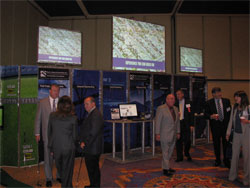 | �
�| Event exhibitors and sponsors contribute to an informative and engaging environment | �
�This year’s meeting was the best yet for the industry-leading construction defect and claims event.
�This year’s seminar concluded on May 13, 2011 with the Construction Defect Community Charitable Foundation Golf Tournament, held at Strawberry Farms Golf Course.
�The Disneyland Hotel in Anaheim, California was the place where more than 1,500 attendees convened for two days of professional development activities and seminars that included CLE workshops and panel discussions of special interest to legal and insurance professionals concerned with construction defect and claims litigation. Key events included “Challenges for Experts in Construction Defect Claims and Litigation,” “Keeping Up with Construction Defect Coverage,” and “Tips for Avoiding the ‘Perfect Storm’ in Handling of Wrap Claims.”
� �  | �
�| Supporting the golf tournament at the 15th hole | �
�This year’s Ollie award was given to George D. Calkins II, Esq. The West Coast Casualty Jerrold S. Oliver Award of Excellence was named in honor of the late Judge Jerrold S. Oliver, and recognizes an individual who is outstanding or has contributed to the betterment of the construction community.
�In addition to being the most comprehensive professional development seminar in the area of construction defects, this year’s seminar was equally valuable as a networking opportunity for members of the industry. People participated in professional development events during the day and then continued networking in the evening at numerous social events. The Lawn Party as well as the legendary Wood, Smith, Henning & Berman events were very well attended. Additional valuable networking events were hosted by a number of industry professionals at the House of Blues, and Tortilla Joe’s.
�As of this writing the 2011, West Coast Casualty's Construction Defect Seminar has applied for or has already received the following continuing education accreditation in the following areas;
�Read the full story…
�For more information about next year’s event, visit West Coast Casualty.
Association May Not Make Claim Against Builder in Vermont Construction Defect Case�
October 23, 2012 — CDJ Staff
The Vermont Supreme Court issued a ruling on September 28 on Long Trail House Condominium Association. The case was heard by a panel of two Supreme Court justices, Marilyn Skoglund and Brian Burgess, and three justices specially assigned for the case, Kupersmith, Davenport, and Johnson. The decision came down with a 3-2 split; Judges Kupersmith and Johnson joining in a dissent.
�In the underlying case, Stratton Corporation entered into an agreement with Engelberth Construction in which Engelberth would supply “recommendations on construction feasibility, consultation as to the selection of materials and equipment, assistance with zoning requirements and permits, and cooperation with the ‘design team’ to provide valuable engineering services.” Engelberth was not responsible to determine that the drawings and specifications were in accordance with the law and building codes, nor were they responsible “for the design team’s designs, errors, or omissions.”
�Subsequent to the agreement was a construction project which culminated in the incorporation of the Long Trail House Condominium Association. The condominium owners initiated a lawsuit over alleged defects. Stratton, Intrawest, and the association settled claims for $7,025,00 with Stratton and Intrawest both pursuing claims against Engelberth. This case is still unsettled.
�The association progressed on remediation, which cost about $1,500,00 more than was provided by the settlement, and so the association also sued Engelberth. In this case, the court granted a summary judgment to Engelberth, concluding that negligence claim was barred both “by the economic loss rule and that the absence of contractual privity was fatal to the warranty claims.”
�The court upheld both determinations of the lower court. The court noted that “the economic loss rule ‘prohibits recovery in tort for purely economic losses’” and that “in tort law, duties are imposed by law to protect the public from harm.” A negligence claim could only be supported with evidence of “some accompanying physical harm, which does not include economic loss.”
�The association made the claim that the economic loss rule applies only when there is a contractual relationship between the two parties. The court rejected this argument, citing a reference that “economic interests are protected, if at all, by contract principles, rather than tort principles.”
�Nor did the court find it persuasive that a “professional services” exception to the economic loss doctrine applied, noting that the court has rejected this notion in two prior cases. The noted that the association’s losses were purely economic, and their inability to settle those claims with Engelberth did not mean that they had not means of settling them, as they were able to settle these very claims with Stratton and Intrawest.
�The association also raised claims of an implied warranty, resting on the construction contract between Engelberth and Stratton. This was also rejected by the court, noting that Vermont “case law plainly contemplates the existence of contractual privity before a breach of implied warranty claim can be raised.” The court noted that there was neither a contract nor a sale between Engelberth and the association, and thus there were no grounds for an implied warranty. The court concluded that “the Association’s warranty remedy lies against the entity that sold it the condominium units and implicitly warranted through the sale that the units were built in a good and workmanlike manner and that they were suitable for habitation.”
� Read the court’s decision …
�
Court Rejects Anti-SLAPP Motion in Construction Defect Suit
September 1, 2011 — CJD Staff
The California Court of Appeals has upheld the denial of an anti-SLAPP motion in Claredon American Insurance Company v. Bishop, Barry, Howe, Haney & Ryder. This case was triggered by a water intrusion problem at a condominium complex, the Terraces at Emerystation, built and sold by Wareham Development Corporation. The insurer, Claredon, retained Risk Enterprise Management as the third party claims administrator. REM retained the law firm Bishop, Barry, Howe, Haney & Ryder. The construction defect case was settled in 2007 and the condo owners moved back by early 2008.
Due to issues with the claims settlement, Claredon filed against REM for “professional negligence, indemnity, apportionment and contribution,” with a cross-complaint that the cross-defendants negligently defended the developer, Wareham.
In response, the cross-defendants filed a motion to strike the cross-complaint under the anti-SLAPP statute. The trial court denied this motion and now this has been upheld by the appeals court.
The court noted that “The fundamental thrust of the cross-complaint is not protected litigation-related speech and petitioning activity undertaken on another’s behalf in a judicial proceeding.”
Read the court’s decision…
Court Sends Construction Defect Case from Kansas to Missouri
August 2, 2012 — CDJ Staff
The United State Court of Appeals for the Tenth Circuit has ruled in Mid-Continent Casualty Company v. The Village at Deer Creek Homeowners Association. The prior case was heard by the United States District Court for the District of Kansas. In this appeal, Mid-Continent sought a declaratory judgement. The Village at Deer Creek Homeowners Association moved to dismiss, and the district court had granted this, giving jurisdiction to the Missouri state courts.
The homeowners association had sued Greater Midwest Builders, Ltd., who had constructed the subdivision, in the Kansas state courts. The suit ended with a verdict against Greater Midwest for more than $7 million. The association and other plaintiffs in that case filed for equitable garnishment against State Auto, Mid-Continent, and Greater Midwest. State Auto removed the garnishment action to federal court in Missouri. Mid-Continent moved to sever the actions against it and transfer the case to the District of Kansas.
Subsequently, the plaintiffs filed a notice of voluntary dismissal in the Western District of Missouri. A second garnishment action followed in which Mid-Continent was named as an additional plaintiff. State Auto again removed to the Western District of Missouri, while Mid-Continent moved to sever and transfer to the District of Kansas. The Kansas court granted the association’s motion to dismiss.
In the appeal, Mid-Continent sought a declaratory judgment. This was denied by the appeals court. The district court “concluded that the Missouri courts were better situated to provide complete relief to all parties involved in the coverage dispute.” The appeals court affirmed the association’s movement to dismiss. Mid-Continent’s motion was denied as moot.
Read the court's decision…
Exclusion Bars Coverage for Mold, Fungus�
October 23, 2012 — Tred Eyerly, Insurance Law Hawaii
The court considered whether rain damage to a house was barred by the policy's mold exclusion. Stewart v. State Farm Fire & Cas. Co., 2012 U.S. Dist LEXIS 127804 (D. S.D. Sept. 7, 2012).
�The insureds hired DJ Construction to build a new home. Before construction was completed, it was discovered that DJ Construction and some of its subcontractors had failed to protect the partially constructed house from the elements, which allowed melting snow and rain to intrude into the house. Soon after this discovery, DJ Construction abandoned the project. The house remained incomplete and uninhabitable.
�The insureds sued DJ Construction.
� Read the full story…
��Reprinted courtesy of Tred R. Eyerly, Insurance Law Hawaii. Mr. Eyerly can be contacted at te@hawaiilawyer.com
��
Construction Employment Rises in Half of the States
December 9, 2011 — CDJ Staff
The Labor Department has noted that half the states and the District of Columbia saw increases in construction employment during the month of October. During the same month, twenty-three states lost construction jobs.
The biggest gains were in North Dakota, Oklahoma, DC, Texas, and California. The biggest losses were in Georgia, New Mexico, Wisconsin, and Florida. There was no change for Alabama.
The chief executive officer of the Association of General Contractors of America, Stephen E. Sandherr, called for more infrastructure development. “Allowing water, transportation and energy networks to deteriorate will hurt construction employment and force taxpayers to spend more later, to fix broken infrastructure.”
Read the full story…
Brown Paint Doesn’t Cover Up Construction Defects
April 25, 2012 — CDJ Staff
In a decision that describes the case as illustrating “the perils that real estate brokers and their agents assume when acting as a dual listing agent to both the buyers and sellers of the same house,” the California Court of Appeals has issued a decision in William L. Lyon & Associates v. The Superior Court of Placer County. Lyon & Associates sought summary judgment to dismiss the claims of the Henleys who bought a home in a transaction where a Lyon agent represented both sides.
�The prior owners of the home, the Costas, had used a Lyon agent in purchasing their home. When they later sought to sell it, that agent “became aware of some of the house’s defects and problems.” In response, the Costas sought the help of another agent, Connie Gidal, also of Lyons & Associates. Photos taken in the presence of Ms. Gidal show defects of the paint and stucco. The Costas also took the step of painting the house dark brown. During the sale process, “rain caused many of the painted-over defects to reappear.” The Costas “purchased more dark brown paint and covered up the newly visible damage prior to inspection by the Henleys.”
�With the damage concealed, the Henleys bought the home in May 2006. The agreement with Lyons & Associates noted that “a dual agent is obligated to disclose known facts materially affecting the value or desirability of the property to both parties.” Escrow closed on May 9, 2006. The contract with the broker included a two-year limit on the time to bring legal action.
�The Henleys moved in during June 2006, and “began to discover construction defects that had been concealed by the Costas.” In addition to the painted-over stucco problems, the Henleys found that the Costas had “installed quartzite stone overlays on the backyard steps in a manner that caused water intrusion on the house’s stucco walls.”
�In May 2009, the Henleys sued the Costas, Ron McKim Construction, Lyons & Associates, and Ms. Gidal. Their complaint alleged that Lyons & Associates had committed breach of contact, negligence, fraud, breach of fiduciary duty, and negligent nondisclosure in connection with the construction defects. The Costas named Lyons in a cross complaint. Lyons moved for summary judgments on the grounds that the two-year statute of limitations had expired before the complaint and cross-complaint were filed. Both the Henleys and the Costas opposed this claim. The court denied the motion and Lyons appealed.
�The appeals court upheld the denial, noting that the both California Supreme Court decision and later action by the legislature compels real estate brokers and salespersons “to conduct a reasonably competent and diligent visual inspection of the property offered for sale.” The court noted that under California law, brokers have responsibilities to both sellers and buyers. The section of law cited by Lyons applies to seller’s agents. The court rejected the contention by Lyons that they were “cooperating brokers.” The Henleys were “not constrained by the two-year statute of limitations.”
�Lyons contended that even if California’s statute did not apply, there was a contractual limit of two years. The court also rejected this, agreeing with the Henleys that “the two-year limitation period must be extended by the discovery rule.”
�The court noted that “Lyon & Associates may not reap the benefit of a shortened contractual limitation period when its own alleged malfeasance contributed to the delay in the discovery of the buyer’s injury.” The court found that the Henleys could proceed with their breach of contract claim, because, “when a breach of contract is committed in secret, such as the intentional nondisclosure of a real estate broker regarding a previously visible construction defect, the contractual limitations period is properly held subject to the discovery rule.” The court felt that the interpretation favored by the California Association of Realtors would “halve the applicable statute of limitations period.”
�In addition to rejecting Lyon request for summary judgment on the claims made by the Henleys, the court also rejected the request of summary judgment on the claims made by the Costas, concluding that neither claim is time-barred. Costs were awarded to both the Henleys and Costas.
� Read the court’s decision…
�
Fourteen More Guilty Pleas in Las Vegas Construction Defect Scam
June 19, 2012 — CDJ Staff
The ongoing case over claims that a group fixed homeowner board elections in order to supply the conspirators with a stream of construction defect cases and repairs has lead to fourteen guilty pleas. The judge recently issued charges against fifteen of the accused; one defendant did not join in the group as he was recovering from pneumonia. The prosecutors have asked the judge to delay sentencing, as the investigation is continuing. Prosecutors note that another dozen people may be indicted.
Along with an earlier group who plead guilty, this brings the total number of guilty pleas in the case to twenty-five. All have promised to cooperate with authorities.
The case has also involved four deaths, although authorities have not suspected foul play in the deaths. Nancy Quon, one of the four, was the construction defect attorney suspected to be at the center of the conspiracy.
Read the full story…