Partial Settlement in DeKalb Construction Management Case
July 10, 2012 — CDJ Staff
The DeKalb County School District has made a partial settlement in a lawsuit over their claims of mismanagement of construction projects. The Atlanta Journal-Constitution reports that the school board settled with E. R. Mitchell & Co., the smaller of two firms that they have sued. As part of the settlement, Mitchell will be testifying against their former partner. Claims from the other side of the lawsuit are that the school board improperly fired the Heery/Mitchell partnership. The superintendant who fired the company, Crawford Lewis, and his chief operations office, Pat Reid, have since been charged with criminal conspiracy to defraud the construction program. A lawyer for Heery said that “we believe that when presented to a jury, Heery will be vindicated.”
Read the full story…
Ohio Adopts Energy-Efficient Building Code
June 19, 2012 — CDJ Staff
In a compromise between environmental groups, who were looking for stricter standards, and homebuilders, who were trying to contain building costs, the state of Ohio has adopted buildings codes that will increase the energy efficiency of new homes. The estimated costs are about $1,100 with estimated annual savings of $230. According to Corey Roblee of the International Code Council, “It’s something needed in the state of Ohio.”
The Ohio Home Builders Association opposed a proposal to adopt the guidelines of the International Code Council. Builders will be able to either follow the ICC guidelines or they can use the Ohio guidelines to meet the same energy efficiency. Vincent Squillace, the executive vice president of the OHBA, said, “We came up with an equivalent code that’s more strict but is about $2,000 cheaper per home to implement than the original code.”
The new code will require that at least 75% of lighting must be high efficiency, increases the degree of insulation, and specifies more efficient windows, among other changes.
Read the full story…
Insurer Has Duty to Defend in Water Intrusion Case
July 10, 2012 — CDJ Staff
The Seventh Circuit Court of Appeals has upheld a summary judgment against an insurance company in a construction defect suit. Lagestee-Mulder, Incorporated (LMI) was hired by Crown Centre to construct a multi-story office building in Franfort, Illinois. LMI hired Frontrunner Glass & Metal to supply and install windows and doors. Frontrunner purchased an insurance policy from Consolidated which named LMI as an additional insured. The project experienced water intrusion and other construction defects and Crown sued LMI. Consolidated denied coverage. LMI sued Consolidated and the US District Court granted a summary judgment against Consolidated.
The appeals court reviewed the grounds for summary judgment and determined that under Illinois law, Consolidated had a duty to defend. The court cited an earlier opinion that “if the underlying compliant alleges facts within or potentially within policy coverage, an insurer is obligated to defend its insured even if the allegations are groundless, false, or fraudulent.”
Read the court’s decision…
Insurance Company Prevails in “Chinese Drywall” Case
June 17, 2011 — CDJ Staff
The Louisiana Court of Appeals rejected an appeal to reverse a summary judgment granted to Louisiana Citizens Property Insurance Company. Terrence and Rhonda Ross contracted for a remodel of their home in which Chinese-made drywall was used. When the drywall emitted harmful gasses, the Rosses filed a claim under their insurance policy. This claim was rejected under four exclusions: for faulty materials, latent defect, loss by corrosion, and loss by pollution. After the claim was denied, the Rosses sued Louisiana Citizens.
In April 2010, the lower court granted a summary judgment, followed by a May, 2010 order dismissing the Rosses’ claims against Louisiana Citizens. The Rosses appealed this decision. In the court’s review, they agreed with Louisiana Citizens and the lower court on all counts. Although the Rosses maintained that the drywall was not defective (as it still functioned as drywall), the court ruled that its emission of sulfuric gases was a defect. Further, as it was in place for two years before this became evident, it was also a latent defect. Damage to the Rosses’ home consisted of corrosion damage caused by the pollutants in the drywall.
The Rosses made an additional claim that since their policy covered smoke damage, this should be covered, as the harm was done by sulfuric gases. The court noted that the contract specifies “fumes or vapors from a boiler, furnace, or related equipment,” none of which apply in this case.
Read the court’s decision
Ohio “property damage” caused by an “occurrence.”
May 18, 2011 — May 18, 2011 - CDCoverage.com
In JTO, Inc. v. State Automobile Mut. Ins. Co., No. 2010-L-062 (Ohio Ct. App. March 25, 2011), general contractor JTO was sued by hotel project owner Marriott for breach of contract and warranties seeking damages for the repair of construction defects resulting in moisture penetration property damage to interior components. JTO filed a third party complaint against subcontractor Farizel and also tendered its defense as an additional insured under Farizel’s State Auto CGL policy.
�Read the full story…
�Reprinted courtesy of CDCoverage.com
�
�Census Bureau, HUD Show Declines in Residential Construction
�May 17, 2011 – CDJ Staff
�The U.S. Census Bureau and the Department of Housing and Urban Development released their summary of residential construction for April 2011 on May 17.
�Building permits for privately owned housing units were down 4% from last month and 12% from last year. Similarly, privately-owned housing starts were down 10% from March and 23% below the previous year.
�For further details, read the Census Bureau/HUD report
Pier Fire Started by Welders
August 2, 2012 — CDJ Staff
Welders working on Pier 29 in San Francisco were preparing the building for the America’s Cup sailing race. Instead, they accidentally caused $2.4 million in damages. Mindy Talmadge, a fire department spokesperson, attributed the fire to crews welding a latter to a wall. According to Talmadge, a spark entered a crack in the concrete wall and “the wood on the building underneath was really dry.” It took firefighters more than two hours to extinguish the blaze.
Read the full story…
California Supreme Court Binds Homeowner Associations To Arbitration Provisions In CC&Rs
September 13, 2012 — Stephen A. Sunseri and Aarti Kewalramani, Gatzke Dillon & Ballance LLP (http://www.gdandb.com).
The California Supreme Court ruled in Pinnacle Museum Tower Assn. v. Pinnacle Market Development (August 16, 2012, S186149) __ Cal.4th __ [2012 WL 3516134], that arbitration provisions within the covenants, conditions, and restrictions (“CC&Rs”) for condominium projects are enforceable against their homeowner associations. The ruling — two years in the making — was based on legislative history of laws governing common interest developments, and decades of decisional authority involving contracts and arbitration provisions.
�In Pinnacle, a homeowners association sued a condominium builder for construction defects and resultant property damage to the common areas, and to the separate property interests held by the individual members. The builder moved to compel arbitration, based on a provision contained in the CC&Rs which required resolution of all construction disputes through binding arbitration. The association argued it could not be compelled to arbitrate these claims because it was not a party to the agreement to arbitrate, asserting “the Association did not bargain with [the builder] over the terms of the Project CC&R's or participate in their drafting.”
�The Supreme Court rejected the association's argument on the grounds that the builder-authored CC&Rs complied with the Davis-Stirling Act (“the Act”) (Civil Code §1350, et seq.) ? the law that governs all common interest developments in California. Under the Act, builders and sellers of common interest residential units are required to provide a copy of the CC&Rs to all purchasers, as well as copies of the Department of Real Estate's public report, which informs purchasers of their rights and remedies as members of the association, and encourages each prospective purchaser to review the terms carefully before entering into any agreement. Further, the Act states all CC&Rs are enforceable, unless unreasonable, and inure to the benefit of and bind all owners in the development. (Civ. Code, §1354, subd. (a).) The Court found each owner who purchased a condominium in the project either expressly consented to the terms and provisions of the CC&Rs or was deemed to have consented to the terms at the time of purchase.
�The Court also did not find the arbitration provision to be unconscionable. The Court indicated the provision was drafted and recorded in accordance with the Act, which allowed each prospective purchaser to make an informed decision prior buying a condominium unit. The provision also limited arbitration to construction defect disputes. The Court did not find any evidence the provision “shocked the conscience” or was “oppressive” in any way.
�Pinnacle settles a decades-long conflict over whether arbitration provisions in CC&Rs for condominium projects are enforceable against homeowner associations and their members. It remains unclear, however, whether Pinnacle’s rationale will be applied to cases involving homeowner associations for single-family residences (as opposed to condominiums), assuming those CC&Rs have similar arbitration requirements. Regardless, the result of Pinnacle is clear, if arbitration provisions contained in condominium CC&Rs meet the fairness and unconscionability tests set out by the Court, more condominium construction defect cases brought by homeowner associations will be resolved through the arbitration process.
� Read the court’s decision…
�Printed courtesy of Stephen A. Sunseri and Aarti Kewalramani, Gatzke Dillon & Ballance LLP. Mr. Sunseri can be contacted at ssunseri@gdandb.com and Ms. Kewalramani can be contacted at akewalramani@gdandb.com.
Arizona Court of Appeals Decision in $8.475 Million Construction Defect Class Action Suit
May 9, 2011 — May 9, 2011 Beverley BevenFlorez - Construction Defect Journal
In the case of Leflet v. Fire (Ariz. App., 2011), which involved an $8.475 million settlement in a construction defect class action suit, the question put forth to the Appeals court was “whether an insured and an insurer can join in a Morris agreement that avoids the primary insurer’s obligation to pay policy limits and passes liability in excess of those limits on to other insurers.” The Appeals court provided several reasons for their decision to affirm the validity of the settlement agreement as to the Non-Participatory Insurers (NPIs) and to vacate and remand the attorney fee awards.
�First, the Appeals court stated, “The settlement agreement is not a compliant Morris agreement and provides no basis for claims against the NPIs.” They conclude, “Appellants attempt to avoid the doctrinal underpinnings of Morris by arguing that ‘the cooperation clause did not prohibit Hancock from assigning its rights to anyone, including Appellants.’ This narrow reading of the cooperation clause ignores the fact that Hancock did not merely assign its rights — it assigned its rights after stipulating to an $8.475 million judgment that neither it nor its Direct Insurers could ever be liable to pay. Neither Morris nor any other case defines such conduct as actual ‘cooperation’—rather, Morris simply defines limited circumstances in which an insured is relieved of its duty to cooperate. Because Morris agreements are fraught with risk of abuse, a settlement that mimics Morris in form but does not find support in the legal and economic realities that gave rise to that decision is both unenforceable and offensive to the policy’s cooperation clause.”
�The Appeals court further concluded that “even if the agreement had qualified under Morris, plaintiffs did not provide the required notice to the NPIs.” The court continued, “Because an insurer who defends under a reservation of rights is always aware of the possibility of a Morris agreement, the mere threat of Morris in the course of settlement negotiations does not constitute sufficient notice. Instead, the insurer must be made aware that it may waive its reservation of rights and provide an unqualified defense, or defend solely on coverage and reasonableness grounds against the judgment resulting from the Morris agreement. The NPIs were not given the protections of this choice before the agreement was entered, and therefore can face no liability for the resulting stipulated judgment.”
�Next, the Appeals court declared that “the trial court abused its discretion in awarding attorney’s fees under A.R.S § 12-341.” The Appeals court reasoned, “In this case, the NPIs prevailed in their attack on the settlement. But the litigation did not test the merits of their coverage defenses or the reasonableness of the settlement amount. And Plaintiffs never sued the NPIs, either in their own right or as the assignees of Hancock. Rather, the NPIs intervened to test the conceptual validity of the settlement agreement (to which they were not parties) before such an action could commence. In these circumstances, though it might be appropriate to offset a fee award against some future recovery by the Plaintiff Leflet v. Fire (Ariz. App., 2011) class, the purposes of A.R.S. § 12-341.01 would not be served by an award of fees against them jointly and severally. We therefore conclude that the trial court abused its discretion in awarding fees against Plaintiffs ‘jointly and severally.’”
�The Appeals court made the following conclusion: “we affirm the judgment of the trial court concerning the validity of the settlement agreement as to the NPIs. We vacate and remand the award of attorney’s fees. In our discretion, we decline to award the NPIs the attorney’s fees they have requested on appeal pursuant to A.R.S. § 12-341.01(A).”
�Read the court’s decision…
Florida Law: Defects in Infrastructure Improvements Not Covered in Home Construction Warranties
July 10, 2012 — CDJ Staff
In April 2012, Governor Rick Scott signed into law House Bill 1013, despite lobbying from homeowner and condominium associations among others. The law was in response to a case in which the court had found that implied warranties covered external subdivision improvements. Prior to the court decision, these were not thought to be covered.
According to an article in the Martindale-Hubble Legal Library, under the new law, road and drainage improvements will not be included implied warranty of a new home. The law took effect on July 1.
Read the full story…
Official Tried to Influence Judge against Shortchanged Subcontractor
February 10, 2012 — CDJ Staff
A contractor testified in the trial of former Cuyahoga County Commissioner Jimmy Dimora. According to Fox 8 in Cleveland, Ohio, Sean Newman, the president of Letter Perfect testified that his company was a subcontractor on the reconstruction of the locker rooms at the Cleveland Browns Stadium. Newman said his company was paid only $400,000 of their $650,000 bid. When Letter Perfect sued the contractor, D.A.S. Construction, Dimora called the judge to influence her to rule in favor of D.A.S.
� The judge in the earlier case, Bridgett McCafferty, has been found guilty of lying to the FBI during their investigation and is serving a 14-month prison sentence.
Read the full story…
�
California Supreme Court Finds Associations Bound by Member Arbitration Clauses
September 13, 2012 — CDJ Staff
In a decision with great implications for construction defect suits in California, the California Supreme Court has ruled in Pinnacle Museum Tower Association v. Pinnacle Market Development that arbitration clauses binding on the members of the association are also binding on the association itself. They concluded this, even though “the association did not exist as an entity independent of the developer when the declaration was drafted and recorded.” The opinion, written by Justice Baxter, was joined by four additional justices, with two separate concurrences and a dissenting opinion by Justice Kennard.
�The Pinnacle homeowners sought to bring suit over construction defect claims. In response, the developer filed a motion to compel arbitration. The association argued that the arbitration clause signed by its individual members was not binding on it. The Appeals Court invalidated the arbitration agreement “finding it marked by slight substantive unconscionability and high degree of procedural unconscionability. The Appeals Court determined that “for all intents and purposes, Pinnacle was the only party to the ‘agreement,’ and there was no independent homeowners association when Pinnacle recorded the CC&R’s.” However, the California Supreme Court said that this was “not persuasive in light of the statutory and contract principles in play.”
�The opinion notes that “the Project CC&R’s provides that Pinnacle and, by accepting a deed to any portion of the Project property, the Association and each individual condominium owner agree to submit any construction dispute to binding arbitration in accordance with the FAA.” The Court noted that “settled principles of condominium law establish that an owners association, like its constituent members, must act in conformity with the terms of a recorded declaration,” which, as the Court notes, includes the CC&Rs.
�After finding that the terms were binding on the Association, the Court then questioned whether the terms were “unenforceable as unconscionable,” noting that “the party resisting arbitration bears the burden of proving unconscionability.” But the Court found that “the arbitration provisions of article XVIII are not substantively unconscionable.” Additionally, they found “no support for the Association’s claims of unfairness and absence of mutuality.”
Read the court’s decision…
Nevada Budget Remains at Impasse over Construction Defect Law
June 1, 2011 — CDJ Staff
Negotiations for the Nevada state budget have stalled over proposals to amend the state’s construction defect laws. Assembly Republicans had offered changes to the law to make it friendlier to contractors; however, after a state Supreme Court ruling that the state could not move a local government entity’s funds into state coffers, pressure has increased on the governor to lift the expiration dates of taxes approved in 2009.
The Reno Gazette-Journal quotes John Madole, a construction industry lobbyist, “We agree with them that you have to address the issue of the attorney fees, and for all practical purposes, they are automatically awarded when anybody brings any kind of suit.”
Speaker of the Assembly, John Oceguera, a Democrat, has proposed a bill that “makes it absolutely crystal clear that the only time you get attorney's fees is if you're the prevailing party.”
Read the full story…
Reference to "Man Made" Movement of Earth Corrects Ambiguity
December 20, 2012 — Tred Eyerly, Insurance Law Hawaii
In Pioneer Tower Owners Assn. v. State Farm Fire & Cas. Co., 12 NY3d 302 (2009), the New York Court of Appeals found an "earth movement" exclusion was ambiguous when applied to an excavation. The court now considered whether a similar exclusion, expressly made applicable to "man made" movement of earth, eliminated the ambiguity when loss was created by excavation. Bentoria Holdings, Inc. v. Travelers Indem. Co., 2012 N.Y. LEXIS 3087 (N.Y. Oct. 25, 2012).
Plaintiff's building suffered cracks due to an excavation being conducted on the lot next door. A claim was submitted to Travelers, plaintiff's insurer. Travelers rejected the claim, relying on the earth movement exclusion.
Read the full story…
Reprinted courtesy of Tred R. Eyerly, Insurance Law Hawaii. Mr. Eyerly can be contacted at te@hawaiilawyer.com
Insurer Beware: Failure to Defend Ends with Hefty Verdict
June 1, 2011 — Douglas Reiser in the Builders Counsel Blog
Served with a lawsuit that you turned over to your insurer? Insurer refusing to defend you? Well, find some hope in this news. Washington’s IFCA has the claws to ensure that insurers perform their duties.
�Contractors heavily rely on the defense provisions of their Commercial General Liability (CGL) policies. In construction, a legal dispute can easily rear its head when you least expect it. Luckily, Washington registered contractors are required to maintain CGL insurance. That insurance often provides contractors with adequate legal defense in the event that they are sued.
�But, what if your insurer turns down the defense request? They might be staring at massive damages. A current Reiser Legal client, Australia Unlimited, Inc., recently won a large verdict against Hartford Insurance, after the insurer unreasonably denied their claim. The firm who represented Australia Unlimited Inc. in that case, Hackett Beecher and Hart, were successful in procuring a $5.43 Million verdict
�Read the full story…
�Reprinted courtesy of Douglas Reiser of Reiser Legal LLC. Mr. Reiser can be contacted at info@reiserlegal.com
Construction Upturn in Silicon Valley
August 17, 2011 — CDJ Staff
Work resumed after nearly three years on an office tower in Santa Clara, according to the San Jose Mercury News. Work had stalled on the building due to the economy, but now the developer is planning a second five-story building on the site. Other dormant projects in the area are also getting restarted. Santa Clara County saw the addition of 1,800 construction jobs in June.
�A spokesperson for the Operating Engineers Local 3 in Alameda told the paper, “two years ago we had five thousand folks on the out-of-work list. It’s now down to about 1,700.”
Read the full story…
2011 West Coast Casualty Construction Defect Seminar – Recap
June 1, 2011 — CDJ Staff
� 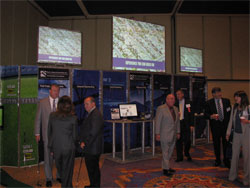 | �
�| Event exhibitors and sponsors contribute to an informative and engaging environment | �
�This year’s meeting was the best yet for the industry-leading construction defect and claims event.
�This year’s seminar concluded on May 13, 2011 with the Construction Defect Community Charitable Foundation Golf Tournament, held at Strawberry Farms Golf Course.
�The Disneyland Hotel in Anaheim, California was the place where more than 1,500 attendees convened for two days of professional development activities and seminars that included CLE workshops and panel discussions of special interest to legal and insurance professionals concerned with construction defect and claims litigation. Key events included “Challenges for Experts in Construction Defect Claims and Litigation,” “Keeping Up with Construction Defect Coverage,” and “Tips for Avoiding the ‘Perfect Storm’ in Handling of Wrap Claims.”
� �  | �
�| Supporting the golf tournament at the 15th hole | �
�This year’s Ollie award was given to George D. Calkins II, Esq. The West Coast Casualty Jerrold S. Oliver Award of Excellence was named in honor of the late Judge Jerrold S. Oliver, and recognizes an individual who is outstanding or has contributed to the betterment of the construction community.
�In addition to being the most comprehensive professional development seminar in the area of construction defects, this year’s seminar was equally valuable as a networking opportunity for members of the industry. People participated in professional development events during the day and then continued networking in the evening at numerous social events. The Lawn Party as well as the legendary Wood, Smith, Henning & Berman events were very well attended. Additional valuable networking events were hosted by a number of industry professionals at the House of Blues, and Tortilla Joe’s.
�As of this writing the 2011, West Coast Casualty's Construction Defect Seminar has applied for or has already received the following continuing education accreditation in the following areas;
�Read the full story…
�For more information about next year’s event, visit West Coast Casualty.
Repair of Part May Necessitate Replacement of Whole
February 10, 2012 — CDJ Staff
Judge Gleuda E. Edmonds, a magistrate judge in the United States District Court of Arizona issued a ruling in Guadiana v. State Farm on January 25, 2012. Judge Edmonds recommended a partial summary judgment in favor of the plaintiff.
� Ms. Guandiana’s home had water damage due to pluming leaks in September 2004. She was informed that polybutylene pluming in her house could not be repaired in parts “it must be completely replaced.” She had had the plumbing replaced. State Farm denied her claim, arguing that “the tear-out provision did not cover the cost of accessing and replacing those pipes that were not leaking.”
� In September 2007, State Farm filed a motion to dismiss. The court rejected this motion, stating that “If Guadiana can establish as a matter of fact that the system that caused the covered loss included all the pipes in her house and it was necessary to replace all the pipes to repair that system, State Farm is obligated to pay the tear-out costs necessary to replace all the pipes, even those not leaking.”
� In March 2009, State Farm filed for summary judgment, which the court granted. State Farm argued that “the tear-out provision only applied to ‘repair’ and not ‘replace’ the system that caused the covered leak.” As for the rest of the piping, State Farm argued that “the policy does not cover defective materials.”
� In December 2011, Ms. Guadiana filed for summary judgment, asking the court to determine that “the policy ‘covers tear-out costs necessary to adequately repair the plumbing system, even if an adequate repair requires replacing all or part of the system.”
� In her ruling, Judge Edmonds noted that Ms. Guadiana’s claim is that “the water damage is a covered loss and she is entitled to tear-out costs necessary to repair the pluming system that caused that covered loss.” She rejected State Farm’s claim that it was not obligated to replace presumably defective pipes. Further, she rejected State Farm’s argument that they were only responsible for the leaking portion, noting “Guadiana intends to prove at trial that this is an unusual case where repair of her plumbing system requires replacement of all the PB plumbing.”
� Judge Edmonds concluded by directing the District Court to interpret the tear out issue as “the tear-out provision in State Farm’s policy requires State Farm to pay all tear-out costs necessary to repair the plumbing system (that caused the covered loss) even if repair of the system requires accessing more than the leaking portion of the system.”
Read the court’s decision…
Harmon Tower Construction Defects Update: Who’s To Blame?
August 17, 2011 — CDJ Staff
Reporting on the site VegasInc.com, Liz Benton notes that “nobody wants to take the fall for what happened at Harmon.” Work on the Harmon hotel building in Las Vegas’s CityCenter stopped in 2008 after 26 of the planned 49 stories were completed. Lorence Slutzky, a construction law professor at John Marshall Law School and a partner with the Chicago firm Robbins Schwartz Nicholas Lifton & Taylor told Benton that while inspectors and others are complicit, “the real responsibility rests with Perini, which has an obligation to comply with the plan specifications.” Perini’s claim is that they were given faulty design drawings. MGM disputes this.
�Perini has offered to repair the building defects, however MGM has released a statement that they have “zero confidence or trust that Perini can and will properly fix a building it has so badly constructed thus far.” One MGM spokesperson likened these requests from Perini to “the director of ‘Ishar’ demanding a sequel.” “Ishtar,’ cost Columbia Pictures $55 million dollars and earned only $4.2 million in its initial run. Perini claims that MGM halted work because of the economy.
Read the full story…