Florida Law: Defects in Infrastructure Improvements Not Covered in Home Construction Warranties
July 10, 2012 — CDJ Staff
In April 2012, Governor Rick Scott signed into law House Bill 1013, despite lobbying from homeowner and condominium associations among others. The law was in response to a case in which the court had found that implied warranties covered external subdivision improvements. Prior to the court decision, these were not thought to be covered.
According to an article in the Martindale-Hubble Legal Library, under the new law, road and drainage improvements will not be included implied warranty of a new home. The law took effect on July 1.
Read the full story…
No Coverage for Construction Defects Under Alabama Law
June 19, 2012 — Tred Eyerely, Insurance Law Hawaii
The federal district court determined that under Alabama law, there was no coverage for breach of contract claims arising from alleged construction defects. Owners Ins. Co. v. Shep Jones Constr., Inc., 2012 U.S. Dist. LEXIS 62085 (N.D. Ala. May 3, 2012).
The insured entered a contract with the homeowner to remodel her home. After construction was completed, the homeowner sued the insured, alleging damages arising form breach of contract, negligence and negligent supervision.
The insured had a policy with Owners Insurance Company. Owners Insurance defended under a reservation rights.
Read the full story…
Reprinted courtesy of Tred R. Eyerly, Insurance Law Hawaii. Mr. Eyerly can be contacted at te@hawaiilawyer.com
California insured’s duty to cooperate and insurer’s right to select defense counsel
April 14, 2011 — April 14, 2011 - CDCoverage.com
In Travelers Property Casualty Co. v. Centex Homes, No. C 10-02757 (N.D. Cal. April 1, 2011), general contractor Centex was sued by homeowners for construction defects. Centex tendered its defense to Travelers as an additional insured under policies issued by Travelers to two Centex subcontractors. Travelers agreed to defend Centex under a reservation of rights and selected defense counsel to defend Centex. Centex refused to accept the defense, asserting that it was entitled to select defense counsel. Travelers filed suit against Centex seeking a declaratory judgment that Centex had breached the duty to cooperate condition in the Travelers’ policy.
�Read the full story...
�Reprinted courtesy of CDCoverage.com
Construction Defect Not a RICO Case, Says Court
August 4, 2011 — CDJ Staff
The US District Court of North Carolina has rejected an attempt by a homeowner to restart her construction defect claim by turning it into a RICO lawsuit. Linda Sharp, the plaintiff in the case of Sharp v. Town of Kitty Hawk, attempted to amend a claim under the Racketeer Influenced and Corrupt Organizations Act (RICO) and argued that her case belonged in the federal courts.
Ms. Sharp sued in November, 2010 claiming construction defects. She sued in federal court, although the court noted that as she and most of the defendants are citizens of North Carolina, the state court would have been the appropriate jurisdiction. Further, the court noted that one federal claim Sharp made was dismissed with prejudice, leaving only the state law claims. These the court dismissed without prejudice, declining to exercise jurisdiction over North Carolina law.
�After the dismissal, Ms. Sharp attempted to amend her complaint after the deadline. To do so, according to the court, she would be required to obtain consent from defendants or leave of the court. She did neither.
�In his opinion, Judge W. Earl Britt rejected her motion for leave to amend. He also granted the defendants’ motion to dismiss. The clerk was directed to close the case.
� Read the court’s decision…
2011 West Coast Casualty Construction Defect Seminar – Recap
June 1, 2011 — CDJ Staff
� 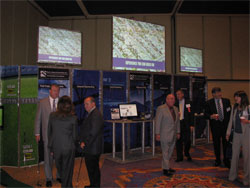 | �
�| Event exhibitors and sponsors contribute to an informative and engaging environment | �
�This year’s meeting was the best yet for the industry-leading construction defect and claims event.
�This year’s seminar concluded on May 13, 2011 with the Construction Defect Community Charitable Foundation Golf Tournament, held at Strawberry Farms Golf Course.
�The Disneyland Hotel in Anaheim, California was the place where more than 1,500 attendees convened for two days of professional development activities and seminars that included CLE workshops and panel discussions of special interest to legal and insurance professionals concerned with construction defect and claims litigation. Key events included “Challenges for Experts in Construction Defect Claims and Litigation,” “Keeping Up with Construction Defect Coverage,” and “Tips for Avoiding the ‘Perfect Storm’ in Handling of Wrap Claims.”
� �  | �
�| Supporting the golf tournament at the 15th hole | �
�This year’s Ollie award was given to George D. Calkins II, Esq. The West Coast Casualty Jerrold S. Oliver Award of Excellence was named in honor of the late Judge Jerrold S. Oliver, and recognizes an individual who is outstanding or has contributed to the betterment of the construction community.
�In addition to being the most comprehensive professional development seminar in the area of construction defects, this year’s seminar was equally valuable as a networking opportunity for members of the industry. People participated in professional development events during the day and then continued networking in the evening at numerous social events. The Lawn Party as well as the legendary Wood, Smith, Henning & Berman events were very well attended. Additional valuable networking events were hosted by a number of industry professionals at the House of Blues, and Tortilla Joe’s.
�As of this writing the 2011, West Coast Casualty's Construction Defect Seminar has applied for or has already received the following continuing education accreditation in the following areas;
�Read the full story…
�For more information about next year’s event, visit West Coast Casualty.
Insurer’s Motion for Summary Judgment Based on Earth Movement Exclusion Denied
October 28, 2011 — Tred Eyerley, Insurance Law Hawaii
After carefully dissecting the earth movement exclusion, the court denied the insurer’s motion for summary judgment. High Street Lofts Condominium Assoc., Inc. v. Am. Family Mut. Ins. Co., 2011 U.S. Dist. LEXIS 109043 (D. Colo. Sept. 26, 2011).
The City of Boulder performed road repair work near High Street’s property, some of which involved the use of a vibrating compactor to compact and set the roadbed. High Street noticed damage to its building, such as cracks in walls, sloping of floors and separations of porches from the building itself. High Street contacted the City of Boulder, who forwarded the complaint to its contractor, Concrete Express, Inc.
High Street also filed a claim with its business insurer, American Family, who denied the claim. American Family relied on an opinion letter by High Street’s engineer. The letter indicated that the damage was the result of "soil consolidation/settlement," in response to the construction activities. Based on this letter American Family concluded the claim was excluded under the policy’s earth movement exclusion.
High Street sued American Family, who moved for summary judgment.
Read the full story...
Reprinted courtesy of Tred R. Eyerly, Insurance Law Hawaii. Mr. Eyerly can be contacted at te@hawaiilawyer.com
Lawsuit over Construction Defects Not a Federal Case
August 16, 2012 — CDJ Staff
The United State District Court in California has dismissed the claims of a contractor against the United States government, on the grounds that it was not within the subject matter jurisdiction of the court. The origins of the case are in a related construction defect claim. The current plaintiff, Performance Contracting, Inc., did the lath and plaster work for a building for the Department of Veterans Affairs. After the building was completed, the Veterans Affairs complained to the general contractor, Wynema, Inc., of water intrusion problems.
Wyema and Performance conducted testing and the water intrusion was found to be due to “a variety of design defects and omissions, including: 1) omission of proper window flashing; 2) inadequate waterproof membrane around the windows; 3) inadequate T-molding around the windows; 4) lack of a window sill pan for the windows; 5) lack of any backing in the window framing; 6) lack of any backing for the stucco expansion joints and seams; and 7) failure to require that a performance mock-up of the window assembly and adjacent areas be built and water tested.” Wyema filed a construction defect action against Performance and other subcontractors.
In the current case, Performance claims that Veteran Affairs was negligent, that it “breached its duty to Plaintiff when it provided deficient plants and specifications” and “failed to properly oversee construction and inspect Project work.” The court determined that it could not hear this case, noting that “Federal Courts are presumptively without jurisdiction over civil actions.”
Performance raised its claims under the Federal Tort Claims Act. The judge was not persuaded by this claim, noting that the FTCA does not apply to purported breach of the General Contract. The FTCA waives the government’s sovereign immunity in cases of “injury or loss of property, or personal injury or death caused by the negligent or wrongful act or omission of an employee of the Government while acting within the scope of his office or employment, under circumstances where the United States, if a private person, would be liable to the claimant in accordance with the law of the place where the act or omission occurred.”
Performance was unable to pursue its claims in the Court of Federal Claims as there was no contract between Performance and the government. However, the court noted that Performance’s inability to file suit in the Court of Federal Claims does not open up a path to the District Court. “Litigants are not guaranteed a forum in which to sue the United States.” The court further noted that “if this Court were to accept Plaintiff’s logic, non-parties to contracts, but not parties, would be free to pursue contract claims in the fora of their choosing.”
Read the court’s decision…
A Loud Boom, But No Serious Injuries in World Trade Center Accident
March 1, 2012 — CDJ Staff
The Wall Street Journal reports that nearly twenty tons of steel fell forty stories at the World Trade Center site on February 16. One person was checked by medical personnel. One person who works in the Financial District said it was “almost like thunder.” Frank Pensabene, one of the ironworkers on the site said that after “loud boom,” “all hell broke loose.” The steel beams and cables fell onto a flatbed truck, which was not occupied at the time.
Read the full story…
Construction Bright Spot in Indianapolis
March 1, 2012 — CDJ Staff
The downtown Indianapolis area is the site of about 85 major building projects that are from groundbreaking to just complete. The Indianapolis Star reports that the cumulative worth of the projects is about $3 billion, a level of construction that Indianapolis has seen only once before.
�About thirty of the projects are residential. The main commercial project is a $754 million hospital building. The boom in downtown Indianapolis is not matched elsewhere, with the Indianapolis Star reporting that in the rest of Central Indiana, construction has slowed.
Read the full story…
Washington Supreme Court Sides with Lien Claimants in Williams v. Athletic Field
September 30, 2011 — Douglas Reiser, Builders Counsel
The Washington Supreme Court issued their opinion today on Williams v. Athletic Field, perhaps the most talked about construction law case in the past few years. I have discussed this case exhaustively here on Builders Counsel. Today we have a resolution.
In an unanimous opinion issued today, the high court sided with lien filers who followed a sample form provided in RCW 60.04.091. Additionally, the court found that a lien company - and presumably other persons - could sign the lien for the lien claimant, as an agent, without invalidating the lien.
Read the full story…
Reprinted courtesy of Douglas Reiser of Reiser Legal LLC. Mr. Reiser can be contacted at info@reiserlegal.com
Driver’s Death May Be Due to Construction Defect
August 16, 2012 — CDJ Staff
A man driving a rental truck collided with a parking ramp at the Mall of America in Bloomington, Minnesota, leading to his death when the ramp broke and crushed the cab of the truck. One expert said that the ramp should have been built to withstand the impact. Tim Galarnyk told Fox News that the building feature didn’t’ even bear weight, describing it as “a cosmetic facial panel.” Nevertheless, in a contest with a truck he said the ramp portion should “peel it like a tin can before it takes the concrete element down.”
The Mall of American is not commenting on the accident.
Read the full story…
DA’s Office Checking Workers Comp Compliance
February 10, 2012 — CDJ Staff
The San Bernardino office of the California District Attorney is partnering with the California Contractor’s State License Board to check if subcontractors are holding the required workers compensation insurance. The High Desert Daily Press reports that the process of checking at sites has been going on for several months.
� Investigators visit sites and ask supervisors to provide a list of subcontractors which the state then checks for compliance. One worker was quoted that insurance inspections were so rare that he had never seen one before, despite 20 years in construction.
� On one day, investigators in two teams visited fourteen construction sites and reviewed the insurance status of twenty-two firms. Three were found out of compliance and stop work orders were issued.
Read the full story…
OSHA Extends Temporary Fall Protection Rules
March 1, 2012 — CDJ Staff
OSHA announced that its current rules on fall protection for residential construction will remain in place until September 15, 2012. The current measures became effective in June 2011. Under the new rules, falls must be prevented by fall protection measures unless the measures can be shown to be unfeasible or even hazardous.
�Under the extension of the temporary enforcement measures, contractors who ask for compliance assistance with OSHA are given top priority and penalties can be reduced. OSHA has conducted more than 1,000 outreach sessions on the new rules.
Read the full story…
California Supreme Court to Examine Arbitration Provisions in Several Upcoming Cases
December 9, 2011 — CDJ Staff
Glen C. Hansen, writing on Abbott & Kinderman’s Land Use Law Blog looks at several cases pending before the California Supreme Court which ask if a developer can insist on arbitration of construction defect claims, based on provision in the CC&Rs. Currently, there is a split of opinions in the California appeals courts on the issue.
Four of the cases are in California’s Fourth Appellate District. In the earliest case, Villa Milano Homeowners Association v. Il Davorge, from 2000, the court concluded that the arbitration clause was sufficient to require that construction defect claims undergo arbitration. However, the Fourth Appellate District Court concluded in three later cases that the arbitration clauses did not allow the developer to compel arbitration. In two cases, argued in 2008 and 2010, the court concluded that to do otherwise would deprive the homeowners of their right to a jury trial. In the most recent case, Villa Vicenza Homeowners Association v. Nobel Court Development, the court decided that the CC&Rs did not create contractual rights for the developer.
The Second Appellate District Court came to a similar decision in Promenade at Playa Vista Homeowners Association v. Western Pacific Housing, Inc. In their decision, the court noted that CC&Rs could be enforced by homeowners and homeowners associations, but not developers.
Read the full story…
Housing Prices Up through Most of Country
December 20, 2012 — CDJ Staff
Home prices in October were up more than six percent compared with prices in October 2011. The LA Times noted that some of the strongest gains were in California and Arizona. The Phoenix metropolitan area saw a 24.5% rise in home prices. In California, Riverside and Los Angeles were just above the national average, at 7.3% and 6.4%, contributing to the state’s overall nine percent increase.
The news wasn’t good throughout the entire country, as five states did not see any price increases. Mark Fleming, the chief economist at CoreLogic, a research firm in Irvine, California said that “the housing recovery that started earlier in 2012 continues to gain momentum.
Read the full story…
Don MacGregor To Speak at 2011 West Coast Casualty Construction Defect Seminar
January 1, 2011 — February 08, 2011 CDJ Staff
“Challenges for Experts in Construction Defect Claims and Litigation” will be held Thursday May 13, 2011 between 1:30 and 3:00 PM at this year’s West Coast Casualty Construction Defect Seminar. Among the various topics covered will be of Right to Repair/Opportunity to Repair statutes, improper testing methodologies, new challenges where a case involves a Wrap Policy, OCIPS, CCIPS, and other owner controlled insurance programs, as well as the need for realistic testing protocols for the party the expert is retained to represent.
�During the presentation Mr. MacGregor will be working in connection with a group of construction and design experts each of which have extensive experience with construction defect and claims related litigation. This particular session is expected to attract a standing-room only crowd, drawing in excess of 1700 attendees.
�The West Coast Casualty Construction Defect Seminar is the largest seminar of its type. This year’s event is scheduled for will take place on May 12 and 13, 2011, at The Disneyland Hotel and Resort. For more information regarding the years event please visit http://www.westcoastcasualty.com/dyncat.cfm?catid=3322
http://www.westcoastcasualty.com/dyncat.cfm?catid=3322
Harmon Towers Duty to Defend Question Must Wait, Says Court
March 1, 2012 — CDJ Staff
The Harmon Towers project in Las Vegas was eventually halted short of the planned forty-seven stories after “it was determined that there was substantial defective construction, including defective installation of reinforcing steel throughout the Harmon.” The American Home Insurance Company and Lexington Insurance Company put forth a claim that they had no duty to defend Perini Construction, the builder of the defective Harmon Towers. Further, American Home seeks to recover the monies American reimbursed Perini. The United States District Court of Nevada ruled in the case of American Home Assurance Co. v. Perini Building on February 3, 2012.
�The two insurance companies covered Perini and its subcontractors, Century Steel, Pacific Coast Steel, and Ceco Concrete Construction. Century Steel was the initial subcontractor for the reinforcing steel; they were later acquired by Pacific Coast Steel. In this current case, Perini Construction is the sole defendant.
�Perini sought a dismissal of these claims, arguing that without the subcontractors joined to the case, “the Court cannot afford complete relief among existing parties.” The court rejected this claim, noting that the court can determine the duties of the insurance companies to Perini, which the court described as “separate and distinct from those of the subcontractors.” The subcontractors “have not claimed an interest in the subject matter of the action.” The court concluded that it could determine whether Perini was entitled or not to coverage without affecting the subcontractors. The court rejected Perini’s claim.
�Perini also asked the court to abstain from the case, arguing that it was better heard in a state court. The court noted that several considerations cover whether a case is heard in state or federal courts. The court noted that if the case weighed heavily on state law, the state courts would be the obvious location. Further, if there were a parallel action in the state courts, “there is a presumption that the whole suit should be heard in state courts.” This is, however, no parallel state suit, although the court noted that Perini has “threatened” to do so.
�However, the issue of who is to blame for the problems at Harmon Towers has not been resolved. The court concluded that until the “underlying action” was concluded, it was premature to consider the issues raised in this case while the earlier lawsuit was still in progress. The court denied Perini’s motion to dismiss the case. Given that the outcome of the earlier construction defect case may lead to further litigation in state court, the District Court granted Perini’s motion to abstain, but staying their judgment until the construction defect case is resolved.
Read the court’s decision…
Florida trigger
May 18, 2011 — May 18, 2011 - CDCoverage.com
In Johnson-Graham-Malone, Inc. v. Austwood Enterprises, Inc., No. 16-2009-CA-005750-XXXX-MA (Fla. 4th Cir. Ct. Duval County, April 29, 2011), insured JGM was the general contractor for an apartment project completed in 1998. In 2007, the project owner sued JGM seeking damages for defective construction resulting in moisture penetration property damage. JGM tendered its defense to Amerisure. Amerisure denied a defense. JGM defended and settled the underlying suit and then filed suit against Amerisure seeking recovery of defense and settlement costs. The trial court granted JGM’s motion for partial summary judgment. The court first addressed Amerisure’s duty to defend. Applying Florida law, the court held that, although the underlying complaint alleged that the property damage was not discovered until after expiration of the Amerisure policies
�Read the full story…
�Reprinted courtesy of CDCoverage.com