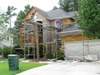
Brown Paint Doesn’t Cover Up Construction Defects
April 25, 2012 — CDJ Staff
In a decision that describes the case as illustrating “the perils that real estate brokers and their agents assume when acting as a dual listing agent to both the buyers and sellers of the same house,” the California Court of Appeals has issued a decision in William L. Lyon & Associates v. The Superior Court of Placer County. Lyon & Associates sought summary judgment to dismiss the claims of the Henleys who bought a home in a transaction where a Lyon agent represented both sides.
�The prior owners of the home, the Costas, had used a Lyon agent in purchasing their home. When they later sought to sell it, that agent “became aware of some of the house’s defects and problems.” In response, the Costas sought the help of another agent, Connie Gidal, also of Lyons & Associates. Photos taken in the presence of Ms. Gidal show defects of the paint and stucco. The Costas also took the step of painting the house dark brown. During the sale process, “rain caused many of the painted-over defects to reappear.” The Costas “purchased more dark brown paint and covered up the newly visible damage prior to inspection by the Henleys.”
�With the damage concealed, the Henleys bought the home in May 2006. The agreement with Lyons & Associates noted that “a dual agent is obligated to disclose known facts materially affecting the value or desirability of the property to both parties.” Escrow closed on May 9, 2006. The contract with the broker included a two-year limit on the time to bring legal action.
�The Henleys moved in during June 2006, and “began to discover construction defects that had been concealed by the Costas.” In addition to the painted-over stucco problems, the Henleys found that the Costas had “installed quartzite stone overlays on the backyard steps in a manner that caused water intrusion on the house’s stucco walls.”
�In May 2009, the Henleys sued the Costas, Ron McKim Construction, Lyons & Associates, and Ms. Gidal. Their complaint alleged that Lyons & Associates had committed breach of contact, negligence, fraud, breach of fiduciary duty, and negligent nondisclosure in connection with the construction defects. The Costas named Lyons in a cross complaint. Lyons moved for summary judgments on the grounds that the two-year statute of limitations had expired before the complaint and cross-complaint were filed. Both the Henleys and the Costas opposed this claim. The court denied the motion and Lyons appealed.
�The appeals court upheld the denial, noting that the both California Supreme Court decision and later action by the legislature compels real estate brokers and salespersons “to conduct a reasonably competent and diligent visual inspection of the property offered for sale.” The court noted that under California law, brokers have responsibilities to both sellers and buyers. The section of law cited by Lyons applies to seller’s agents. The court rejected the contention by Lyons that they were “cooperating brokers.” The Henleys were “not constrained by the two-year statute of limitations.”
�Lyons contended that even if California’s statute did not apply, there was a contractual limit of two years. The court also rejected this, agreeing with the Henleys that “the two-year limitation period must be extended by the discovery rule.”
�The court noted that “Lyon & Associates may not reap the benefit of a shortened contractual limitation period when its own alleged malfeasance contributed to the delay in the discovery of the buyer’s injury.” The court found that the Henleys could proceed with their breach of contract claim, because, “when a breach of contract is committed in secret, such as the intentional nondisclosure of a real estate broker regarding a previously visible construction defect, the contractual limitations period is properly held subject to the discovery rule.” The court felt that the interpretation favored by the California Association of Realtors would “halve the applicable statute of limitations period.”
�In addition to rejecting Lyon request for summary judgment on the claims made by the Henleys, the court also rejected the request of summary judgment on the claims made by the Costas, concluding that neither claim is time-barred. Costs were awarded to both the Henleys and Costas.
� Read the court’s decision…
�
Construction Defect Not a RICO Case, Says Court
August 4, 2011 — CDJ Staff
The US District Court of North Carolina has rejected an attempt by a homeowner to restart her construction defect claim by turning it into a RICO lawsuit. Linda Sharp, the plaintiff in the case of Sharp v. Town of Kitty Hawk, attempted to amend a claim under the Racketeer Influenced and Corrupt Organizations Act (RICO) and argued that her case belonged in the federal courts.
Ms. Sharp sued in November, 2010 claiming construction defects. She sued in federal court, although the court noted that as she and most of the defendants are citizens of North Carolina, the state court would have been the appropriate jurisdiction. Further, the court noted that one federal claim Sharp made was dismissed with prejudice, leaving only the state law claims. These the court dismissed without prejudice, declining to exercise jurisdiction over North Carolina law.
�After the dismissal, Ms. Sharp attempted to amend her complaint after the deadline. To do so, according to the court, she would be required to obtain consent from defendants or leave of the court. She did neither.
�In his opinion, Judge W. Earl Britt rejected her motion for leave to amend. He also granted the defendants’ motion to dismiss. The clerk was directed to close the case.
� Read the court’s decision…
A Call to Washington: Online Permitting Saves Money and the Environment
October 28, 2011 — Douglas Reiser, Builders Counsel
Here’s some good news for Oregon contractors: Electronic Permitting is here. That’s right, no more standing in line with folders full of printed submittals and waiting all day for your permit. The click of a few buttons and you are in business. Great news, right? Unfortunately, Oregon isn’t sharing that celebration with Washington. So I say - why not?
Last week, the State of Oregon released its new ePermitting online interface. The website allows contractors, owners and even local building departments to create an account, submit building plans and procure permits. With your account, you can track the progress of submissions, print documents and get posting information.
The state ran a limited test version in the City of Florence since 2009, working out the kinks. Perhaps the most impressive result of the new system is that Oregon tackled the task of coagulating a local process into one central location.
Read the full story...
Reprinted courtesy of Douglas Reiser of Reiser Legal LLC. Mr. Reiser can be contacted at info@reiserlegal.com
Five Years of Great Legal Blogging at Insurance Law Hawaii
December 9, 2011 — CDJ Staff
Our congratulations to Tred Eyerly who has been blogging at Insurance Law Hawaii for five years now. Over the years, he has posted more than five hundred posts and has provided us all with fascinating insights into the laws on insurance coverage. He describes his blog as “a commentary on insurance coverage issues in Hawaii and beyond.” We are grateful that the “beyond” has just in the last few weeks included Colorado, Illinois, Washington, Minnesota, and Rhode Island (about as far from the island of Hawaii as you can get).
You can read his blog at Insurance Law Hawaii.
Homeowners May Not Need to Pay Lien on Defective Log Cabin
July 1, 2011 — CDJ Staff
The Idaho Supreme Court has ruled in the case of Perception Construction Management v. Bell. The Bells hired PCM to build a log home, agreeing to play monthly invoices in full within ten days. The Bells paid the first four invoices in full, part of the fifth, and ceased payment after that. Beofre seventh invoice, the Bells terminated the contract and hired a new contractor. PCM filed a claim of lien and ceased work.
�The Bells responded that PCM was in breach of contract and had failed to fulfill the contract in a workmanlike manner. They claimed construction defects and in the lien suit, sought to include testimony from an architect and a plumber reviewing PCM’s work. The court only allowed the architect to testify as to whether the amount of the lien was reasonable. No testimony was permitted from the plumber.
�The Idaho Supreme Court concluded that the claims of construction defects were important to case and remanded it to the lower court for a new trial taking into evidence that Bell’s contention that PCM’s work was defective.
Read the court’s decision
Australian Developer Denies Building Problems Due to Construction Defects
June 15, 2011 — CDJ Staff
The Sunland Group, the developer, is objecting to claims that it is responsible for corrosion damage in a residential building in Gold Coast, Australia, as reported in the Courier & Mail. Residents of Q1, the world’s tallest residential tower, are suing the developer, claiming that defects and corrosion “compromise the long-term durability and appearance of” the six-year-old building.
�The developer has not only denied that there are defects in the building, but has also stated that the construction contract “did not warrant that the construction would be defects-free.” Sunland claimed that corrosion was due to the homeowners association having “failed to carry out the maintenance requirements.”
�Repair of the building is expected to cost millions of dollars. Sunland denies that it should pay any of that.
�Read the full story…
Cabinetmaker Exceeds Expectations as Conditions Improve�
October 23, 2012 — CDJ Staff
American Woodmark, the manufacturer of several national brands of cabinets and vanities, saw greater than anticipated earnings in its most recent quarter. Their revenue was $148.3 million, an increase of 13% over the same quarter a year prior. They saw a 40% increase in sales. As a result, their per-share earnings were 7 cents, instead of the projected loss of 3 cents per share. Forbes reports that the share price for American Woodmark has been rising in August 2012.
� Read the full story…
�
Local Government Waives Construction Fees to Spur Jobs
June 19, 2012 — CDJ Staff
Warren Township in New Jersey has waived building and electrical permit fees, up to $5,000, for businesses that create at least five new jobs. The fee reductions are available for construction in areas zones under various designations. Buildings that have received a zoning variance are not eligible. The Echoes-Sentinel notes that other towns in Somerset County, New Jersey have adopted similar ordinances.
Read the full story…
Developer’s Fraudulent Statements Are His Responsibility Alone in Construction Defect Case
February 10, 2012 — CDJ Staff
The Texas Court of Appeals ruled on December 21 in the case of Helm v Kingston, a construction defect case. After purchasing what was described as “an extremely well-built” two-bedroom townhouse, Mr. Kingston made complaints of construction defects. Greenway Development did not repair the defects to Kingston’s satisfaction, and he filed notice of suit. In his suit, he claimed that GDI and its president, John Helm, had committed fraud and negligent misrepresentation. Kingston claimed that Helm “fraudulently induced Kingston to believe that the townhouse evidenced the highest quality of workmanship when in fact the quality of workmanship was atrocious.” Helms brought a counterclaim that Kingston’s suit was frivolous.
�About four years after Kingston purchased the townhome, the suit proceeded to trial. The trial court determined that Helm was not “liable in his individual capacity,” but this was reversed at appeal.
�A second trial was held ten years later on the question of whether Kingston’s unit was a townhome or an apartment. A jury found that Helm “engaged in a false, misleading or deceptive act or practice that Kingston relied on to his detriment.” Kingston was awarded $75,862.29 and an additional $95,000 in attorney fees by the jury. Helms made an unsuccessful appeal to the Appeals Court, after which Kingston was awarded an additional $10,000. Helms then made an unsuccessful appeal to the Texas Supreme Court, which lead to an additional $3,000 for Kingston. There was also a verdict of $48,770.09 in pre-judgment interest and “five percent post-judgment interest accruing from the date of the judgment until the time the judgment is paid. Helm appealed.
�In his appeal, Helm raised seven issues, which the court reorganized into five Kingston raised one issue on cross-appeal.
�Helms’ first claim was that Kingston “failed to satisfy the requirement of” Texas’s Residential Construction Liability Act and that by not filing under the RCLA, Kingston’s fraud and misrepresentation claims were preempted. Further Helms claimed that the RCLA limited Kingston’s damages. The court rejected this, as the RCLA deals with complaints made to a contractor and not only did Helm fail to “conclusively establish” his “status as a ‘contractor’ under the statutory definition,” Helm testified that he was “not a contactor” at the pre-trial hearing.
�Helms’s second claim was that Kingston’s later claim of a misconstructed firewall should be barred, claiming that Kingston “‘had knowledge of a defect in the firewall’ as early as 1997 but did not assert them until 2007.” The court rejected this because Kingston’s claim was that “Helm ‘fraudulently induced Kingston to believe that the townhouse evidenced the highest quality of workmanship when in fact the quality of the workmanship was atrocious.’”
�Helms also challenged whether his statements that the residence was of “good quality” constituted fraud and misrepresentation under Texas’s Deceptive Trade Practices-Consumer Protection Act. The court concluded that Helm was in a position to make knowledgeable statements and further that “residential housing units are not artistic works for which quality is inherently a matter of subjective judgment.” Helm also claimed that Kingston could have avoided certain repair expenses through the “exercise of reasonable care.” Helms argued that the repairs could have been made for $6,400. The court disagreed, as these claims were cited only to invoke the DTPA, and that later petitions established additional defects.
�Helms’s next claim was that he was not allowed to designate responsible third parties. The court rejected this because there GDI represented matters concerning the residence only through Helm’s statements. The court noted that “Helm is correct that?third parties may be liable for fraud if they ‘participated in the fraudulent transactions and reaped the benefits,’” but they note that “Helm never specifically alleged that GDI or CREIC participated in Helm’s alleged fraudulent transactions.
�The final issue in the decision was about court costs, and here the court denied claims on both sides. Helm argued that the award of legal fees were excessive, as they exceeded the actual damages. The court noted that they “may not substitute our judgment for that of the jury,” and also that “the ratio between the actual damages awarded and the attorney’s fees is not a factor that determines the reasonableness of the fees.” But the court also rejected Kingston’s claim for post-judgment interest on $10,312.30 that Helm had deposited in the trial court’s registry. The court noted that the monies were to be paid out upon final judgment, but the mandate did not include any reference to interest.
Read the court’s decision…
Fifth Circuit Reverses Insurers’ Summary Judgment Award Based on "Your Work" Exclusion
November 18, 2011 — Tred Eyerley, Insurance Law Hawaii
Application of the facts to the "your work" exclusion was the key to resolving coverage issued in Am. Home Assurance Co. v. Cat Tech L.L.C., 2011 U.S. App. LEXIS 21076 (5th Cir. Oct. 5, 2011).
Ergon Refining, Inc. hired Cat Tech L.L.C. to service a hydrotreating reactor. In January 2005, Cat Tech replaced certain parts in the reactor. After Cat Tech finished the job and left, Ergon noticed a high pressure drop in the reactor, forcing it to be shut down. Cat Tech returned in February 2005, removed, repaired and replaced the damaged parts, and loaded new parts. After completion, a second large pressure drop occurred during the reactor’s start-up process. The reactor was shut down until October 2005, when Ergon hired a different contractor to perform the repair work. Additional damage to the reactor was found.
Read the full story…
Reprinted courtesy of Tred R. Eyerly, Insurance Law Hawaii. Mr. Eyerly can be contacted at te@hawaiilawyer.com
Largest Per Unit Settlement Ever in California Construction Defect Case?
October 28, 2011 — CDJ Staff
BusinessWire reports that the Chelsea Court Homeowners Association has settled their construction defect case for $5.4 million. That works out to $169,000 per unit, which BusinessWire describes as “California’s largest per-unit recovery known to be on record to date.”
Most of the money in the settlement is coming from insurance companies for the builder and thirteen subcontractors. Issues included roof and window leaks, deck failures, and unsafe walkways.
Read the full story...
Federal District Court Predicts Florida Will Adopt Injury In Fact Trigger�
October 23, 2012 — Tred Eyerly, Insurance Law Hawaii
The U. S. District Court for the Middle District of Florida was confronted with determining whether Florida would follow the manifestation or injury in fact trigger in Axis Surplus Ins. Co. v. Contravest Constr. Co., 2012 U.S. Dist. LEXIS 104502 (D. Fla. June 5, 2012).
�The homeowner's association sued the insureds for alleged negligent construction and development of individual dwelling units and common areas of their condominium. Due to this negligence, severe damage was caused by water intrusion. The Association's members only became aware of the defects through the retention of construction experts.
�The insured had CGL coverage with Axis, with policies issued from 2003 to 2007. Coverage was denied for the periods 2003-2004 and 2004-2005. Axis provided a defense under the policies issued for 2005-2006 and 2006-2007, but under a reservation of rights. Axis sought a declaration that it had no duty to defend or indemnify because the damage manifested before its policy periods.
�For coverage to exist, "property damage" must have "occurred" during Axis' policy period.
� Read the full story…
��Reprinted courtesy of Tred R. Eyerly, Insurance Law Hawaii. Mr. Eyerly can be contacted at te@hawaiilawyer.com
��
Plans Go High Tech
April 25, 2012 — CDJ Staff
One construction executive described it as “the wave of the future.” What is it? Accessing building plans on an iPad. According to an article in MacWorld, several companies are now offering solutions to distribute and update construction plans on iPads. Changes to plans and notes can be distributed quickly through cloud computing.
�Alan Dillon, a senior superintendent at DPR Construction told MacWorld, “I can take my iPad into the field and have my whole set of drawings.” He described a set of drawings for a large construction project as “five or six inches thick.” Danielle Douthet, of Level 10 Construction said it “can help everyone be on the same page more quickly, and make sure that everybody is working off the most current set of documents.”
�And it’s not just building plans. Other firms offer building management applications designed to be taken into the field on mobile devices.
� Read the full story…
�
Pennsylvania Court Extends Construction Defect Protections to Subsequent Buyers
December 20, 2012 — CDJ Staff
The Pennsylvania courts have long held that there is an implied warranty of habitability for the initial purchaser of a home. Now, as some defects may not immediately show up, the court has extended that implied warranty to second and subsequent purchasers. As Marc D. Brookman, David I. Haas, and Christopher Bender of Duane Morris note, “this judicially created doctrine shifts the risk of a latent defect in the construction of a new home from the purchaser to the builder-vendor.”
The Pennsylvania Supreme Court concluded that a contractual relationship is not needed for an implied warranty of habitability. The court’s concern was inequalities would result when a home was sold while other homes were protected by being within the statute of repose.
Read the full story…
State Farm Too Quick To Deny Coverage, Court Rules
July 22, 2011 — CDJ Staff
On July 13, 2011, Judge Sarah S. Vance of the US District Court issued a rule in the case of Travelers Cas. & Surety Co. of Am. v. Univ. Facilities, Inc. (E.D. La., 2011). In this case, Stanley Smith Drywall was contracted by Capstone Building Corporation to “perform undisclosed work at the facility believed to involve the installation of drywall.” The project involved the design and construction of student residences for the Southeastern Louisiana University in Hammond, Louisiana. In May, 2009, University Facilities, Inc. (UFI) sued Capstone Development Corporation and Capstone On-Campus Management.
�State Farm insured Stanley Smith Drywall and they sought a declaration that they have no duty: “(1) to insure Stanley Smith or CBC, or (2) to defend or indemnify any party against UFI's claims in the pending arbitration.” State Farm contends “(1) there is no "occurrence" to trigger coverage under the policy; (2) only breach of contract claims are asserted; (3) there is no property damage alleged; and (4) various coverage limitations and exclusions apply to prevent coverage.’
�The court concluded that “whether State Farm has a duty to defend in the arbitration must be determined by considering the claims asserted in the arbitration.” However, the arbitration claims were not made part of the record. There, “, the Court cannot determine as a matter of law State Farm's duty to defend on the present record.” The same was true of State Farm’s duty to indemnify. “Stanley Smith and CBC assert that State Farm's motion for summary judgment was filed before any discovery was conducted in the arbitration proceeding or in this case. The Court finds that State Farm has failed to develop the record sufficiently to establish that there is no genuine issue of material fact as to its duty to indemnify Stanley Smith or CBC in the arbitration.’
�The court denied State Farm’s motion for a summary judgment on its duty to defend and indemnify.
� Read the court’s decision…
Water Drainage Case Lacks Standing
March 28, 2012 — CDJ Staff
The Texas Court of Appeals has ruled in the case La Tierra de Simmons Familia Ltd. V. Main Event Entertainment, LP. The trial court had found for Main Event. On appeal, the court threw out some of the grounds on which the trial court had reached its decision.
�The case involved two commercial lots in northwest Austin, Texas. The uphill tract (Phase III of the Anderson Arbor development) diverts its runoff onto the lower tract (the “Ballard tract”). The owners of the Ballard tract claim that “the drainage system was designed or constructed in a manner that has damaged and continues to damage the Ballard tract.”
�Both tracts have undergone changes of ownership since the construction of the drainage system in 2004. At the time the drainage system was constructed, the parcel was owned by Sears Roebuck and Co. Sears later sold the property. Main Event Entertainment is the current tenant. Likewise, the Ballard tract was previously owned by the Ballard Estate which sold the property to La Tierra on an “as is” basis in 2007.
�After La Tierra bought the Ballard tract, La Tierra’s engineer “witnessed and videotaped what he described as ‘flooding’ on the Ballard tract caused by storm water discharge from the Anderson Arbor drainage system during a rainfall event.” La Tierra determined that an adequate drainage system would cost about $204,000. Development plans were put on hold.
�La Tierra sued Main Event and various other parties associated with the uphill tract, seeking “actual damages for (1) decrease and loss in rental income due to delay in obtaining the development permit, (2) interest on carrying costs during that time period, (3) the cost to build a water conveyance system on the Ballard tract, (4) engineering fees incurred to redesign the water conveyance system, (5) unspecified out-of-pocket real estate expenses, and (6) property devaluation occasioned by the need to construct an expensive water conveyance system.” The trial court never reached these claims, ruling instead that La Tierra lacked standing, that its claims were barred under the statute of limitations, and that there was no evidence of damage.
�La Tierra appealed, arguing that “(1) the summary-judgment evidence does not conclusively establish that property damage claims accrued or were discovered prior to September 11, 2007, which is within the limitations period and was after La Tierra purchased the property; (2) even if the property was damaged before La Tierra acquired ownership of the Ballard tract, standing exists based on the assignments of interest from the Ballard Estate heirs, and the discovery rule tolls limitations until the injury was discovered on September 11, 2007; (3) limitations does not bar La Tierra's request for injunctive relief; (4) La Tierra's water code claim against Main Event and M.E.E.P. is viable based on their control over the drainage system, which makes them necessary and indispensable parties for injunctive relief; (5) La Tierra presented more than a scintilla of evidence to raise a fact issue on damages, causation, and other essential elements of its causes of action; and (6) the trial court abused its discretion when it sustained the defendants' objections to La Tierra's summary-judgment evidence.”
�The appeals court concluded that La Tierra’s second claim was irrelevant to standing, as La Tierra “obtained assignments from the Ballard Estate heirs ? nearly one year after the lawsuit was initially filed.” Nor did the court accept their first point. The water system had been operating unaltered since January, 2004, with monthly maintenance and inspection to maintain its designed operation. Further, a feasibility report La Tierra received stated that “over sixteen acres drain into those ponds, and thus onto this site.” The court noted that “the underlying facts giving rise to a cause of action were known before La Tierra acquired ownership of the Ballard tract.”
�The court concluded that the drainage issue is a permanent injury, but that it “accrued before La Tierra acquired an ownership interest in the property.” As La Tierra has standing, the appeals court ruled that it was improper for the trial court to rule on the issues. The appeals court dismissed the questions of whether the case was barred under the statute of limitation and also the question of whether or not La Tierra had damages.
�As the issue of standing would not allow La Tierra to bring the suit, the appeals court found for the defendants, dismissing the case for this single reason, and otherwise affirming the ruling of the lower court.
Read the court’s decision…
El Paso Increases Surety Bond Requirement on Contractors
April 25, 2011 — April 25, 2011 Beverley BevenFlorez - Construction Defect Journal
The city of El Paso has recently increased surety bonds required of contractors from $10,000 to $50,000, according to the El Paso Times. Proponents of the increase believe it was necessary to protect homeowners from fly-by-night builders, while opponents argue that the increase will have an adverse effect on an industry in that is already suffering due to the economic slowdown.
�Arguments for and against the increase have been flooding the blogosphere with their views. Christian Dorobantescu on the Small Business Entrepreneur Blog claims that “only about 15% of the city’s 2,500 contractors had been able to secure a higher bond to remain eligible for work after the new requirements were announced.” However, insurance companies have a different take. “From a surety broker standpoint, most contractors will be able qualify for the bond; some will just have to pay higher premium rates to obtain it,” a recent post on the Surety1 blog argues.
�While the increased bond may help homeowners deal with construction defect claims, it is not clear what effect it will have on builders in El Paso.
�Read more from the El Paso Times…
�Read more from the Small Business Entrepreneur Blog…
�Read more from the Surety1 Blog…
Legislatures Shouldn’t Try to Do the Courts’ Job
March 1, 2012 — CDJ Staff
David Thamann, writing in Property Casualty 360, argues that current actions by legislatures on insurance coverage amount to “legislative interference or overreach.” He notes that under current Colorado law, “a court shall presume that the work of a construction professional that results in property damage — including damage to the work itself or other work — is an accident unless the property damage is intended and expected by the insured.” He argues that here legislators are stepping into the role of the courts. “Insureds and insurers are not always going to be pleased with a court ruling, but that is the system we have.”
Read the full story…