2011 West Coast Casualty Construction Defect Seminar – Recap
June 1, 2011 — CDJ Staff
� 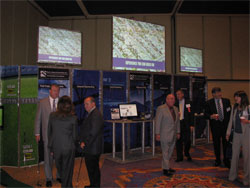 | �
�| Event exhibitors and sponsors contribute to an informative and engaging environment | �
�This year’s meeting was the best yet for the industry-leading construction defect and claims event.
�This year’s seminar concluded on May 13, 2011 with the Construction Defect Community Charitable Foundation Golf Tournament, held at Strawberry Farms Golf Course.
�The Disneyland Hotel in Anaheim, California was the place where more than 1,500 attendees convened for two days of professional development activities and seminars that included CLE workshops and panel discussions of special interest to legal and insurance professionals concerned with construction defect and claims litigation. Key events included “Challenges for Experts in Construction Defect Claims and Litigation,” “Keeping Up with Construction Defect Coverage,” and “Tips for Avoiding the ‘Perfect Storm’ in Handling of Wrap Claims.”
� �  | �
�| Supporting the golf tournament at the 15th hole | �
�This year’s Ollie award was given to George D. Calkins II, Esq. The West Coast Casualty Jerrold S. Oliver Award of Excellence was named in honor of the late Judge Jerrold S. Oliver, and recognizes an individual who is outstanding or has contributed to the betterment of the construction community.
�In addition to being the most comprehensive professional development seminar in the area of construction defects, this year’s seminar was equally valuable as a networking opportunity for members of the industry. People participated in professional development events during the day and then continued networking in the evening at numerous social events. The Lawn Party as well as the legendary Wood, Smith, Henning & Berman events were very well attended. Additional valuable networking events were hosted by a number of industry professionals at the House of Blues, and Tortilla Joe’s.
�As of this writing the 2011, West Coast Casualty's Construction Defect Seminar has applied for or has already received the following continuing education accreditation in the following areas;
�Read the full story…
�For more information about next year’s event, visit West Coast Casualty.
Lien Law Unlikely To Change — Yet
May 26, 2011 — Melissa Brumback, Construction Law in North Carolina
For those of you following the proposed revisions to the NC lien law that is currently at the NC House Judiciary Subcommittee B, a quick update: the proposed bill (HB 489) is unlikely to be voted on this legislative session due to its unpopularity with several constituency groups, including both the AIA-North Carolinaand the NC Home Builders Association.
�Read the full story…
�Reprinted courtesy of Melissa Brumback of Ragsdale Liggett PLLC. Ms. Brumback can be contacted at mbrumback@rl-law.com.
Continuous Trigger of Coverage Adopted for Loss Under First Party Policy
August 2, 2012 — Tred Eyerly, Insurance Law Hawaii
The Seventh Circuit predicted that the Wisconsin Supreme Court would adopt the continuous injury trigger for first party property loss that extends over several policy periods. Miller v. Safeco Ins. Co. of Am., 2012 U.S. App. LEXIS 12940 (7th Cir. June 25, 2012).
A home inspection report performed before the Millers purchased their home showed a soft spot on the roof. The stucco's finish color was also uneven and stained. Further, some water damage was found in the study and skylights above the kitchen sink. But the report advised that the exterior walls, chimney, grass roof, flashings, floor joists/beams and columns, garage walls and floor appeared serviceable. A roof specialist determined the soft spot was not significant and could be repaired for $1,500.
The Millers purchased a homeowner's policy from Safeco on June 30, 2005. The policy went into effect the next day when the Millers closed on the property. But the Millers did not see the policy's terms until Safeco mailed them a copy of the policy at the end of July.
Before receiving the policy, the Millers discovered severe inner wall water leaks and significant water infiltration on three of the home's exterior walls.
Read the full story…
Reprinted courtesy of Tred R. Eyerly, Insurance Law Hawaii. Mr. Eyerly can be contacted at te@hawaiilawyer.com
History of Defects Leads to Punitive Damages for Bankrupt Developer
March 1, 2012 — CDJ Staff
The South Carolina Court of Appeals has ruled that evidence of construction defects at a developer’s other projects were admissible in a construction defect lawsuit. They issued their ruling on Magnolia North Property Owners’ Association v. Heritage Communities, Inc. on February 15, 2012.
�Magnolia North is a condominium complex in South Carolina. The initial builder, Heritage Communities, had not completed construction when they filed for bankruptcy protection under Chapter 11. The remaining four buildings were completed by another contractor. The Property Owners’ Association subsequently sued Heritage Communities, Inc. (HCI) alleging defects. The POA also sued Heritage Magnolia North, and the general contractor, BuildStar.
�The trial court ruled that all three entities were in fact one. On appeal, the defendants claimed that the trial court improperly amalgamated the defendants. The appeals court noted, however, that “all these corporations share officers, directors, office space, and a phone number with HCI.” Until Heritage Communities turned over control of the POA to the actual homeowners, all of the POA’s officers were officers of HCI. The appeals court concluded that “the trial court’s ruling that Appellants’ entities were amalgamated is supported by the law and the evidence.”
�Heritage also claimed that the trial court should not have allowed the plaintiffs to produce evidence of construction defects at other Heritage properties. Heritage argued that the evidence was a violation of the South Carolina Rules of Evidence. The court cited a South Carolina Supreme Court case which made an exception for “facts showing the other acts were substantially similar to the event at issue.” The court noted that the defects introduced by the plaintiffs were “virtually identical across all developments.” This included identical use of the same products from project to project. Further, these were used to demonstrate that “HCI was aware of water issues in the other projects as early as 1998, before construction on Magnolia North had begun.”
�The trial case ended with a directed verdict. Heritage charged that the jury should have determined whether the alleged defects existed. The appeals court noted that there was “overwhelming evidence” that Heritage failed “to meet the industry standard of care.” Heritage did not dispute the existence of the damages during the trial, they “merely contested the extent.”
�Further, Heritage claimed in its appeal that the case should have been rejected due to the three-year statute of limitations. They note that the first meeting of the POA was on March 8, 2000, yet the suit was not filed until May 28, 2003, just over three years. The court noted that here the statute of limitation must be tolled, as Heritage controlled the POA until September 9, 2002. The owner-controlled POA filed suit “approximately eight months after assuming control.”
�The court also applied equitable estoppel to the statute of limitations. During the time in which Heritage controlled the board, Heritage “assured the unit owners the construction defects would be repaired, and, as a result, the owners were justified in relying on those assurances.” Since “a reasonable owner could have believed that it would be counter-productive to file suit,” the court found that also prevented Heritage from invoking the statute of limitations. In the end, the appeals court concluded that the even apart from equitable tolling and equitable estoppel, the statute of limitations could not have started until the unit owners took control of the board in September, 2002.
�Heritage also contested the jury’s awarding of damages, asserting that “the POA failed to establish its damages as to any of its claims.” Noting that damages are determined “with reasonable certainty or accuracy,” and that “proof with mathematical certainty of the amount of loss or damage is not required,” the appeals court found a “sufficiently reasonable basis of computation of damages to support the trial court’s submission of damages to the jury.” Heritage also claimed that the POA did not show that the damage existed at the time of the transfer of control. The court rejected this claim as well.
�Finally, Heritage argued that punitive damages were improperly applied for two reasons: that “the award of punitive damages has no deterrent effect because Appellants went out of business prior to the commencement of the litigation” and that Heritages has “no ability to pay punitive damages.” The punitive damages were upheld, as the relevant earlier decision includes “defendant’s degree of culpability,” “defendants awareness or concealment,” “existence of similar past conduct,” and “likelihood of deterring the defendant or others from similar conduct.”
�The appeals court rejected all of the claims made by Heritage, fully upholding the decision of the trial court.
Read the court’s decision…
Exclusion Bars Coverage for Mold, Fungus�
October 23, 2012 — Tred Eyerly, Insurance Law Hawaii
The court considered whether rain damage to a house was barred by the policy's mold exclusion. Stewart v. State Farm Fire & Cas. Co., 2012 U.S. Dist LEXIS 127804 (D. S.D. Sept. 7, 2012).
�The insureds hired DJ Construction to build a new home. Before construction was completed, it was discovered that DJ Construction and some of its subcontractors had failed to protect the partially constructed house from the elements, which allowed melting snow and rain to intrude into the house. Soon after this discovery, DJ Construction abandoned the project. The house remained incomplete and uninhabitable.
�The insureds sued DJ Construction.
� Read the full story…
��Reprinted courtesy of Tred R. Eyerly, Insurance Law Hawaii. Mr. Eyerly can be contacted at te@hawaiilawyer.com
��
Arbitration Clause Found Ambiguous in Construction Defect Case
October 28, 2011 — CDJ Staff
The California Court of Appeals ruled on September 28 in the case of Burch v. Premier Homes. Ms. Burch bought a home after negotiating various addendums to the contract. The contract was a standard California Association of Realtors contract to which both the buyer and seller made additions. At issue in this case was paragraph 17 of the contract which included that “Buyer and Seller agree that any dispute or claim in Law or equity arising between them out of this Agreement or resulting transaction, which is not settled through mediation, shall be decided by neutral, binding arbitration.”
The seller/defendant’s Addendum 2 “included provisions relating to the arbitration of disputes that may arise.” Ms. Burch’s realtor, Lisa Morrin, told Burch that “she had never seen a proposed contractual provision that would require a home buyer to agree to arbitrate with a builder over construction defects.” Ms. Burch told Morrin that she did not want to buy the property if she would have to give up her rights under California law.
As part of Addendum 2, the buyer had to buy a warranty from the Home Buyers Warranty Corporation. The sale was held up for a while, as Ms. Burch waited for a copy of the warranty. When she received it, she took further exception to Addendum 2. Scott Warren of Premier Homes said he could not sell the property without Addendum 2. Ms. Burch told her realtor that despite the claims made by Mr. Warren that this was for her benefit, she felt it was more to the benefit of Premier Homes. Don Aberbrook of HBW agreed to the clause, contained in the final sentence of Addendum 2, being struck.
Subsequent to buying the home, Burch submitted a claim concerning construction defects. HBW denied the claim and Burch began an action against the defendants. Premier filed a motion to compel arbitration which Burch opposed.
The trial court ruled that the striking out of the arbitration clause at the end of Addendum 2 “created a conflict with respect to the parties’ intent as to the scope of arbitration.” The trial court found that “the parties’ intention was to preserve Burch’s right to make state law claims including her right to a jury trial for any non-warranty claims against the builder.”
The appeals court in their ruling looked at the standard of review and concluded that the purchase agreement was ambiguous and that extrinsic evidence was required to resolve that ambiguity. As the contract contained contradictory provisions as to whether or not arbitration was required, it was necessary for the trial court to examine these claims. The appeals court found that the evidence supported the conclusions of the trial court.
Finally, the appeals court found that “there was no valid agreement to arbitrate disputes.” The court noted that arbitration can only happen by mutual consent and “it is clear that Burch did not enter into an agreement to arbitrate any construction defect disputes she might have.”
Read the court’s decision…
Construction Law Alert: A Specialty License May Not Be Required If Work Covered By Another License
March 7, 2011 — By
Steve Cvitanovic of
Haight Brown & Bonesteel, LLP.Contractors should always be sure that they understand the licensing in any Subcontract or Prime Contract before entering into any agreement. However, on March 3, 2011, in the case of Pacific Casson & Shoring, Inc. v. Bernards Bros., Inc. 2011 Cal.App.Lexis 236, the Court of Appeal determined that if a specialty license is subsumed within another license, the specialty license may not be required.
�Bernards entered into a subcontract with Pacific to excavate, backfill, grade and provide geotechnical design parameters for a hospital. The Prime Contract required the bidder to maintain a Class C-12 specialty earthwork license. However, Pacific only held a Class A general engineering license which it turns out was suspended during the performance of the work. Pacific sued Bernards for nonpayment of $544,567, but the lawsuit was dismissed because the trial court found that Pacific (1) lacked a C-12 license, and (2) Pacific’s Class A license was suspended for failure to pay an unrelated judgment. Pacific was also ordered to disgorge $206,437 in prior payments.
�The Court of Appeal reversed and remanded. The Court of Appeal agreed with Pacific and held that a C-12 specialty license was not required despite the Prime Contract. The Court of Appeal found that the C-12 specialty license would have been “superfluous” since it was fully encompassed within the Class A requirements. However, the Court of Appeal also remanded the case for further
�Read the full story...
�Reprinted courtesy of Steve Cvitanovic of Haight Brown & Bonesteel, LLP.
Negligent Misrepresentation in Sale of Building Altered without Permits
September 30, 2011 — CDJ Staff
The Supreme Court of New Hampshire has ruled in the case Wyle v. Lees. The Leeses owned a two-unit apartment building in North Conway, New Hampshire. They hired a contractor to add a third, larger apartment, including a two-car garage. The Leeses and their contractor submitted a building permit application. They were informed that site plan review was required. After receiving approval on the site plan, construction started. At no point did they obtain a building permit and the construction was never inspected. The Leeses subsequently added more space to the unit, reducing parking spaces below the minimum required. Again, they did not obtain a building permit.
In 2007, three years after all these changes were complete, the Leeses sold their building to Mr. Wyle. To the question “are you aware of any modifications or repairs made without the necessary permits?” they answered “no.” About six weeks after closing, Wyle “received a letter from the town code enforcement officer regarding the legality of the removal of a garage door from the new unit.” A subsequent inspection revealed “numerous building and life safety code violations.”
Mr. Wyle brought a claim against the Leeses for negligent misrepresentation. The defendants filed a motion “seeking to preclude economic loss damages.” At a two-day bench trial, Mr. Wyle won. The Leeses appealed.
The appeals court found that “the defendants negligently misrepresented that the premises were licensed for immediate occupancy and that the defendants had obtained all necessary permits,” and thus upheld the lower court’s finding of negligent misrepresentation. The appeals court also rejected the Leeses’ argument that damages must be apportioned on all parties, including “the plaintiff himself, the plaintiff’s building inspector, and the defendant’s contractor,” finding a lack of “adequate evidence.”
The Leeses further argued that they were unaware that modifications and repairs were accomplished without the required permits. The appeals court noted that “the trial court found that both the conditional approval and final approval for the site plan stated that a building permit and a certificate of occupancy were required prior to any use.” The court concluded that the Leeses “knew or should have known of the falsity of their representation.”
The appeals affirmed the findings of the trial court.
Read the court’s decision…
Going Green for Lower Permit Fees
October 23, 2012 — CDJ Staff
Clay County, Kansas is offering rebates on building permits for green homes. According to the Kansas City Star, building permits in the county are typically $2,500. The county will rebate anything from half to all of the permit fee, depending on how well the builder meets green standards. The county will monitor and inspect the process to make certain that builders adhere to their promises for green construction. The county hopes this will encourage green building by offsetting the cost.
� Read the full story…
�
Architect Not Liable for Balcony’s Collapse
September 13, 2012 — CDJ Staff
The Texas Supreme Court declined to hear an appeal from a woman who was partially paralyzed due to the collapse of a balcony. She had sued the architect of her friends’ home, but the Texas Third Circuit Court of Appeals had reversed a jury ruling against the architect, Sinclair Black. Black’s firm, Black + Vernooy, had designed the home and had supervised “administration of the construction contract.” Despite a contractual obligation to “endeavor to guard the owner against defects and deficiencies,” the balcony builder had not followed the architect’s specifications, including in the construction of the balcony.
�While the jury found Black liable for ten percent of the blame, Black argued that he could not be held liable for the contractor’s negligence, nor did he have any duty to third parties.
Read the full story…
Construction Defects and Contractor-Owners
July 10, 2012 — CDJ Staff
On the expert advice site Avvo.com, a user asks if he can be sued for construction defects by the new owner of a building for which he served as general contractor and then owned for four years. He had construction insurance, but does not think he had construction defect insurance.
A lawyer responding to his question says that “you could be sued.” In the event of a suit, “you would have to bring claims against all of your subcontractors.”
Read the full story…
Insurer Has Duty to Defend Despite Construction Defects
January 6, 2012 — CDJ Staff
In a case the judge attributed to “shoddy masonry work,” the US District Court of Illinois has rendered a decision in AMCO Insurance Company v. Northern Heritage Builders. Northern Heritage built a home in Chicago for Michael McGrath (who joined Northern Heritage as a defendant). According to the decision, “seven months after he moved into the house, McGrath noticed water coming in the house and warped millwork.” This was attributed to porous block, installed by the mason with Northern Heritage’s knowledge.
McGrath sued National Heritage for both the damage to his house and its contents. The court rejected his claim for the contents. For the damages to his house, he was awarded $601,570.50 in damages. He also sued his homeowner’s insurance carrier for damages not covered in his suit against National Heritage. There he was awarded $1,130,680.16.
AMCO informed National Heritage that it had neither duty to defend nor duty to indemnify. The judge considered whether AMCO had a duty to defend. Under Illinois law, “damage to a construction project resulting from construction defects is not an ‘accident’ or ‘occurrence’ because it represents the natural and ordinary consequence of faulty construction.” However, it is noted that while if the defects lead only to damage to the project itself, there is no occurrence, “if the building owner asserts damages to other property besides the construction itself, there is an ‘occurrence’ and ‘property damage.’” The judge further noted that were construction defects an occurrence, “shoddy work” would be rewarded by double pay, once by the homeowner and a second time by the insurer. Judge Kendall concluded that as McGrath had alleged damage to the contents of his house, AMCO had a duty to defend National Heritage.
She then looked at the issue of whether AMCO had a duty to indemnify. Should they pay the $601,570.50? Judge Kendall noted that “the duty to indemnify is narrower than the duty to defend.” The key point here was that once McGrath’s insurance carrier covered him for the damage to the contents of his house, “AMCO’s duty to defend ended.” Once McGrath “only sought damages for the natural consequences of faulty workmanship” there was no occurrence, hence nothing for AMCO to cover.
Judge Kendall granted a summary dismissal of AMCO’s claim that they had no duty to defend while upholding their claim that they had no duty to indemnify.
Read the court’s decision…
Ohio Court Finds No Coverage for Construction Defect Claims
March 28, 2012 — Tred Eyerly, Construction Law Hawaii
Charles and Valerie Myers hired Perry Miller to build their home. Myers v. United Ohio Ins. Co., 2012 Ohio App. LEXIS 287 (Ohio Ct. App. Jan. 26, 2012). After completion of the home, Miller was again hired to construct an addition which included a full basement, staircases, bathroom, bedroom, hallway and garage.
�After the addition was completed, one of the basement walls began to crack and bow. Miller began to make repairs, but eventually stopped working on the project. Other contractors were hired to make repairs, but further problems developed. A second basement wall began to bow and crack, allowing water into the basement. The wall eventually had to be replaced. Subsequently, the roof over the addition began to leak in five or six places before the drywall could be painted. The leaks caused water stains on the drywall and caused it to separate and tear. It was discovered the roof needed to be replaced.
�The Myers sued Miller and his insurer, United Ohio Insurance Company. The trial court ruled that the policy did not provide coverage for faulty workmanship, but did provide coverage for consequential damages caused by repeated exposure to the elements. United Ohio conceded liability in the amount of $2,000 to repair water damage to the drywall. United Ohio was also found liable for $51,576, which included $31,000 to repair the roof and ceiling and $18,576 to replace the basement wall.
Read the full story…
���Reprinted courtesy of Tred R. Eyerly, Insurance Law Hawaii. Mr. Eyerly can be contacted at te@hawaiilawyer.com
�
Don MacGregor To Speak at 2011 West Coast Casualty Construction Defect Seminar
January 1, 2011 — February 08, 2011 CDJ Staff
“Challenges for Experts in Construction Defect Claims and Litigation” will be held Thursday May 13, 2011 between 1:30 and 3:00 PM at this year’s West Coast Casualty Construction Defect Seminar. Among the various topics covered will be of Right to Repair/Opportunity to Repair statutes, improper testing methodologies, new challenges where a case involves a Wrap Policy, OCIPS, CCIPS, and other owner controlled insurance programs, as well as the need for realistic testing protocols for the party the expert is retained to represent.
�During the presentation Mr. MacGregor will be working in connection with a group of construction and design experts each of which have extensive experience with construction defect and claims related litigation. This particular session is expected to attract a standing-room only crowd, drawing in excess of 1700 attendees.
�The West Coast Casualty Construction Defect Seminar is the largest seminar of its type. This year’s event is scheduled for will take place on May 12 and 13, 2011, at The Disneyland Hotel and Resort. For more information regarding the years event please visit http://www.westcoastcasualty.com/dyncat.cfm?catid=3322
http://www.westcoastcasualty.com/dyncat.cfm?catid=3322
Kentucky Court Upholds Arbitration Award, Denies Appeal
June 15, 2011 — CDJ Staff
The Kentucky Court of Appeals has ruled in Lake Cumberland Community Action Agency v. CMW, Inc. affirming the arbitration award. CMW, Inc. was responsible for the construction of a facility to be used for pre-school students and the housing of Alzheimer patients and senior citizens. An agreement was made that any disputes would be heard by an arbitrator selected by the construction industry.
�The plaintiff alleged that there were design and construction defects in the building trusses, violation of the Kentucky Building Code, and problems with the HVAC system. The arbitrator awarded $106,000 to the plaintiff which then sought to vacate the award. The circuit court upheld the arbitrator’s decision.
�The Court of Appeals found that there was no basis for rejecting the arbitrator’s decision, noting “there is nothing to show that there was any fraud or bias on the part of the arbitrator.” The appeals court, with all three judges concurring, upheld the arbitration award.
�Read the court’s decision
State Audit Questions College Construction Spending in LA
August 17, 2011 — CDJ Staff
A state audit of the Los Angeles Community College District found many problems with their construction spending. Their report, as described in the Los Angeles Times, found construction money spent for other purposes, such as promotional photography and public relation tours, $28.3 million spent on projects that were later cancelled, and oversight committees that provided no oversight.
�Earlier this year, the LA Times ran a series of articles detailing problems with the Los Angles Community College District’s construction program. The LA Times reported that the State Controller’s audit reached many of the same conclusions.
�The Community College District disputed the findings.
Read the full story…
Faulty Workmanship Exclusion Does Not Bar Coverage
November 18, 2011 — Tred Eyerley, Insurance Law Hawaii
The court determined that the Faulty Workmanship Exclusion only barred coverage for damages arising from problems with the property under construction itself and not to losses incurred to correct damage from accidents during construction. See 1756 First Associates, LLC v. Continental Casualty Co., 2011 U.S. Dist. LEXIS 117100 (S.D.N.Y. Oct. 3, 2011).
A tower crane collapsed at the construction site, causing damage. First Associates tendered the claim to its insurer, Continental. Continental reimbursed First Associates for certain costs arising from damage to and cleanup of the construction site and building stemming from the crane collapse. Continental refused, however, to reimburse First Associates for costs associated with construction delays resulting from the collapse.
Read the full story…
Reprinted courtesy of Tred R. Eyerly, Insurance Law Hawaii. Mr. Eyerly can be contacted at te@hawaiilawyer.com
Texas Construction Firm Files for Bankruptcy
December 20, 2012 — CDJ Staff
A Texas construction firm, founded in 1937, filed for bankruptcy, bringing twenty-two projects to a sudden halt, and resulting in the loss of jobs for hundreds of employees. Ballenger Construction told its employees to go home, as it could not complete the jobs. In some cases, work will need to be done to ensure that the work sites do not cause public safety hazards.
Read the full story…