2011 West Coast Casualty Construction Defect Seminar – Recap
June 1, 2011 — CDJ Staff
� 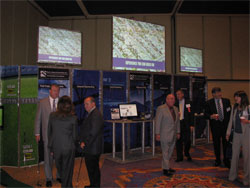 | �
�| Event exhibitors and sponsors contribute to an informative and engaging environment | �
�This year’s meeting was the best yet for the industry-leading construction defect and claims event.
�This year’s seminar concluded on May 13, 2011 with the Construction Defect Community Charitable Foundation Golf Tournament, held at Strawberry Farms Golf Course.
�The Disneyland Hotel in Anaheim, California was the place where more than 1,500 attendees convened for two days of professional development activities and seminars that included CLE workshops and panel discussions of special interest to legal and insurance professionals concerned with construction defect and claims litigation. Key events included “Challenges for Experts in Construction Defect Claims and Litigation,” “Keeping Up with Construction Defect Coverage,” and “Tips for Avoiding the ‘Perfect Storm’ in Handling of Wrap Claims.”
� �  | �
�| Supporting the golf tournament at the 15th hole | �
�This year’s Ollie award was given to George D. Calkins II, Esq. The West Coast Casualty Jerrold S. Oliver Award of Excellence was named in honor of the late Judge Jerrold S. Oliver, and recognizes an individual who is outstanding or has contributed to the betterment of the construction community.
�In addition to being the most comprehensive professional development seminar in the area of construction defects, this year’s seminar was equally valuable as a networking opportunity for members of the industry. People participated in professional development events during the day and then continued networking in the evening at numerous social events. The Lawn Party as well as the legendary Wood, Smith, Henning & Berman events were very well attended. Additional valuable networking events were hosted by a number of industry professionals at the House of Blues, and Tortilla Joe’s.
�As of this writing the 2011, West Coast Casualty's Construction Defect Seminar has applied for or has already received the following continuing education accreditation in the following areas;
�Read the full story…
�For more information about next year’s event, visit West Coast Casualty.
Architectural Firm Disputes Claim of Fault
May 27, 2011 — CDJ Staff
Lake-Flato Architects has disputed the arbitration panel’s conclusion that problems with the home of Tom Hanks and Rita Wilson were due to design flaws. The firm settled with the couple for $900,000, however the Idaho Mountain Express reports that David Lake said, “the settlement in the case in no way represents that Lake Flato was responsible for faulty design.” The Express reported that “the arbitrators found that problems at the home were attributable to design errors that did not take into account the cold winter climate of the Sun Valley area.”
�Read the full story…
Kentucky Court Upholds Arbitration Award, Denies Appeal
June 15, 2011 — CDJ Staff
The Kentucky Court of Appeals has ruled in Lake Cumberland Community Action Agency v. CMW, Inc. affirming the arbitration award. CMW, Inc. was responsible for the construction of a facility to be used for pre-school students and the housing of Alzheimer patients and senior citizens. An agreement was made that any disputes would be heard by an arbitrator selected by the construction industry.
�The plaintiff alleged that there were design and construction defects in the building trusses, violation of the Kentucky Building Code, and problems with the HVAC system. The arbitrator awarded $106,000 to the plaintiff which then sought to vacate the award. The circuit court upheld the arbitrator’s decision.
�The Court of Appeals found that there was no basis for rejecting the arbitrator’s decision, noting “there is nothing to show that there was any fraud or bias on the part of the arbitrator.” The appeals court, with all three judges concurring, upheld the arbitration award.
�Read the court’s decision
Home Repair Firms Sued for Fraud
September 30, 2011 — CDJ Staff
The Illinois Attorney General has filed a lawsuit in Cook County Circuit Court alleging that two connected firms took money from homeowners and then failed to perform the contracted work. One of the three defendants, Chris Bidigare, was an owner of agent of both Fairway Construction and Maintenance Services, LLC, and Rock Construction Management, LLC.
In once case, according to the article on the OakPark Patch, one homeowner provided a $111,000 down payment, only to have the company cancel the job and refuse to return the money. One homeowner was told by Fairway that she should contact their insurance provider. The insurance provider told her that Fairway’s insurance had been cancelled due to non-payment.
The suit seeks to bar the three defendants from working in home repair in Illinois.
Read the full story…
DA’s Office Checking Workers Comp Compliance
February 10, 2012 — CDJ Staff
The San Bernardino office of the California District Attorney is partnering with the California Contractor’s State License Board to check if subcontractors are holding the required workers compensation insurance. The High Desert Daily Press reports that the process of checking at sites has been going on for several months.
� Investigators visit sites and ask supervisors to provide a list of subcontractors which the state then checks for compliance. One worker was quoted that insurance inspections were so rare that he had never seen one before, despite 20 years in construction.
� On one day, investigators in two teams visited fourteen construction sites and reviewed the insurance status of twenty-two firms. Three were found out of compliance and stop work orders were issued.
Read the full story…
Texas res judicata and co-insurer defense costs contribution
March 23, 2011 — Original story by CDCoverage.com, March 23, 2011
In Truck Ins. Exchange v. Mid-Continent Casualty Co., No. 03-08-00526-CV (Tex. App. 3d Aug. 27, 2010), insured contractor DCI was sued by the project owner seeking damages for defective construction. DCI tendered its defense to its CGL insurers Truck and Mid-Continent. Truck agreed to defend while Mid-Continent denied a defense. While the underlying suit was pending, Mid-Continent sued DCI, but not Truck, and obtained a judicial declaration of no duty to defend or indemnify DCI in the underlying suit. After settling the underlying suit, Truck sued Mid-Continent seeking contribution towards defense costs and indemnity payments. The state trial court entered summary judgment for Mid-Continent. The intermediate appellate court affirmed.
�Read the full story...
�Reprinted courtesy of CDCoverage.com
Construction Defect Destroys Home, Forty Years Later
June 19, 2012 — CDJ Staff
Fire investigators in Monroe, North Carolina have blamed a nail as the source of a fire that lead to a home being declared a total loss. The nail, part of the original construction, nicked a wire within a wall, causing a short, which started a fire. The home was built in the late 1960s.
WBTV reported that the homeowner was awakened by a power outage. He went outside and saw flames coming from a vent in the roof. He was unable to contain the fire with a garden hose. Neighbors called firemen who were able to stop the blaze.
Read the full story…
El Paso Increases Surety Bond Requirement on Contractors
April 25, 2011 — April 25, 2011 Beverley BevenFlorez - Construction Defect Journal
The city of El Paso has recently increased surety bonds required of contractors from $10,000 to $50,000, according to the El Paso Times. Proponents of the increase believe it was necessary to protect homeowners from fly-by-night builders, while opponents argue that the increase will have an adverse effect on an industry in that is already suffering due to the economic slowdown.
�Arguments for and against the increase have been flooding the blogosphere with their views. Christian Dorobantescu on the Small Business Entrepreneur Blog claims that “only about 15% of the city’s 2,500 contractors had been able to secure a higher bond to remain eligible for work after the new requirements were announced.” However, insurance companies have a different take. “From a surety broker standpoint, most contractors will be able qualify for the bond; some will just have to pay higher premium rates to obtain it,” a recent post on the Surety1 blog argues.
�While the increased bond may help homeowners deal with construction defect claims, it is not clear what effect it will have on builders in El Paso.
�Read more from the El Paso Times…
�Read more from the Small Business Entrepreneur Blog…
�Read more from the Surety1 Blog…
Builder Waits too Long to Dispute Contract in Construction Defect Claim�
May 10, 2012 — CDJ Staff
The Louisiana Court of Appeals has affirmed the lower court’s judgment in the case of Richard v. Alleman. The Richards initiated this lawsuit under Louisiana’s New Home Warranty Act, claiming that they had entered into a construction contract with Mr. Alleman and that they quickly found that his materials and methods had been substandard. They sued for the cost of repairing the home and filing the lawsuit. Mr. Alleman countersued, claiming the Richards failed to pay for labor, materials, and services. By his claim, they owed him $12,838.80.
�The trial court split the issues of liability and damages. In the first trial, the court concluded that there was a contact between Alleman and the Richards and that the New Home Warranty Act applied. Mr. Alleman did not appeal this trial.
�The second trial was on the issue of damages. Under the New Home Warranty Act, the Richards were found to be entitled to $36,977.11 in damages. In a second judgment, the couple was awarded $18,355.59 in attorney’s fees. Mr. Alleman appealed both judgments.
�In his appeal, Alleman contended that the trial court erred in determining that the Home Warranty Act applied. This was, however, not the subject of the trial, having been determined at the earlier trial. Nor did the court accept Alleman’s claim that the Richards failed to comply with the Act. The trial record made clear that the Richards provided Alleman with a list of problems with their home by certified mail.
�The court did not establish whether the Richards told Alleman to never return to their home, or if Alleman said he would never return to the home, but one thing was clear: Alleman did not complete the repairs in the list.
�A further repair was added after the original list. The Richards claimed that with a loud noise, a large crack appeared in their tile flooring. Mr. Alleman stated that he was not liable for this as he was not given a chance to repair the damage, the Richards hired the flooring subcontractors, and that the trial court rejected the claim that the slab was defective. The appeals court found no problem with the award. Alleman had already “refused to make any of the repairs.”
�Finally Alleman made a claim on a retainage held by the Richards. Since Alleman did not bring forth proof at trial, the appeals court upheld the trial courts refusal to award a credit to Alleman.
� Read the court’s decision…
�
Defect Claims as Occurrences? Check Your State Laws
July 10, 2012 — CDJ Staff
Although four states have defined construction defect claims as occurrences, contractors are still dealing with “coverage gaps for faulty work construction,” says Mike Tsikoudakis in a piece at Business Insurance. He quotes Julian Ehrlich, the senior VP of claims for Aon Risk Services that “one of the interesting and compelling aspects of the issue of coverage for defective construction is that jurisdictions differ, so policyholders don’t know what they’re going to get.” He further notes that “in context of construction defect, the term ‘occurrence’ is ambiguous.”
One problem, as noted by Jeffrey J. Vita, a partner at Saxe Doernberger & Vita, is that construction firms end up needing to simultaneously defend against defect claims and to also file suit to be certain their insurance firms will cover claims. Insurance for construction defect claims is described as “expensive and somewhat limited.” Mr. Vita expects more states to help this situation with new laws, clarifying what is an occurrence.
Read the full story…
No Coverage for Negligent Misrepresentation without Allegations of “Bodily Injury” or “Property Damage”
February 10, 2012 — Tred Eyerly, Insurance Law Hawaii
Jeff City Industries was the general contractor for a sewer system improvement project in Branson, Missouri. Bituminous Cas. Corp. v. United HRB Gen. Contractors, Inc., 2011 U.S. Dist. LEXIS 145666 (W.D. Mo. Dec. 19, 2011). Branson sued Jeff City, alleging breach of the construction contract for the project. The claims included improperly bedded sewer piping, improper aligning portions of trenching for the sewer piping, improper service line connections to the sewer piping, etc.
Read the full story…
� � Reprinted courtesy of Tred R. Eyerly, Insurance Law Hawaii. Mr. Eyerly can be contacted at te@hawaiilawyer.com
Exclusions Bar Coverage for Damage Caused by Chinese Drywall
July 5, 2011 —
Tred R. Eyerly,
Insurance Law HawaiiThe insured homeowners were unsuccessful in arguing around the policy's exclusions when seeking coverage for damage caused by Chinese drywall. Ross v. C. Adams. Constr. & Design, L.L.C., 2011 La. App. LEXIS 769 (La. Ct. App. June 14, 2011).
�Before the insureds purchased and moved into their home, it was renovated. After moving in, the insures discovered foreign gypsum drywall, or Chinese drywall. The insureds submitted a claim to Louisiana Citizens Property Insurance Company. In an investigation, the insurer confirmed the presence of Chinese drywall and damage to the metal surfaces caused by corrosion. Louisiana Citizens refused coverage and the insureds sued. The trial court denied the insured's motion for summary judgment and granted summary judgment to Louisiana Citizens.
�The court of appeal affirmed. Initially, the court determined the insureds sustained a direct physical loss. The inherent qualities of the Chinese drywall created a physical loss to the home and required that the drywall be removed and replaced.
�Four exclusions, however, barred coverage. First, damages due to faulty or defective materials were excluded from coverage. The Chinese drywall emitted high levels of sulfuric gas which caused the damage to the insured's plumbing, electrical wiring and metal components.
� Read the full story…
� �Reprinted courtesy of Tred R. Eyerly, Insurance Law Hawaii. Mr. Eyerly can be contacted at te@hawaiilawyer.com
David McLain to Speak at the CDLA 2012 Annual Conference
June 19, 2012 — CDJ Staff
The Colorado Dense Lawyers Association will be holding their 2012 Annual Conference from July 26 through the 28, in Crested Butte, Colorado. The CDLA provides benefits to its member defense trial lawyers, including educational and information resources.
David McLain of Higgins, Hopkins, McLain & Roswell, LLC will be joining in a discussion with William J. McConnell, PE of Vertex Engineering on Saturday, July 28. Their topic will be common building code violations alleged in construction defect cases and how to respond to these allegations.
Read the full story…
No Third-Quarter Gain for Construction
November 18, 2011 — CDJ Staff
The Associated Builders and Contractors released their analysis of construction work under contract and found that there was no increase in construction backlog from the second quarter of 2011. There was still improvement, however, over 2010, as the third quarter backlog is 16.3 percent higher than that of a year ago.
The current backlog is 8.1 months, which according to Anirban Basu, the chief economist of the ABC, “is consistent with flat construction spending.” He noted that less than 8 months indicated a decline.
Read the full story…
District Court’s Ruling Affirmed in TCD v American Family Mutual Insurance Co.�
May 10, 2012 — CDJ Staff
In the case, TCD, Inc. v American Family Mutual Insurance Company, the district court’s summary judgment was in favor of the defendant. In response, the Plaintiff, TCD, appealed “on the ground that the insurance company had no duty to defend TCD under a commercial general liability (CGL) insurance policy.” The appeals court affirmed the decision.
�The appeals ruling provides a brief history of the case: “This case arises out of a construction project in Frisco, Colorado. The developer, Frisco Gateway Center, LLC (Gateway), entered into a contract with TCD, the general contractor, to construct a building. TCD entered into a subcontract with Petra Roofing and Remodeling Company (Petra) to install the roof on the building. The subcontract required Petra to "indemnify, hold harmless, and defend" TCD against claims arising out of or resulting from the performance of Petra’s work on the project. The subcontract also required Petra to name TCD as an additional insured on its CGL policy in connection with Petra’s work under the subcontract.”
�Furthermore, “TCD initiated this case against Petra and the insurance company, asserting claims for declaratory judgment, breach of insurance contract, breach of contract, and negligence. The district court entered a default judgment against Petra, and both the remaining parties moved for summary judgment. The court granted summary judgment on the entirety of the action, in favor of the insurance company, concluding that the counterclaims asserted by Gateway against TCD did not give rise to an obligation to defend or indemnify under the CGL policy.”
�The appeals court rejected each contention made by TCD in turn. First, “TCD contend[ed] that Gateway’s counterclaims constitute[d] an allegation of ‘property damage,’ which is covered under the CGL policy.” The appeals court disagreed. Next, “TCD argue[d] that [the court] should broaden or extend the complaint rule, also called the ‘four corners’ rule, and allow it to offer evidence outside of the counterclaims to determine the insurance company’s duty to defend in this case.” The appeals court was not persuaded by TCD’s argument.
�The judgment was affirmed. Judge Roman and Judge Miller concur.
� Read the court’s decision…
�
Increased Expenditure on Injuries for New York City School Construction
August 16, 2012 — CDJ Staff
You can buy a lot of bandages for $270 million, but even though the expenses are related to the New York City schools, the money is being budgeted by the School Construction Agency as what they expect to pay for injuries and liability expenses related to school construction. The New York Post notes that this is nearly ten times what the city spent in 2000 on workers' compensation and liability claims. Michael Elmdendorf of the General Contractors Association likened injury compensation to a broken slot machine, telling the Post, "when you pull that lever, you win." A spokesperson from the Department of Education, Margie Feinberg, attributed the rise to higher medical care costs.
Read the full story…
Congress Addresses Homebuilding Credit Crunch
May 20, 2011 — CDJ Staff
The National Association of Home Builders (NAHB) reports that Representatives Gary Miller (CA), Brad Miller (NC) and twenty-nine cosponsors have put forth a bill with bipartisan support to “address the severe credit crunch for acquisition, development, and construction (AD&C) financing.” They report in addition to more than 1.4 million construction workers who have been “idled since 2006,” the housing slump has cost 3 million jobs and $145 million in wages.
NAHB reports that they worked closely with lawmakers on the bill. The association had members meet with legislators both in D.C. and in their home districts. They state that HR 1755 would help homebuilders “find the credit they need to move forward with new or existing projects.”
The bill would allow lenders to use the value upon completion when assessing loan collateral and ban the use of foreclosed or distressed sale properties in assessing values of projects. The would bill would also lessen restrictions by banking regulators, which the lead sponsors said “have hindered federal and state chartered banks and thrifts’ ability to make and maintain loans to qualified small home builders that have viable projects.”
The NAHB is urging members of Congress to cosponsor the bill and is urging the Senate to introduce a companion bill.
Read the full story…
Read HR 1755
Late Filing Contractor Barred from Involving Subcontractors in Construction Defect Claim
March 1, 2012 — CDJ Staff
The Colorado Court of Appeals looked at that state’s Construction Defect Action Reform Act in determining if a general contractor could add subcontractors as third-party defendants to a construction defect lawsuit. Shaw Construction, LLC was the general contraction of the Roslyn Court condominium complex, and was sued by the homeowners’ association in a construction defect case. United Builder Services was the drywall subcontractor on the project. MB Roofing had installed roofs, gutters, and downspouts. The certificate of occupancy for the last building was issued on March 10, 2004. The project architect certified completion of all known remaining architectural items in June, 2004.
�The HOA filed a claim against the developers of the property on January, 21, 2009. A week later, the HOA amended its complaint to add Shaw, the general contractor. Shaw did not file its answer and third-party complaint until March 29, 2010, sending its notice of claim under the CDARA on March 30.
�The subcontractors claimed that the six-year statute of limitations had ended twenty days prior. Shaw claimed that the statute of limitations ran until six years after the architect’s certification, or that the HOA’s suit had tolled all claims.
�The trial court granted summary judgment to the subcontractors, determining that “substantial completion occurs ‘when an improvement to real property achieves a degree of completion at which the owner can conveniently utilize the improvement of the purpose it was intended.’”
�The appeals court noted that “Shaw correctly points out that the CDARA does not define ‘substantial completion.’” The court argued that Shaw’s interpretation went against the history and intent of the measure. “Historically, a construction professional who received a complaint responded by ‘cross-nam[ing] or add[ing] everybody and anybody who had a part to play in the construction chain.’” The court concluded that the intent of the act was to prevent unnamed subcontractors from being tolled.
�The court further rejected Shaw’s reliance on the date of the architect’s certification as the time of “substantial completion,” instead agreeing with the trial court that “the architect’s letter on which Shaw relies certified total completion.”
�The appeals court upheld the trial court’s determination that the statute of limitation began to run no later than March 10, 2004 and that Shaw’s complaint of March 29, 2010 was therefore barred. The summary judgment was upheld.
Read the court’s decision…