Arizona Court of Appeals Rules Issues Were Not Covered in Construction Defect Suit
December 9, 2011 — CDJ Staff
The Arizona Court of Appeals has ruled in the case of Peters v. Marque Homes. In this case, Walter Peters provided the land and funding for Marque Homes to build a luxury residence in Glendale, Arizona. By the terms of the “Joint Venture Agreement,” Peters provided the land and funding, while Marque would not charge Peters for overhead, profits, or supervision fees. The agreement specified that profits would be divided equally.
Two years later, Marque sued Peters claiming he had breached his obligations by refusing several offers for the home. Peters replied that Marque had “failed to complete the home so it is habitable to prospective purchasers.” Peters stated he had “retained an expert inspector who had identified numerous defects.” The court appointed a Special Commissioner to list the home for sale. Peters purchased the home with two stipulations ordered by the court. At this point, the earlier case was dismissed with prejudice.
Peters then sued Marque “asserting express and implied warranty claims arising out of alleged construction defects in the home.” Marque claimed that Peters’s claims were “precluded by the prior joint venture dispute.” The court granted Marque’s motion.
The appeals court reversed the lower court’s decision, determining that Peters’s claims were not precluded by the agreement. Although there had been a prior case between the two parties, warranty issues did not form a part of that case. “Peters never raised these allegations nor presented this evidence in support of any warranty claim.”
The court also noted that the “parties never agreed to preclude future warranty claims.” Marque and Peters “agreed in the stipulated sale order that ‘the sale of the property to a third party shall be “as is” with a 10-year structural warranty.’” The court noted that the agreement said nothing about one of the parties buying the house.
The appeals court left open a claim by Marque that there are no implied or express warranties available to Peters. They asked the Superior Court to address this.
Read the court’s decision…
Although Property Damage Arises From An Occurrence, Coverage Barred By Business Risk Exclusions
July 8, 2011 — Tred R. Eyerly, Insurance Law Hawaii
The homeowners hired the insured to raise the structure of their home twenty-four inches above the flood zone. Lafayette Ins. Co. v. Peerboom, 2011 U.S. Dist. LEXIS 58985 (S.D. Miss. June 2, 2011). When the insured’s crew returned from lunch one day, they found the house had fallen from hydraulic jacks being used to raise the structure a few inches at a time. There was substantial damage to the entire structure.
�The homeowners sued, asserting several claims, including negligence and breach of contract. The complaint alleged the homeowners entered a contract with the insured to raise their structure while maintaining its integrity. However, the insured failed to use proper equipment, which caused the house to fall and be completely destroyed.
�The insured tendered the claim to its insurer, Lafayette Insurance Company. Lafayette defended under a reservation of rights and filed suit for a declaratory judgment. Lafayette’s subsequent motion for summary judgment contended there was no “occurrence” alleged in the underlying complaint and, even if there was, the business risk exclusions barred coverage.
Read the full story…
� �Reprinted courtesy of Tred R. Eyerly, Insurance Law Hawaii. Mr. Eyerly can be contacted at te@hawaiilawyer.com
Water Is the Enemy
August 16, 2012 — CDJ Staff
So says Melissa Mitchell, writing in the blog of Community Association Consultants. She cites the nightmare scenario of “an unseen presence lurking behind the walls.” Not a horror movie, but water intrusion, which she notes can cause hundreds of thousands of dollars in damage. Eric Hoff, of Western Architectural, is quoted that “it only takes a hole one-eighth inch diameter in a building’s exterior to allow the intrusion of 35 gallons of water over twelve months.” Destructive testing on a building in in the Pacific Northwest revealed that water intrusion had lead to structural failure of the building. The wet wood had made a home for carpenter ants. Repairs exceeded $100,000.
Mitchell notes that “deferred maintenance can be costly” and cites the importance of preventative maintenance or the development of a maintenance plan. She concludes that “if you own or are responsible for maintaining a condominium complex, apartment building or commercial structure, it’s simply good business sense to have a building envelope assessment conducted by experts in the field.”
Read the full story…
Joinder vs. Misjoinder in Colorado Construction Claims: Roche Constructors v. One Beacon
July 10, 2012 — David McLain, Higgins, Hopkins, McLain & Roswell, LLC
Often, those practicing in the construction defect field have faced questions concerning the joinder of a party. Recently, the U.S. District Court for the District of Colorado weighed in on the requirements for joinder under the Colorado Rules of Civil Procedure. See Roche Constructors, Inc. v. One Beacon America Ins. Co., 2012 WL 1060000 (D. Colo. 2012). Roche secured a construction contract to build a detention facility for the Lincoln County Sheriff’s Office in Lincoln County, Nebraska. In turn, Roche entered into a subcontract with Dobberstein Roofing Company, Inc. in October 2009 to install the roofing system and other related work at the detention facility. The subcontract agreement required Dobberstein to maintain adequate commercial general liability insurance and to add Roche as an additional insured under the policy. Roche maintained a builder’s risk policy issued by OneBeacon America Insurance Company and Dobberstein secured a certificate of liability insurance underwritten by Transportation Insurance Company (“TIC”). Id. at *1.
Roche alleged that Dobberstein constructed the roofing system in a negligent manner in violation of the subcontract. Roche claims it incurred additional costs to repair structural damage to the roofing system as a result of Dobberstein’s negligent work. In order to cover said damage, Roche tendered insurance claims to OneBeacon and TIC.
Read the full story…
Reprinted courtesy of David McLain, Higgins, Hopkins, McLain & Roswell, LLC. Mr. McLain can be contacted at mclain@hhmrlaw.com
Instant Hotel Tower, But Is It Safe?
March 28, 2012 — CDJ Staff
Broad Sustainable Building has leapfrogged in China’s construction boom by building a thirty-story hotel in just fifteen days in the city of Changsha. According to an article in the Los Angeles Times, most of the building was prefabricated, but most prefabricated buildings require a longer time for assembly. Broad claimed that it cut no corners on safety. However, Zhang Li, a Beijing architect, told the Times that “incredible speed also means incredible risk.”
�At the completion date, the interior was still partially finished. Some rooms were furnished, while others weren’t quite so ready. The hotel will be used to house clients who are visiting Broad and some of its employees.
�Broad called their process “the most profound innovation in human history” and predicted that soon a third of new buildings worldwide would be constructed this way. The company anticipates using the same process to build taller buildings, with hopes of eventually constructing a 150-story building.
�China is currently undergoing a building boom which Zhang attributed to a desire to catch up to the developed world. As a result of this boom, he noted that building inspections are often skipped in China to speed up building.
Read the full story…
Claims Under Colorado Defect Action Reform Act Count as Suits
July 10, 2012 — CDJ Staff
The Colorado Court of Appeals has affirmed the judgment of the lower court in Melssen v. Auto-Owners Insurance. The Melssens built a custom home for the Holleys, during which time the Melssens retained a comprehensive general liability policy from Auto-Owners, which “obligated Auto-Owerns to defend the Melssens with respect to any ‘suit’ seeking damages for ‘property damage’ during the policy period.” Soon after the house was constructed, cracks developed in the drywall, then outside stucco and basement slab. The Holleys contended that “approximately $300,000 of damages to the Holleys’ property was caused by the Melssens’ engineering and construction defects” and filed a claim under the Colorado Defect Action Reform Act (CDARA). The Melssens “demanded Auto-Owners defend and indemnify the Melssens and forwared Auto-Owners the notice of claim.”
Although the Melssens notified Auto-Owners in June 2008, it was not until October 2008 that Auto-Owners denied coverage stating that the claims were sustained outside the policy period. The Melssens filed an action against Auto-Owners. At trial, the jury ruled in favor of the Melssens awarding them damages, to which the trial court added costs and attorney fees.
On appeal, Auto-Owners contended that the trial court erred in allowing the Melssens to argue that the CDARA notice of claim “was the functional equivalent of a complaint commencing a suit.” The appeals court found that “the CDARA notice of claim process constituted an alternative dispute resolution proceeding under the policy.” The court agreed that jury should not have been asked to determine if a CDARA action is a “suit,” but as the jury found for the Melssens, the concluding it “constituted harmless error.” Further, the court found that an action under the CDARA satisfied the definition of a “suit.”
The court found for the Melssens, affirming the lower court’s decision and remanding the case to the lower court for the awarding of appeals costs to the Melssens.
Read the court’s decision…
Ensuing Losses From Faulty Workmanship Must be Covered�
May 10, 2012 — Tred Eyerly, Insurance Law Hawaii
Coverage for damages resulting from faulty workmanship in the construction of an apartment complex was at issue in The Bartram, LLC v. Landmark Am. Ins. Co., 2012 U.S. Dist. LEXIS 44535 (N.D. Fla. March 30, 2012).
�The owner of the apartments, Bartram, had primary coverage and three layers of excess coverage. Each contract excluded loss from faulty workmanship. The policies provided, however, "if loss or damage by a Covered Cause of Loss results, we will pay for that resulting loss or damage."
�Bartram contended water intrusion occurred because of faulty workmanship, which caused damage to the buildings’ exterior and interior finishes, wood sheathing, framing, balcony systems, drywall ceilings and stucco walls. This damage was separate from the work needed to simply fix the faulty workmanship. Therefore, Bartram argued, the ensuing losses that resulted from the water intrusion was covered.
�The insurer argued the ensuing loss exception was not applicable if the ensuing loss was directly related to the original excluded loss.
� Read the full story…
��Reprinted courtesy of Tred R. Eyerly, Insurance Law Hawaii. Mr. Eyerly can be contacted at te@hawaiilawyer.com
��
Construction Workers Unearth Bones
June 28, 2011 — CDJ Staff
While digging for a new steam line at Eastern Michigan University, workers unearthed some old bones. Experts have yet to determine if the bones are human or animal, however Walter Kraft, the EMU vice president of communications, noted that a handle also unearthed might have come from a casket. Cindy Heflin, reporting in AnnArbor.com notes that until 1900 a Catholic cemetery was located in the area. Although the bodies were relocated, these may have been left behind.
Read the full story…
Another Guilty Plea in Las Vegas HOA Scandal
December 20, 2012 — CDJ Staff
A twenty-eighth person has plead guilty in the ongoing Las Vegas HOA scandal. Dax Louderman, who had been a construction company manager had acknowledged that he stole more than $495,000 from his former employers, Alpha 1 Construction and the Stone Canyon Homeowners Association, and further that he did not report this improper income on his tax returns. He has agreed to work with prosecutors and to pay $134,860 to the IRS. His actual sentencing will happen on June 24.
Read the full story…
Workers Hurt in Casino Floor Collapse
February 10, 2012 — CDJ Staff
More than a dozen construction workers fell about thirty feet when a floor collapsed in a Cincinnati casino. The workers were pouring cement on the second-floor level when the accident happened. The area in question will be the gaming area in the completed casino. Scott Allen, OSHA’s regional spokesperson, said their investigation of the accident would probably take about a month to complete.
� The cause of the collapse is still undetermined. Although the weather has been wet in the area, experts thought it unlikely to be the cause. A construction forensics professor at Ohio State University said that “concrete pouring is very common” and that “you cannot go wrong unless something happens with the connection.” Engineering experts said it was more likely an issue with the metal decking.
Read the full story…
Reference to "Man Made" Movement of Earth Corrects Ambiguity
December 20, 2012 — Tred Eyerly, Insurance Law Hawaii
In Pioneer Tower Owners Assn. v. State Farm Fire & Cas. Co., 12 NY3d 302 (2009), the New York Court of Appeals found an "earth movement" exclusion was ambiguous when applied to an excavation. The court now considered whether a similar exclusion, expressly made applicable to "man made" movement of earth, eliminated the ambiguity when loss was created by excavation. Bentoria Holdings, Inc. v. Travelers Indem. Co., 2012 N.Y. LEXIS 3087 (N.Y. Oct. 25, 2012).
Plaintiff's building suffered cracks due to an excavation being conducted on the lot next door. A claim was submitted to Travelers, plaintiff's insurer. Travelers rejected the claim, relying on the earth movement exclusion.
Read the full story…
Reprinted courtesy of Tred R. Eyerly, Insurance Law Hawaii. Mr. Eyerly can be contacted at te@hawaiilawyer.com
2011 West Coast Casualty Construction Defect Seminar – Recap
June 1, 2011 — CDJ Staff
� 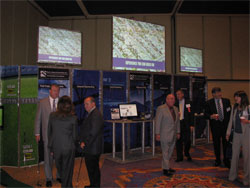 | �
�| Event exhibitors and sponsors contribute to an informative and engaging environment | �
�This year’s meeting was the best yet for the industry-leading construction defect and claims event.
�This year’s seminar concluded on May 13, 2011 with the Construction Defect Community Charitable Foundation Golf Tournament, held at Strawberry Farms Golf Course.
�The Disneyland Hotel in Anaheim, California was the place where more than 1,500 attendees convened for two days of professional development activities and seminars that included CLE workshops and panel discussions of special interest to legal and insurance professionals concerned with construction defect and claims litigation. Key events included “Challenges for Experts in Construction Defect Claims and Litigation,” “Keeping Up with Construction Defect Coverage,” and “Tips for Avoiding the ‘Perfect Storm’ in Handling of Wrap Claims.”
� �  | �
�| Supporting the golf tournament at the 15th hole | �
�This year’s Ollie award was given to George D. Calkins II, Esq. The West Coast Casualty Jerrold S. Oliver Award of Excellence was named in honor of the late Judge Jerrold S. Oliver, and recognizes an individual who is outstanding or has contributed to the betterment of the construction community.
�In addition to being the most comprehensive professional development seminar in the area of construction defects, this year’s seminar was equally valuable as a networking opportunity for members of the industry. People participated in professional development events during the day and then continued networking in the evening at numerous social events. The Lawn Party as well as the legendary Wood, Smith, Henning & Berman events were very well attended. Additional valuable networking events were hosted by a number of industry professionals at the House of Blues, and Tortilla Joe’s.
�As of this writing the 2011, West Coast Casualty's Construction Defect Seminar has applied for or has already received the following continuing education accreditation in the following areas;
�Read the full story…
�For more information about next year’s event, visit West Coast Casualty.
New Buildings in California Soon Must Be Greener
June 19, 2012 — CDJ Staff
The California Energy Commission has approved new energy efficiency standards for new homes and commercial buildings. The 2013 Building Energy Efficiency Standards are set to go into effect on January 1, 2014, and will require 30% more energy efficiency for non-residential construction and 25% more for homes. The standards do not affect hospitals, nursing homes, or prisons.
Buildings covered under the standard will have to have roofs that ready for the installation of solar panels. Additionally, non-residential buildings will require high-performance windows, advanced lighting controls, and cool-roof technologies. Residential requirements include insulated hot-water pipes, whole house fans, and more efficient windows.
The new standards are expected to add 3,500 new building industry jobs. One thing these construction workers won’t be building are power plants, since over the next thirty years, the standards are expected to save as much as six power plants.
Read the full story…
Differing Rulings On Construction Defect Claims Leave Unanswered Questions For Builders, and Construction Practice Groups. Impact to CGL Carriers, General Contractors, Builders Remains Unclear
March 7, 2011 — March 7, 2011 Construction Defect Journal Staff
In the past year a number of state and federal courts have rendered a number of conflicting decisions that promise to alter or perhaps shift entirely the paradigm, of how builders manage risk.
�According to a report today by Dave Lenckus in Property Casualty 360 “Nine state and federal courts and one state legislature over the past year have addressed whether a construction defect a defective product or faulty workmanship is fortuitous and therefore an occurrence under the commercial general liability insurance policy. Four jurisdictions determined it is; three said no; two ruled that a construction defect that causes consequential damage to property other than the work product is an occurrence; and one federal court contributed its conflicting case law that has developed in Oregon since its high court ruled in 2000 that a construction defect is not an occurrence”.
�The article strongly suggests that in the absence of a clear consensus over what the recent rulings mean for builders and contractors coverage disputes will intensify and continue to proliferate.
� Doing this on a state-by-state basis has caused a lot of confusion among buyers and sellers, said Jeffrey A. Segall, a Tampa-based senior vice president and the Florida Construction Practice leader at Willis of Florida, a unit of Willis Group Holdings.
�Read Full Story...
Contractors with Ties to Trustees Reaped Benefits from LA Community College Modernization Program
March 3, 2011 — Original reporting by Gale Holland, Michael Finnegan and Doug Smith, Los Angeles Times
In the latest installment of the “Billions To Spend” series of investigative reports focused on construction defects, management, and cost issues relevant to LACC’s Community College Modernization Projects, the LA Times examines the costs associated with the various layers of construction management and benefits that accrued to contractors with ties to LACC trustees.
�The reporting by the Times is seemingly critical of the project’s utilization of “body shops” an industry term for companies that function as employers of record. The article segment published today cites a number of circumstances wherein their utilization appears to have escalated costs substantially.
�“To gauge the cost of the staffing system, The Times reviewed thousands of pages of financial records from April 2007, when URS began managing the program, to July 2010. Reporters identified two dozen contractors serving as conduits for pay and benefits for employees they did not supervise.
�At least 230 people were employed in this manner, at a total cost of about $40 million, the records show.
�Approximately $18 million of the total was paid to the employees, according to the Times analysis. The remaining $22 million went to profit and overhead for contractors, the records indicate.
�For employees on its own payroll, the district says that medical and other benefits increase compensation costs 40% above base salaries. So if the district had employed its construction staff directly, the total cost for the period studied would have been $25 million instead of $40 million, a savings of $15 million, The Times calculated.”
�Read Full Story...
Construction on the Rise in Denver
September 13, 2012 — CDJ Staff
In another sign of a recovery in the housing industry, the Denver Business Journal reports that the pace of new home construction has accelerated in the Denver area. According to the article, in the first seven months of 2012, forty-eight percent more permits were issued than in the first seven months of 2011. In July, 2012, there were sixty-six percent more permits than a year previously. For the Denver metropolitan area, July was the sixteenth consecutive month in which permits were up from a year previously.
Read the full story…
Conspirators Bilked Homeowners in Nevada Construction Defect Claims
March 28, 2012 — CDJ Staff
Courthouse News has a summary of the current lawsuit over a Nevada conspiracy to defraud homeowners by taking control of homeowner boards and then providing inadequate repairs. Homeowners in eight Las Vegas area communities are involved in the suit, which claims that the conspirators purchased units in the communities and then transferred fractional interests to others to allow them to run for HOA board elections. The suit claims that David Amesbury and his firm helped manipulate the elections.
�Once homeowner boards were controlled by the conspirators, Nancy Quon, the construction defect attorney whose recent death appears to be by suicide, handled the litigation against homebuilders. She would settle out of court, engaging Silver Lining Construction to “do very minor and superficial repairs” to the homes. The remainder of the money was split by the conspirators. The suit also notes that the construction defect claims were “frivolous,” and?in addition to the negative publicity?caused the homes to lose at least 5% of their value.
Read the full story…
Repair of Part May Necessitate Replacement of Whole
February 10, 2012 — CDJ Staff
Judge Gleuda E. Edmonds, a magistrate judge in the United States District Court of Arizona issued a ruling in Guadiana v. State Farm on January 25, 2012. Judge Edmonds recommended a partial summary judgment in favor of the plaintiff.
� Ms. Guandiana’s home had water damage due to pluming leaks in September 2004. She was informed that polybutylene pluming in her house could not be repaired in parts “it must be completely replaced.” She had had the plumbing replaced. State Farm denied her claim, arguing that “the tear-out provision did not cover the cost of accessing and replacing those pipes that were not leaking.”
� In September 2007, State Farm filed a motion to dismiss. The court rejected this motion, stating that “If Guadiana can establish as a matter of fact that the system that caused the covered loss included all the pipes in her house and it was necessary to replace all the pipes to repair that system, State Farm is obligated to pay the tear-out costs necessary to replace all the pipes, even those not leaking.”
� In March 2009, State Farm filed for summary judgment, which the court granted. State Farm argued that “the tear-out provision only applied to ‘repair’ and not ‘replace’ the system that caused the covered leak.” As for the rest of the piping, State Farm argued that “the policy does not cover defective materials.”
� In December 2011, Ms. Guadiana filed for summary judgment, asking the court to determine that “the policy ‘covers tear-out costs necessary to adequately repair the plumbing system, even if an adequate repair requires replacing all or part of the system.”
� In her ruling, Judge Edmonds noted that Ms. Guadiana’s claim is that “the water damage is a covered loss and she is entitled to tear-out costs necessary to repair the pluming system that caused that covered loss.” She rejected State Farm’s claim that it was not obligated to replace presumably defective pipes. Further, she rejected State Farm’s argument that they were only responsible for the leaking portion, noting “Guadiana intends to prove at trial that this is an unusual case where repair of her plumbing system requires replacement of all the PB plumbing.”
� Judge Edmonds concluded by directing the District Court to interpret the tear out issue as “the tear-out provision in State Farm’s policy requires State Farm to pay all tear-out costs necessary to repair the plumbing system (that caused the covered loss) even if repair of the system requires accessing more than the leaking portion of the system.”
Read the court’s decision…